ISACA's new COBIT guidance builds upon best practices shared for the governance and management of information and technology aimed at the whole enterprise through the lens of information security, and details additional metrics and activities that should be considered when implementing or assessing COBIT in the context of information security.
The US Government Accountability Office (GAO)'s recent report on the COVID-19 pandemic response and past work on other disasters has identified potential challenges the Federal Emergency Management Agency (FEMA) faces in responding to the pandemic and any future nationally significant biological incidents.
Lynchburg, Virginia Circuit Court Judge Patrick Yeatts has largely upheld Virginia’s new law requiring a background check on all gun sales, but has issued a limited, narrow injunction, which Attorney General Mark R. Herring intends to appeal, temporarily blocking the law from applying to handgun purchases made by 18-20 year olds.
Evacuations and lockdowns are two events no organization wants to face, but every organization should be prepared for. They often happen in response to particularly dangerous situations that pose an immediate threat to people and property. It can be difficult to know how and when to make the decision to lockdown or evacuate, and it can be even more difficult to manage once the decision has been made. In either case, it requires organizations plan, test and have the right tools in place to reach all of their people quickly with information on what actions they should take to stay safe.
Unfortunately, the pandemic has forced many people and businesses to reconsider biometric technology. With the COVID-19 virus spreading easily through touchpoints, fingerprint scanners can quickly become a source for infections, especially in public spaces. Offices and ATMs contain many points of contact, and maintaining cleanliness on surfaces is nearly impossible. Unfortunately, these high traffic areas are also frequently the ones that would benefit the most from increased security.
It’s easy to see why the Open Supervised Device Protocol (OSDP), has become the security industry’s gold standard for access control installations. It enhances security, adds flexibility and makes systems easy to update and integrate with other devices. The Security Industry Association (SIA), with significant input from manufacturers and integrators, introduced OSDP in 2011 and it is now recommended for any public or private enterprise installation requiring a high level of security. Earlier this year, the International Electrotechnical Commission approved OSDP as an international standard.
Theft, fraud and losses from other retail “shrink” totaled $61.7 billion in 2019, up from $50.6 billion the year before as industry security executives reported increases in the number of shoplifting, organized retail crime and employee theft incidents, according to the annual National Retail Security Survey released by the National Retail Federation.
T-Rex Solutions, LLC announced Marine Corps veteran, entrepreneur and cybersecurity executive Dr. Allen Harper joined the organization as Executive Vice President of Cybersecurity. Dr. Harper will lead the company’s delivery of secure cloud services to the Federal government.
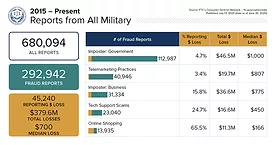
The Federal Trade Commission launched a new tool that explores data about problems military consumers may experience in the marketplace. For the first time, data about reports the FTC has received from active duty service members and veterans will be available online in an interactive dashboard at ftc.gov/explore data.
The presidential campaign of former Vice President Joe Biden announced that it had filled the positions of chief information security officer (CISO) and chief technology officer (CTO) in order to address potential cybersecurity threats to the campaign.
 RSS
RSS