The NYU School of Professional Studies Center for Global Affairs recently launched a 36-credit MS in Global Security, Conflict, and Cybercrime, which is currently taking applications for Fall 2019.
A Gallup poll says that Americans are more likely to say a household member has had their personal, credit card or financial information stolen by computer hackers, than report being victimized by any of eight other forms of criminal activity.
A small subset of professional criminal actors is responsible for the bulk of cybercrime-related damage, employing tools and techniques as sophisticated, targeted and insidious as most nation-state actors, says the State of Cybercrime Report 2018.
The frequency with which Americans worry about becoming the victim of a variety of different crimes is similar to last year, as they remain much more likely to fear being victimized by cybercrimes than traditional crimes.
A report illustrates how cyber criminals are increasingly targeting retailers and their customers through digital and social channels as retailers leverage new channels for increased revenue opportunities.
The all-too-common practice of using the same email address/password combination to log into multiple websites can be damaging, especially for employers with many users and valuable assets protected by passwords, like universities.
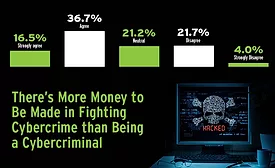
A new report from Malwarebytes reveals that almost one in 10 U.S. security professionals has admitted to having considered participating in Black Hat activity. Surprisingly, this was the lowest rate among all countries surveyed. More than one in five (21 percent) of U.K. security professionals have considered the Black Hat route.
Advocating for the return on investment (ROI) in IT security has traditionally been a challenge for IT professionals to communicate to management. IT teams are responsible for the complicated task of balancing budget limitations with strong protection that will reduce the risk of a cyberattack in today’s dynamic threat landscape. However, according to a recent Kaspersky Lab report, businesses are starting to invest more in IT security rather than treat it as a cost center.
Almost one in 10 U.S. security professionals admits to having considered participating in Black Hat – or cybercriminal – activity, according to the report White Hat, Black Hat and the Emergence of the Grey Hat: The True Costs of Cybercrime, conducted by Osterman Research and sponsored by Malwarebytes.