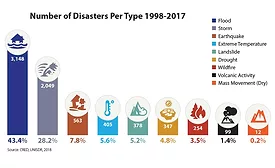
Over the past 20 years, direct economic losses from climate-related disasters rose 151 percent, according to a report from the UN Office for Disaster Risk Reduction.
According to the Ipsos MORI ‘Business Resilience Trends Watch 2019’, a significant number of business decision-makers expect travel risks to rise next year. However, this demonstrates a decrease year on year for the past three years.
Natural disasters are life-changers for all involved, and understanding why some communities recover faster than others can be better achieved by looking at both the social and physical networks within these communities and their interplay, according to a new study.
Despite the U.S. experiencing its highest number of billion-dollar disasters in 2017, a new survey found two-thirds of American homeowners are still unprepared in the event of a disaster.
Twenty-two percent of Americans who have ever had to evacuate their homes due to the threat of a natural disaster, according to new data from YouGov Omnibus.
Advocating for the return on investment (ROI) in IT security has traditionally been a challenge for IT professionals to communicate to management. IT teams are responsible for the complicated task of balancing budget limitations with strong protection that will reduce the risk of a cyberattack in today’s dynamic threat landscape. However, according to a recent Kaspersky Lab report, businesses are starting to invest more in IT security rather than treat it as a cost center.
Business continuity does not have to be complex, nor should it burn a hole in your IT budget. Standby virtual desktops offer a sensible alternative to maintaining and updating physical desktop computer infrastructures – at a fraction of the cost.
On Call International, a leading travel risk management company, released new research that reveals which major cities throughout the United States are best equipped for hosting productive, seamless business travel experiences.