Security awareness isn't just education, communications and training. It is cultural change and a movement that requires buy in from the top down and the bottom up. All too often, employees are told they are the weakest link, but they can also be a huge asset to any security team if they are given the right tools and trained properly.
The Certified Protection Officer (CPO) program and Certified in Security Supervision and Management (CSSM) certifications through IFPO will translate into direct course credit that can be applied toward an associate’s or bachelor’s degree in criminal justice at Kaplan University.
Your main users are not Spartan warriors. They are not professional security geeks. They don’t think like hackers. Elevated security measures do not come naturally to most people. They all have real jobs to do which are NOT focused on information and cybersecurity.
The first objection to a proper cybersecurity program is typically the cost – most small and medium organizations have not budgeted for or considered cyber as part of their business continuity plan.
Acquiring a higher-level education is time consuming and expensive, and fraudsters have long been marketing fast-track ways to obtain what appears to be an impressive diploma, at least on the surface. These programs and methods have been around for many years; therefore, it is not always easy to identify what is real and what is a wasted investment of your money and time.
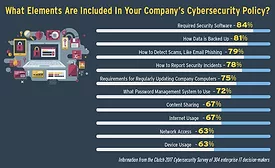
Ninety-four percent of large businesses in the U.S. have a cybersecurity policy, according to the 2017 Cybersecurity Survey by Clutch, and most of them have had a policy for more than three years. U.S. enterprises are more likely to have a cybersecurity policy than most global organizations (two-thirds of which lack a formal cybersecurity policy), and policies most commonly include required security software, backups, scam detection and security incident reporting protocols.
Board training is a vital aspect of effective ethics and compliance programs, but fewer organizations are providing training to their board members – in 2017, only 44 percent of organizations are providing this education, compared to 58 percent in 2016. According to the NAVEX Global 2017 Ethics & Compliance Training Benchmark Report, only 17 percent of new directors received ethics and compliance training, and only one-fourth of organizations cover cybersecurity and cyber risk with the board.
The heart of the ASIS International Annual Seminar and Exhibits has been its education program, and in 2017 there are many exciting changes to the ASIS 2017 conference program.
Millennials like Snapchat, digital banking, online shopping, Whataburger, selfies and Robinhood, the app that lets you trade stocks without paying fees.