SPECIAL REPORT
Dr. Bryan Stoker — Top Cybersecurity Leaders 2026
The Art of Defense
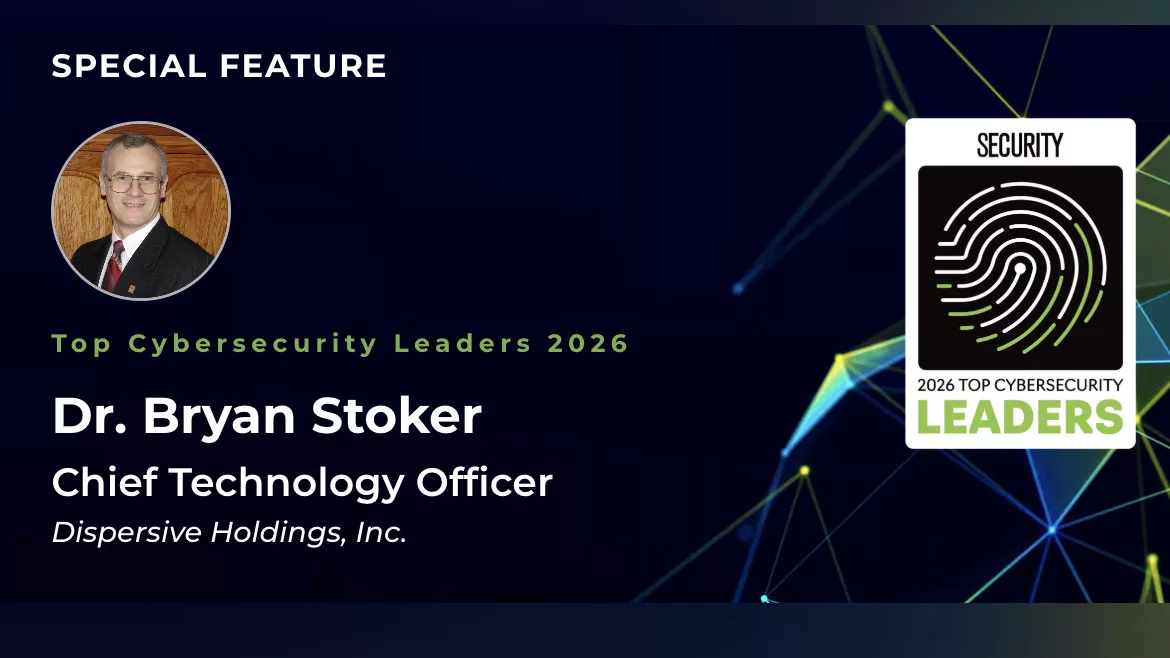
When considering cybersecurity and martial arts, one might think they don’t have a lot in common, however both require involved levels of discipline and resilience in order to succeed and rise to the challenges presented. This is something Dr. Bryan Stoker knows all too well.
Stoker, a Third-Degree Taekwondo Black Belt, Second-Degree Choi Kwang Do Black Belt and First-Degree Ninjutsu Black Belt, has utilized his years of martial arts training throughout his equally impressive security career.
Stoker currently serves as the Chief Technology Officer at Dispersive Holdings, Inc. (Dispersive), where he leads the company’s technology strategy and innovation focused on advanced network security and cyber resilience. Prior to joining Dispersive in 2025, Stoker spent more than four decades at the National Security Agency (NSA), where he served in multiple senior roles across operations, cybersecurity, and enterprise technology.
During his time as Senior Electrical Engineer and Technical Director in several organizations within the NSA, Stoker led the development and deployment of dozens of major intelligence and cybersecurity systems, including SIGINT signal processing and geolocation platforms, wireless vulnerability assessments and AI-driven technology transitions.
Prior to Dispersive, Stoker also served three years as Technical Director of USCYBERCOM J2. There he architected a global secure networking framework designed to be quantum-resistant and resilient across both low-bandwidth and high-capacity environments.
“The kind of discipline that it takes to reach your goals is basically what I think of as ‘bulldog tenacity’,” Stoker says. “You just bite into it, and you don't let go until you accomplish it, and that's what I did.”
Taking Chances
Stoker was studying Electronics Engineering at North Carolina State University when he happened upon a posting on a bulletin board announcing the National Security Agency was going to be conducting interviews. Stoker was intrigued and decided to take a chance.
You have to have that discipline, that refusal to give up. It is extremely important if you're going to actually accomplish anything.
“I thought, oh that would be cool … I’ll get to learn all the James Bond stuff,” he recalls with a laugh. That chance turned into 41-years with the NSA.
Throughout his career, Stoker has gained invaluable experience including a master’s degree in electrical engineering and a doctorate in business as well as a deep expertise in applied cryptography, large-scale systems engineering, and operational cybersecurity. During his time in the government, Stoker says he and his teams were able to accomplish a lot of things that they were told couldn’t be done.
“It was kind of my specialty,” he recalls. “I don't even remember how many briefings I would be giving where someone would say ‘that's not possible, that can't be done’ and I would say ‘this is actually an informational briefing because I already did it. ’You have to have that discipline, that refusal to give up. It is extremely important if you're going to actually accomplish anything.”
Among his many achievements, Stoker created the CRYSTALVISTA (CV) initiative, a cross-agency innovation program for secure communications and data obfuscation, which won a Joint Capability Technology Demonstration (JCTD) from the Office of the Secretary of Defense.
“With CRYSTALVISTA, almost every aspect of it fundamentally changes the approach on how you do cybersecurity,” he says.
Now retired from the NSA, Stoker says he’s excited to be embarking on a new chapter in his cybersecurity career outside of the government and inside the industry. Looking back on his career, Stoker offers some insights to those looking to get into the industry. At Dispersive, Stoker says the mission feels like the natural extension of both his martial arts discipline and his government career.
“In martial arts, you don’t wait to be hit. You position yourself so the strike never lands cleanly. Networking should be the same way,” Stoker says. “Instead of assuming the network is safe, you design it to survive attack. That’s what drew me to Dispersive. It’s not incremental improvement. It’s a fundamentally different approach.”
“In my opinion, there's two things you really need to do: learn networking and how they operate — not just technology, not just IT — you need to know some of the theoretical aspects of the packet communications and things. Then you also need to branch out and learn about the things that would affect the security of those kinds of things.”
Looking for a reprint of this article?
From high-res PDFs to custom plaques, order your copy today!