The Australian Government has released The Code of Practice: Securing the Internet of Things for Consumers (Code of Practice). The guide represents a first step in the Australian Government’s approach to improve the security of IoT devices in Australia.
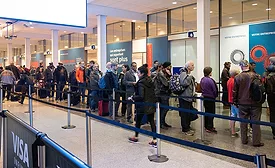
The Transportation Security Administration (TSA) is piloting a new touchless “self-service” technology that matches a traveler’s live photo with the photo on their ID. The initiative automatically authenticates a traveler’s ID, matches the live photo with the image on their ID, and confirms their flight information in near real time.
The U.S. Department of Homeland Security (DHS) continues to prepare against ever evolving threats against the American homeland, most recently highlighting efforts to combat an Electromagnetic Pulse attack which could disrupt the electrical grid and potentially damage electronics.
The Department of Homeland Security today announced the imminent publication of a Notice of Proposed Rulemaking that proposes expanding department authorities and methods for collecting biometrics that will establish a defined regulatory purpose for biometrics.
The Secure Cyber Risk Aggregation and Measurement (SCRAM), a new platform from the Massachusetts Institute of Technology (MIT) Computer Science and Artificial Intelligence Laboratory (CSAIL), quantifies companies' security risk without requiring them to disclose sensitive data about their systems to the research team, much less their competitors.
IAA, Inc. announced the appointment of Andrew Albrecht as Vice President and Chief Information Security Officer. Albrecht will report directly to Maju Abraham, Senior Vice President and Chief Information Officer.
The nonprofit association of certified cybersecurity professionals has published "The Enterprise Guide to Establishing a Cybersecurity Training Program," designed to help companies create cybersecurity training plans.
The Department of Homeland Security's Small Business Innovation Research Program gave funding to a small business to advance explosive detection equipment for airports by using machine learning.
Beginning this fall, the Washington Metropolitan Area Transit Authority (Metro) will partner with Georgetown’s School of Continuing Studies in its efforts to examine and solve some of the cybersecurity issues facing critical infrastructure today.
A proposed ordinance in Albany, N.Y. would would regulate the city’s surveillance technology, including facial recognition software and surveillance cameras.
 RSS
RSS