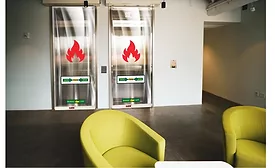
How can electronic access control solutions and other devices like biometrics technologies be configured to help mitigate unauthorized entry through swing doors and turnstiles? Here, we’ll take a look at swing doors and turnstiles first, then the high security revolving doors and mantrap portals.
According to a new study by Zebra Technologies, nearly two-thirds (67%) of retail shoppers are concerned with surface sanitation or social exposure in stores. To better accommodate customers, retailers must deploy technologies that aid in compliance with social distancing measures, mask mandates, and sanitation practices. Through the use of security solutions, like hands-free two-way audio, video surveillance, access control, and artificial intelligence (AI)-driven analytics, business owners can better protect employees and customers.
While Artificial Intelligence (AI) has already been introduced into medical facilities – revolutionizing the research and development methods of critical disease treatments, it’s also bringing about a transformation in healthcare security operations. With technologies such as smart cameras and IoT platforms to better manage field level operations, healthcare organizations are seeing the possibility of a more streamlined, efficient and cost-effective way to manage their facilities.
Member colleges and school districts can apply for the Alertus Grant beginning February 1
February 9, 2021
Alertus Technologies announced a partnership with the Texas Computer Education Association (TCEA) to offer an emergency preparedness grant to Texas schools in need of enhancing their safety and notification systems. The grant, valued up to $75,000, will be offered to one qualified member of the TCEA.
The Martin County School District in Florida upgraded its emergency communications system. Teachers and administrators use a card attached to their lanyards similar to a credit card. When repeatedly clicked, the cards issues an emergency alert, which cues sirens, flashing lights and communications over the speakers such as "This is a lockdown."
The Port of Palm Beach implemented human trafficking prevention training for its employees. The training focuses on teaching employees how to identify human trafficking victims and how to get them help.
Adoption of Push-to-Talk over Cellular and Wi-Fi networks is growing in the security market due to the wide area coverage, low cost, the bandwidth to accommodate voice and video communications, and integration with dispatching applications. This article reviews the different types of Push to Talk network deployments, how they work, the devices used, and the benefits to users. The types of Push-to-Talk networks include Push to Talk over Cellular (PoC), Push-to-Talk over Wi-Fi, and unified PoC, Wi-Fi and LMR radio networks.
Often, the touch-free conversation is tied with the need for mobile access solutions. While the two approaches are not interchangeable, both are ideal choices to reduce hand-to-door contact in high traffic public areas such as office lobbies and entry ways, healthcare facilities, restaurants, schools, and restrooms. When combined, they offer contactless, barrier-free and user-friendly access that assure secure entry, minimize high frequency touchpoints, and reduce the spread of germs.
With no one size fits all solution, there have always been different ways to tackle the plethora of security threats. However, the increasing use of drones, or unmanned aerial vehicles (UAVs) as they are often called, is changing that. Fully automated drones can be operated by security agents, with no pilot certification, and are directly integrated into existing security networks and processes. But aren’t they expensive? And won’t the technology turn out to be just a passing trend?