
Northland Controls is a global physical security integrator delivering consulting, design, installation, managed services, and maintenance for enterprise security programs across more than 90 countries worldwide.


The Execution Gap: Why Great Security Design Doesn't Always Deliver Great Security
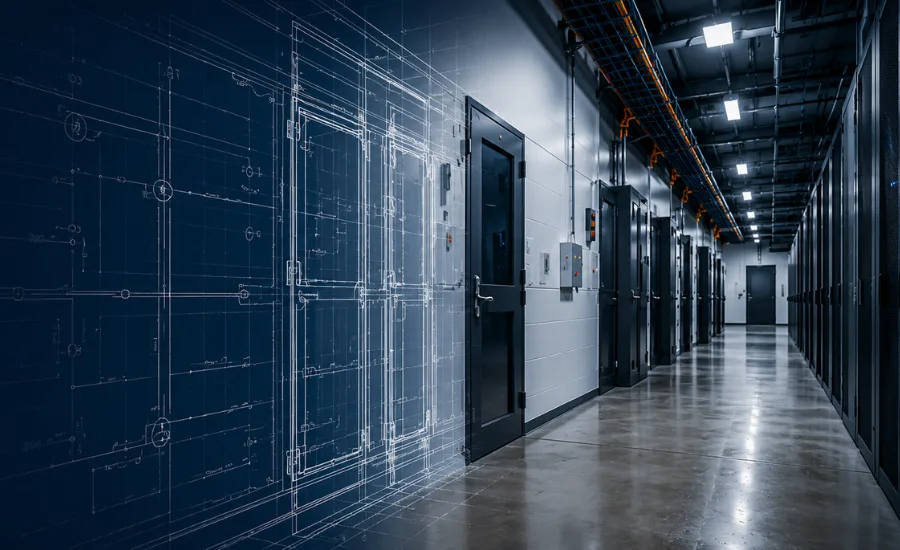
Walk through almost any modern data centre and you'll find some of the most advanced physical security technology ever deployed. Intelligent video analytics, integrated access control, sophisticated perimeter protection, and increasingly AI-enabled operations have transformed what our industry is capable of delivering.
At the same time, the standards governing these environments have never been stronger as most enterprise and hyperscale organisations have invested significant time defining how their facilities should be designed, installed, commissioned, and maintained. As a result, they have established global governance frameworks, comprehensive commissioning procedures, and rigorous quality checks in the process. In many respects, we know what good security should look like.
Yet despite this maturity, one theme continues to appear on projects around the world: the completed facility doesn't always reflect the original design intent.
This means that we are seeing a fundamental shift in how we view data centre security. The question is no longer "How do we best secure our data centres?" Instead, it is "How do we consistently deliver the same standard across dozens of facilities, multiple continents, and increasingly compressed construction programmes?"
And that is a very different challenge.
After visiting data centres across North America, EMEA, Asia and Latin America, one observation continues to stand out. The standards are often remarkably aligned, but the execution rarely is. I don't believe this is a technology problem, nor do I believe it is a standards problem. Instead, I believe it to be an execution problem, and as our industry continues to scale at unprecedented speed, execution has become one of the defining challenges facing global physical security programmes today.
Why Hyperscale Changes Everything
Demand for digital infrastructure continues to accelerate, driven by cloud computing, AI, and society's ever-growing dependence on data. New campuses are being developed at extraordinary speed, often with multiple facilities under construction simultaneously across different regions.
The expectation from clients, however, remains unchanged. Whether a facility is delivered in Virginia, Dublin, São Paulo, Hyderabad, or Singapore, it should provide the same operational experience, the same resilience, and the same level of security.
Achieving that level of consistency is significantly more difficult than writing a global standard as every project introduces different contractors, local regulations, supply chains, labour markets, and construction practices. Standards may be global, but delivery is always local, and so challenge becomes ensuring those standards survive the realities of design, procurement, construction, commissioning, and handover.
And that is where many global programmes begin to diverge. Not because the design was flawed, but because consistently translating design intent into operational reality becomes increasingly difficult as speed, scale, and complexity grow.
The Execution Gap
One of the biggest misconceptions within our industry is that security issues begin during installation. In reality, they usually begin much earlier.
They begin when security is engaged after key design decisions have already been made, when ownership between construction trades is unclear, when communications infrastructure, electrical systems, and security systems are designed independently rather than collaboratively, and when procurement decisions are made without fully considering long-term requirements.
Individually, these decisions appear insignificant. Collectively, however, they determine whether the completed facility reflects the original design intent.
I believe many projects experience what I describe as “design drift,” or the gradual movement away from the original design intent through hundreds of well-intentioned decisions made during procurement, construction, commissioning, and handover. It is rarely the result of one major mistake, but more often the accumulation of many small decisions, each logical in isolation, but collectively moving the finished solution further away from the original vision.
Projects rarely drift because of one poor decision. They drift because of hundreds of reasonable ones.
Consider something as simple as an access-controlled door. A global client may specify a mortise stile lock with concealed cabling routed internally through the door leaf, creating a clean, maintainable installation that supports both security and long-term serviceability.
Visit another facility built to the same global standard and you may find the exact same functional requirement but delivered in a very different way. The lock operates correctly, access control functions as intended, but the control cable is routed externally using flexible armoured conduit across the hinge side of the door.
Neither installation prevents the system from working. Both may comply with local regulations and achieve the same immediate objective, but they are no longer the same solution.
Somewhere between the original design and the completed installation, a series of well-intentioned local decisions changed the outcome.
This principle extends far beyond a single door. It can be seen in cable containment, door hardware selection, life safety interfaces, commissioning methods, equipment positioning, and trade coordination. None of these decisions, in isolation, is likely to determine whether a project succeeds or fails. Together, however, they create variation that has a lasting impact on the larger security program.
Multiply those decisions across hundreds of doors, multiple buildings, and several countries, and standardisation gradually disappears. The issue isn't that people are making poor decisions; it's that different teams are making different decisions. And that distinction matters.
Because as inconsistency increases across a portfolio, so does complexity. Maintenance teams encounter different hardware configurations, commissioning documentation becomes less reliable, spare parts inventories expand, training requirements increase, and troubleshooting becomes more time-consuming. What began as a series of sensible local decisions gradually creates a programme that is more difficult and more expensive to operate.
More importantly, inconsistency introduces uncertainty. When every facility is delivered slightly differently, organisations can no longer assume that maintenance procedures, operational workflows, or future upgrades will be executed the same way across their portfolio. At hyperscale, where programmes span multiple countries and facilities, it quickly becomes a business risk rather than simply a technical issue.
Governance Is About Protecting Good Decisions
Governance often receives an unfair reputation, associated with additional meetings, more approvals, and increased documentation.
In my experience, however, good governance doesn't slow projects down, it reduces future rework at the ground level.
Its purpose is to protect good decisions before they become expensive corrections. It establishes clear ownership early in the project lifecycle, identifies trade dependencies before installation begins, and ensures regional delivery teams understand not only what the standard is, but why it exists.
For organisations delivering programmes across multiple regions, governance provides something even more valuable: repeatability. And with this level of repeatability, it creates the discipline needed to keep regional delivery aligned with global standards.
This only becomes more important as our industry continues to evolve. AI and analytics will become more intelligent, automation will improve overall efficiency, and the integration of physical and digital security will continue to strengthen.
And while these developments are exciting, they don’t remove the need for consistent execution. If anything, increasing system complexity makes it even more critical because every new integration, automation, and intelligent workflow introduces additional dependencies that must be coordinated throughout design, construction, commissioning, and operations.
Technology alone cannot compensate for poor coordination. AI, for example, cannot resolve unclear ownership, and automation cannot replace effective programme management. The more sophisticated our technology becomes, the greater the need for disciplined execution.
The Competitive Advantage We Don't Talk About Enough
The security industry rightly celebrates innovation. Manufacturers continue to develop remarkable products, software capabilities evolve rapidly, and new technologies continue to attract significant attention.
And while innovation will undoubtedly continue, I believe the next competitive advantage will come from organisations that are able to preserve design intent throughout every stage of delivery.
The value of that capability extends well beyond delivering technology that simply functions. It gives clients confidence that the intended design will be accurately reflected in the finished facility, regardless of where it is built or who delivers it. As a result, it reduces operational complexity, simplifies future maintenance and expansion, improves the predictability of lifecycle costs, and ultimately lowers long-term programme risk.
Perhaps most importantly, though, it creates trust. Trust that every new facility will meet the same standard, deliver the same experience, and perform as intended without requiring each project to reinvent established practices.
The companies that succeed over the next decade will not necessarily be those with the newest technology, but those capable of delivering the same quality. Because the true measure of a global security programme isn't whether it can produce an excellent design one time, but rather whether it can be reproduced with the same outcome, regardless of geography, contractor, or programme scale.
Execution Will Define the Next Decade
I've been fortunate throughout my career to visit data centres across North America, Europe, Asia, and Latin America. Every project teaches something, every region has exceptional engineers, designers, and delivery teams, but every country approaches projects in slightly different ways.
That diversity is one of our industry's greatest strengths. Delivering it consistently is one of it greatest challenges.
Technology will continue to evolve, and standards will continue to improve. And with that evolution presents one of our industry's greatest opportunities to protect design intent throughout the entire project lifecycle. Because security is rarely judged by how well it was designed but rather by how well it performs once construction is complete.
At the end of the day, technology creates capability, standards define intent, but execution is what transforms vision into operational reality.

By Terry Browne, General Manager – Global Data Centre Group, Northland Controls
Looking for a reprint of this article?
From high-res PDFs to custom plaques, order your copy today!


