The Port recently upgraded its mission-critical Transportation Management and Emergency Operations Center (TMC/EOC) to oversee the Port’s traffic flow, improve its maritime operations and provide a safer, more secure maritime area.
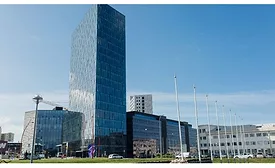
Reiknistofa Bankanna (RB), an IT service provider for Icelandic financial institutions, recently overhauled its security infrastructure with an array of physical security technology including cameras, access control, and video analytics through one unified interface.
Once it is safe to do so, will employees return to the office full-time or will companies opt for hybrid scenarios in which some time is still spent working from home? And how will organizations be able to make informed decisions that are safe for their employees and respect their bottom line?
Technological innovations representing new, advanced solutions to a previously unforeseen problem. Advancements that, even once the pandemic is finally dealt with, will continue to change not only their respective industries but also the world. The fields in which such innovation is most prevalent are, not surprisingly, healthcare and the public sector. Here are just a few ways in which this has manifested.
Six onboard cameras and low-bandwidth video streaming technology will capture footage on the Mayflower Autonomous Ship's (MAS) missions. On its maiden voyage this spring, MAS will trace the route of the 1620 Mayflower, sailing from Plymouth, UK, to Plymouth, MA, only this time there will be no human captain or crew on board as the 15m, lightweight, hybrid-electric powered trimaran crosses the Atlantic.
In the run-up to Prince Harry and Meghan Markle's much-anticipated royal wedding, the local Thames Valley Police (TVP) force knew that it had to make this high-profile event as secure as possible. The same security level would have to be maintained for Princess Eugene and Jack Brooksbank's royal wedding five months later, located at Windsor Castle. The police knew that both events would carry significant risk to the attendees and the general public without full security measures. Therefore, the police had to ensure that threats would be identified as soon as possible, before, after, and during the events. In fact, it was estimated that the security operation cost was in excess of $41,701,500, or £30 million, becoming one of the biggest UK operations ever.
Marco Island has installed cameras mounted on poles at each bridge leading to the island, which will scan license plates of all drivers coming and going.
The Seattle Theatre Group (STG) recently used a cloud video surveillance to solve their surveillance and server management challenges. The solution helped STG streamline their video security infrastructure by being compatible with existing IP cameras and networks.
UAB Italiana LT needed to secure its Kaunas region factory, boosts access control, perimeter security and surveillance to protect employees and assets.
 RSS
RSS