Security Magazine logo
search
cart
facebook twitter linkedin youtube
  • Sign In
  • Create Account
  • Sign Out
  • My Account
Security Magazine logo
  • NEWS
    • Security Newswire
    • Technologies & Solutions
  • MANAGEMENT
    • Leadership Management
    • Enterprise Services
    • Security Education & Training
    • Logical Security
    • Security & Business Resilience
    • Profiles in Excellence
  • PHYSICAL
    • Access Management
    • Fire & Life Safety
    • Identity Management
    • Physical Security
    • Video Surveillance
    • Case Studies (Physical)
  • CYBER
    • Cybersecurity News
    • More
  • BLOG
  • COLUMNS
    • Career Intelligence
    • Cyber Tactics
    • Cybersecurity Education & Training
    • Leadership & Management
    • Security Talk
  • EXCLUSIVES
    • Annual Guarding Report
    • Most Influential People in Security
    • The Security Benchmark Report
    • Top Guard and Security Officer Companies
    • Top Cybersecurity Leaders
    • Women in Security
  • SECTORS
    • Arenas / Stadiums / Leagues / Entertainment
    • Banking/Finance/Insurance
    • Construction, Real Estate, Property Management
    • Education: K-12
    • Education: University
    • Government: Federal, State and Local
    • Hospitality & Casinos
    • Hospitals & Medical Centers
    • Infrastructure:Electric,Gas & Water
    • Ports: Sea, Land, & Air
    • Retail/Restaurants/Convenience
    • Transportation/Logistics/Supply Chain/Distribution/ Warehousing
  • EVENTS
    • Industry Events
    • Webinars
    • Solutions by Sector
    • Security 500 Conference
  • MEDIA
    • Interactive Spotlight
    • Photo Galleries
    • Podcasts
    • Polls
    • Videos
      • Cybersecurity & Geopolitical Discussion
      • Ask Me Anything (AMA) Series
  • MORE
    • Call for Entries
    • Classifieds & Job Listings
    • Continuing Education
    • Newsletter
    • Sponsor Insights
    • Store
    • White Papers
  • EMAG
    • eMagazine
    • This Month's Content
    • Advertise
  • SIGN UP!
Access ManagementFire & Life SafetyIdentity ManagementPhysical Security

Red Alert! Security Doors and Emergency Egress Plans


By Kurt J. Measom
evacuation
boon edam 1
boon edam 2

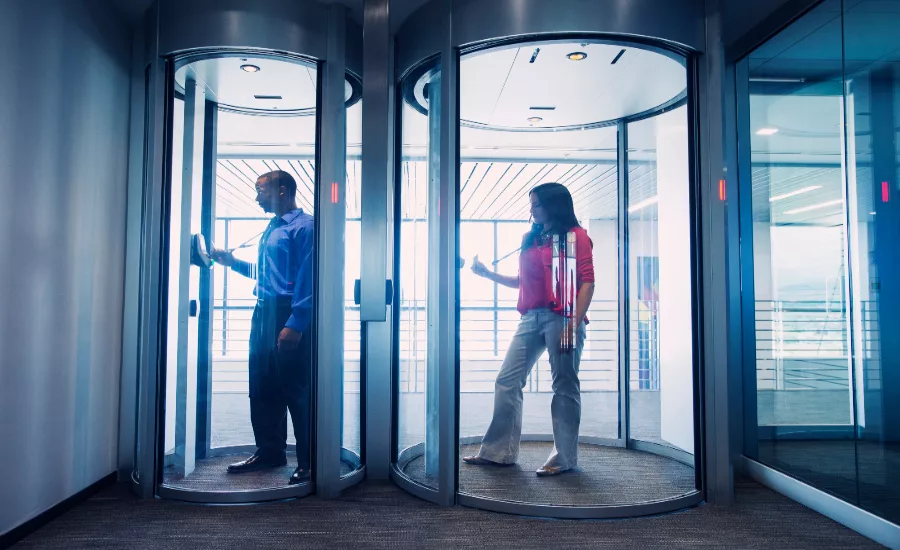
Mantrap portals can only be part of an egress plan if deemed “security access turnstiles” according to the NFPA. Photo courtesy of Boon Edam Inc.

evacuation
boon edam 1
boon edam 2
August 27, 2019

Alarms are sounding, lights are flashing, and there is a sense of panic in the air. 

There is a fire in your facility that requires an immediate evacuation of all employees and visitors, and you are in charge. How you handle that emergency process can be a matter of life and death. 

In the confusion of a sudden evacuation, most people want to run and get out of the building as quickly as possible; however, doing so increases the risk of injury and other unnecessary losses. It can also hamper your ability to obtain a quick and accurate headcount to confirm everyone is out and safe. 

In most cases, employees and visitors panic because they are unsure about what to do in an emergency evacuation. Once panic sets in, they can lose the ability to focus, and soon they begin to behave irrationally or dangerously. 

Having an egress plan will establish a clear set of guidelines about what employees need to do and where they need to go. The clear progression of steps can calm nerves and eliminate confusion, while keeping employees focused on getting to safety. 

Security entrances, which provide a seamless access control solution in all types of buildings, are usually not intended to be the only means of emergency egress from a facility. Even so, some security entrance types such as tripod turnstiles, full height turnstiles, revolving doors and security portals, can be a main component of your emergency egress plan that can help ensure a safe evacuation. 

Security Entrances as part of Egress Plans 

There are several ways that security entrances can support an egress plan, as the products have many built-in features that allow users to choose how their entrance behaves in an emergency. 

It is important to work with an entrance manufacturer who understands building codes and rules from bodies such as the National Fire Protection Association (NFPA) and the International Building Code (IBC), which are the primary entities that provide standards on the behavior of security entrances during an emergency situation. Supporting standards and test methods are supported by the American National Standards Institute (ANSI) and the Nationally Recognized Testing Laboratories (NRTLs). 

A manufacturer with the right experience and knowledge can help you ensure that the specific features of your security entrance and the applicable building codes work hand-in-hand. As shown by the following examples, there are many related factors to consider, and most businesses would benefit by having some expert advice to help them navigate to the best solutions for their particular circumstances.

Turnstile Egress

For example, tripod turnstiles and full height turnstiles can be set to freely rotate in an emergency to allow egress. However, IBC and NFPA codes do not permit these types of turnstiles to be placed in a manner where they would obstruct any means of egress. Tripod type turnstiles that do not exceed 39” in height can be credited for partial egress capability (a maximum of 50 persons), but must not be the sole means of egress. According to building codes, egress doors (including gate type products) must include approved panic hardware and fire exit hardware in order to comply. 

Optical turnstiles are categorized by NFPA as “security access turnstiles”, which are different than traditional turnstiles such as tripod and full height turnstiles. 

Unlike traditional turnstiles, security access turnstiles can be considered a part of the means of egress as long as the building is protected by an automatic sprinkler system. In addition to specifics on minimum clear passages, they must, “automatically” retract and swing in the direction of egress travel; and have other means of egress nearby, such as egress doors equipped with appropriate egress component hardware.  

Security Revolving Door Egress

There are numerous codes for security revolving doors in a fire, according to building standards. First, they must freely rotate when pushed and second, if pushed at a force exceeding 130 ft lbf (foot pounds), the door wings will collapse or book fold. Even more, any type of revolving door can be allotted only a maximum of 50 persons per door or fifty-percent of the capacity of a building, whichever is lesser. Building codes also require an approved and conforming adjacent swing door within 10 feet of a revolving door, and a revolving door must be at least 10 feet away from a stairway or elevator. 

There are no written rules in NFPA or IBC for security mantrap portals during a fire. They are often treated as “security access turnstiles.” They can count as part of an egress plan, but only when considered as a security access turnstile. 

For security portals to be considered part of the egress path, they must completely open. If not considered as part of the egress path, then an approved egress door and path must be determined and approved. In this case, the portal can do about anything from not opening at all, to only opening one door (which is typically the exterior door) to allow anyone inside to escape the portal using battery backup power. 

Security Entrances and Alarm Systems 

Many security products automatically reset to their working condition after a fire alarm activation. However, products such as security revolving doors typically do not have a means of automatically re-positioning the door wings if they have collapsed or have book folded. Facility staff will need to do a post-emergency resetting of the door wings for normal use.  

Typically, security doors can provide a signal to the building management or security access system notifying when the product is not in its running state. It is always advised to have a Standard Operating Procedure in place to ensure security and safe operation of the equipment. This might include a physical or visual inspection either manually or through a video management system. 

Ultimately, you should consult with a manufacturer regarding your building’s occupancy and entrance requirements and then, how egress requirements might adjust your plan.  

In an emergency situation, having the right security entrance solution that works in conjunction with your egress plan, in addition to building codes, can play an important role in getting employees and visitors out safely. 

KEYWORDS: access control emergency response evacuation Security entrances

Share This Story

Looking for a reprint of this article?
From high-res PDFs to custom plaques, order your copy today!


Kurt measom

Kurt J. Measom serves as Vice President of Technology and Product Support and is part of Boon Edam’s Enterprise Account Security Team. A 25-year Boon Edam veteran, Measom, over the past four years, has worked as a security solutions advisor to many Fortune 1000 companies and is currently a Lenel-certified associate. Measom graduated from the University of Utah with BS and MBA degrees and currently lives with his wife and children in the Salt Lake City area.

Recommended Content

JOIN TODAY
To unlock your recommendations.

Already have an account? Sign In

  • Iintegration and use of emerging tools

    Future Proof Your Security Career with AI Skills

    AI’s evolution demands security leaders master...
    Security Leadership and Management
    By: Jerry J. Brennan and Joanne R. Pollock
  • The 2025 Security Benchmark Report

    The 2025 Security Benchmark Report

    The 2025 Security Benchmark Report surveys enterprise...
    The Security Benchmark Report
    By: Rachelle Blair-Frasier
  • The Most Influential People in Security 2025

    Security’s Most Influential People in Security 2025

    Security Magazine’s 2025 Most Influential People in...
    Most Influential People in Security
    By: Security Staff
Manage My Account
  • Security Newsletter
  • eMagazine Subscriptions
  • Manage My Preferences
  • Online Registration
  • Mobile App
  • Subscription Customer Service

More Videos

Sponsored Content

Sponsored Content is a special paid section where industry companies provide high quality, objective, non-commercial content around topics of interest to the Security audience. All Sponsored Content is supplied by the advertising company and any opinions expressed in this article are those of the author and not necessarily reflect the views of Security or its parent company, BNP Media. Interested in participating in our Sponsored Content section? Contact your local rep!

close
  • critical event management
    Sponsored byEverbridge

    Why a Unified View Across IT, Continuity, and Security Makes or Breaks Crisis Response

  • Charlotte Star Room
    Sponsored byAMAROK

    In an Uncertain Economy, Security Is a Necessity - Not an Afterthought

  • Sureview screen
    Sponsored bySureView Systems

    The Evolution of Automation in the Command Center

Popular Stories

Cybersecurity trends of 2025

3 Top Cybersecurity Trends from 2025

Red laptop

Security Leaders Discuss SitusAMC Cyberattack

Green code

Logitech Confirms Data Breach, Security Leaders Respond

Neon human and android hands

65% of the Forbes AI 50 List Leaked Sensitive Information

The Louvre

After the Theft: Why Camera Upgrades Should Begin With a Risk Assessment

Top Cybersecurity Leaders

Events

September 18, 2025

Security Under Fire: Insights on Active Shooter Preparedness and Recovery

ON DEMAND: In today’s complex threat environment, active shooter incidents demand swift, coordinated and well-informed responses.

December 11, 2025

Responding to Evolving Threats in Retail Environments

Retail security professionals are facing an increasingly complex array of security challenges — everything from organized retail crime to evolving cyber-physical threats and public safety concerns.

View All Submit An Event

Products

Security Culture: A How-to Guide for Improving Security Culture and Dealing with People Risk in Your Organisation

Security Culture: A How-to Guide for Improving Security Culture and Dealing with People Risk in Your Organisation

See More Products

Related Articles

  • boon edam

    Best practices on integrating access control, biometrics with swing doors and security entrances

    See More
  • Boon Edam

    Why are UL Listings Important for Security Doors and Turnstiles?

    See More
  • woman walks through entry security tool

    Leveling up: Top 3 trends for entrance security

    See More

Related Products

See More Products
  • 9780367259044.jpg

    Understanding Homeland Security: Foundations of Security Policy

See More Products

Events

View AllSubmit An Event
  • August 20, 2012

    Radiological Emergency Planning: Terrorism, Security, and Communication

    Participants will examine the latest principles and requirements to prepare for and respond to a radiological emergency as well as develop the skills necessary to effectively communicate with the media and public during crisis situations.
View AllSubmit An Event
×

Sign-up to receive top management & result-driven techniques in the industry.

Join over 20,000+ industry leaders who receive our premium content.

SIGN UP TODAY!
  • RESOURCES
    • Advertise
    • Contact Us
    • Store
    • Want More
  • SIGN UP TODAY
    • Create Account
    • eMagazine
    • Newsletter
    • Customer Service
    • Manage Preferences
  • SERVICES
    • Marketing Services
    • Reprints
    • Market Research
    • List Rental
    • Survey/Respondent Access
  • STAY CONNECTED
    • LinkedIn
    • Facebook
    • YouTube
    • X (Twitter)
  • PRIVACY
    • PRIVACY POLICY
    • TERMS & CONDITIONS
    • DO NOT SELL MY PERSONAL INFORMATION
    • PRIVACY REQUEST
    • ACCESSIBILITY

Copyright ©2025. All Rights Reserved BNP Media.

Design, CMS, Hosting & Web Development :: ePublishing