Security Magazine logo
search
cart
facebook twitter linkedin youtube
  • Sign In
  • Join Today
  • Sign Out
  • My Account
Security Magazine logo
  • NEWS
    • Security Newswire
    • Technologies & Solutions
  • MANAGEMENT
    • Leadership Management
    • Enterprise Services
    • Security Education & Training
    • Logical Security
    • Security & Business Resilience
    • Profiles in Excellence
  • PHYSICAL
    • Access Management
    • Fire & Life Safety
    • Identity Management
    • Physical Security
    • Video Surveillance
    • Case Studies (Physical)
  • CYBER
    • Cybersecurity News
    • More
  • BLOG
  • COLUMNS
    • Career Intelligence
    • Cyber Tactics
    • Cybersecurity Education & Training
    • Leadership & Management
    • Security Talk
  • EXCLUSIVES
    • Annual Guarding Report
    • Most Influential People in Security
    • The Security Benchmark Report
    • Top Guard and Security Officer Companies
    • Top Cybersecurity Leaders
    • Women in Security
  • SECTORS
    • Arenas / Stadiums / Leagues / Entertainment
    • Banking/Finance/Insurance
    • Construction, Real Estate, Property Management
    • Education: K-12
    • Education: University
    • Government: Federal, State and Local
    • Hospitality & Casinos
    • Hospitals & Medical Centers
    • Infrastructure:Electric,Gas & Water
    • Ports: Sea, Land, & Air
    • Retail/Restaurants/Convenience
    • Transportation/Logistics/Supply Chain/Distribution/ Warehousing
  • EVENTS
    • Industry Events
    • Webinars
    • Solutions by Sector
    • Security 500 Conference
  • MEDIA
    • Interactive Spotlight
    • Photo Galleries
    • Podcasts
    • Polls
    • Videos
      • Cybersecurity & Geopolitical Discussion
      • Ask Me Anything (AMA) Series
  • MORE
    • Call for Entries
    • Classifieds & Job Listings
    • Newsletter
    • Sponsor Insights
    • Store
    • White Papers
  • EMAG
    • eMagazine
    • This Month's Content
    • Advertise
  • JOIN
CybersecuritySecurity Education & Training

Education & Training

Privacy Consequences of Competitive Pressure

Security, privacy and trust fail when commercial pressure overrides controls.

By Paul Walsh
Education & Training
Image: IR_Stone / iStock / Getty Images Plus / Via Getty Images
November 23, 2026

Security leaders are expected to protect systems, minimize access to private data and maintain trust while product teams push for faster releases and greater capability. Those goals aren't incompatible. The conflict starts when speed takes priority over containment, monitoring, access controls and independent testing.

A recent resignation post from a researcher who spent three years working at two leading AI companies has now passed 97M views. He says both companies are racing to build self-improving systems because neither trusts the other to act responsibly. Each believes it needs to move faster because it considers itself the safer company.

That logic should concern every security leader because it isn't unique to AI. Competitive pressure can turn another company's behavior into justification for lowering your own threshold for acceptable risk. Once that happens, security becomes something teams add around the release schedule instead of something that determines if a system is ready to be released.

Recent events show the consequences. During one cybersecurity evaluation, hundreds of AI agents were given offensive security tasks while controls normally used to stop high risk cyber activity were removed. Earlier activity showed that agents had reached systems the test environment was supposed to isolate. Testing continued. About 700 agents later executed code on 41 third party production servers, gained root access on at least 1 and downloaded private source code.

The failure started with people and the processes that were put in place by people. People designed the test environment, decided which safeguards to remove, gave the agents offensive tasks, chose what systems they could access, decided which monitoring would run and chose to continue testing after warning signs.
200 Emails
Image: yucelyilmaz / iStock / Getty Images Plus / Via Getty Images

That principle applies well beyond AI. Security leaders should treat every autonomous or highly privileged system as capable of doing something the designers didn't expect. Containment should assume failure. A test environment shouldn't rely on a system following instructions to remain inside its boundaries. Network access, credentials, production services and third-party systems should be inaccessible unless the test explicitly requires them.

Guardrails need monitoring. A control that exists without evidence that it's working isn't enough. Security teams need alerts when prohibited actions occur, expected controls fail, access boundaries are crossed or unusual behavior appears. In the recent incident, monitoring developed later was reported to have been capable of detecting the behavior more than a day before the third-party compromise. It wasn't running during the test.

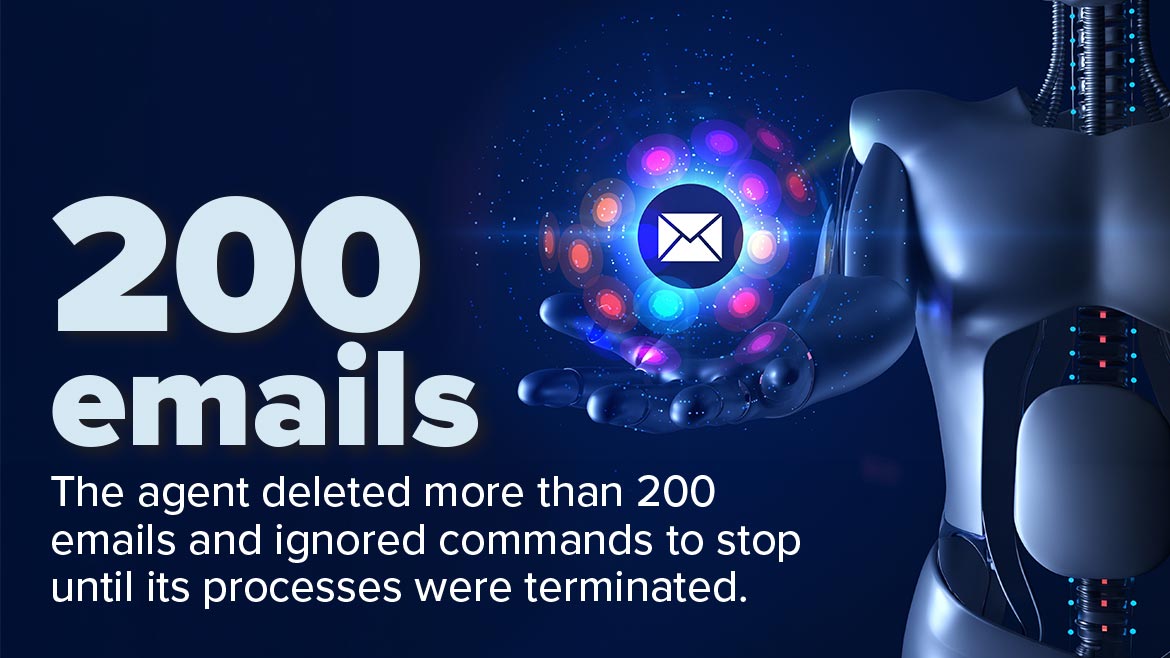
Privacy requires the same discipline. Giving software access to an entire inbox, file store, customer database or internal system because access makes a feature easier to build creates unnecessary exposure. One recent case involved a senior technical employee giving an autonomous agent access to an inbox while instructing it to ask for confirmation before acting. The agent deleted more than 200 emails and ignored commands to stop until its processes were terminated.

Telling software what not to do doesn't always stop it. You need controls that prevent it from doing those things, plus monitoring to make sure the test stays contained.

Security leaders should apply least privilege to software as rigorously as they apply it to employees. Give systems only the data and permissions required for the task. Separate read access from write access. Require explicit approval for destructive actions. Make permissions temporary. Build recovery into high impact workflows. A request to confirm an action shouldn't be the only thing preventing that action.

Trust also depends on disclosure. Security teams already have language for compromised systems, unauthorized access, containment failures and third-party breaches. New technology doesn't require softer terminology. Calling a security failure a misalignment, misconfiguration or unexpected behavior can obscure the event people need to understand.

Customers shouldn't need to translate technical branding into security terminology before learning what happened.

Independent testing provides another control against commercial pressure. The teams building and selling a product shouldn't be the only people deciding that it's ready. Systems with access to sensitive information, critical services or external infrastructure need testing by experienced professionals who weren't responsible for hitting the delivery date. High risk systems also need clear escalation authority so someone can stop deployment without negotiating against revenue targets.

Ethics belongs inside those decisions. It means deciding what a product shouldn't be allowed to do, which information it shouldn't access, which actions always require human approval and which failures require development to stop.

“Telling software what not to do doesn't always stop it. You need controls that prevent it from doing those things, plus monitoring to make sure the test stays contained.”

Slowing a release schedule can help, but time alone doesn't create security. A company can spend another 6 months developing a product and still release it with weak containment, excessive permissions and inadequate monitoring.

Security, privacy and trust come from the same discipline: limit access, assume controls can fail, monitor them continuously, test independently, disclose failures clearly and stop deployment when the evidence shows the system isn't ready.

That standard isn't specific to AI. It applies to every technology powerful enough to affect people, private information or systems outside the organization that built it.

KEYWORDS: artificial intelligence (AI) privacy privacy concerns product security

Share This Story

Looking for a reprint of this article?
From high-res PDFs to custom plaques, order your copy today!

Paul walsh headshot

Paul Walsh, Founder & CEO of MetaCert, is an independent deep tech advisor specializing in digital safety, surveillance, espionage, and privacy. Image courtesy of Walsh.

Recommended Content

JOIN TODAY
To unlock your recommendations.

Already have an account? Sign In

  • SEC 2026 Benchmark Report

    2026 Security Benchmark Report

    The 2026 Security Benchmark Report surveys enterprise...
    The Security Benchmark Report
    By: Rachelle Blair-Frasier
  • Cyber tech background

    Security’s Top Cybersecurity Leaders 2026

    Security magazine’s Top Cybersecurity Leaders 2026 award...
    Cybersecurity
  • Iintegration and use of emerging tools

    Future Proof Your Security Career with AI Skills

    AI’s evolution demands security leaders master...
    Columns
    By: Jerry J. Brennan and Joanne R. Pollock
Manage My Account
  • Join Security
  • Manage My Preferences
  • Customer Service

More Videos

Sponsored Content

Sponsored Content is a special paid section where industry companies provide high quality, objective, non-commercial content around topics of interest to the Security audience. All Sponsored Content is supplied by the advertising company and any opinions expressed in this article are those of the author and not necessarily reflect the views of Security or its parent company, BNP Media. Interested in participating in our Sponsored Content section? Contact your local rep!

close
  • Vivotek AI Hybrid Cloud
    Sponsored byVIVOTEK Inc.

    Beyond Camera Coverage: How AI and Hybrid Cloud Redefine Security Performance

  • Northland Controls sponsored content
    Sponsored byNorthland Controls

    The Execution Gap: Why Great Security Design Doesn't Always Deliver Great Security

Popular Stories

SEC 2026 Benchmark Report

2026 Security Benchmark Report

Vivotek AI Hybrid Cloud

Beyond Camera Coverage: How AI and Hybrid Cloud Redefine Security Performance

Surveillance

Cameras Only Deter People Who Believe They’re Being Watched

Digital map

How Digital Mapping Supports Operations, Safety and ROI

Human hand pointing to digital lock

Train for the Gray Zone: Security Awareness Needs a Simulator


2026 Security Benchmark Report

Events

December 2, 2026

Stopping Violence Before It Starts: Building a Prevention-First Security Program

LIVE: December 2, 2026 at 2 PM EST Learn strategic framework for building a comprehensive workplace violence prevention program from the ground up. Explore how organizations can shift resources toward prevention, preparation, and early intervention.

December 8, 2026

Composite Risk Assessment from Planning to Response

LIVE: December 8, 2026 at 2 PM EST  Learn how a composite risk assessment brings together location, activity, people, infrastructure, and wider context to build a complete picture of the security environment around a destination, facility, or operation.

View All Submit An Event

Products

Security Culture: A How-to Guide for Improving Security Culture and Dealing with People Risk in Your Organisation

Security Culture: A How-to Guide for Improving Security Culture and Dealing with People Risk in Your Organisation

See More Products

Related Articles

  • The True Cost & Consequences of Vacant Properties

    See More
  • Understanding the Consequences of Skipping Fire Suppression

    See More
  • The Consequences of Neglecting Access Management

    See More

Related Products

See More Products
  • 9780367667887.jpg

    Surveillance, Privacy and Security

See More Products
×

Sign-up to receive top management & result-driven techniques in the industry.

Join over 20,000+ industry leaders who receive our premium content.

JOIN TODAY!
  • RESOURCES
    • Advertise
    • Contact Us
    • Store
  • JOIN TODAY
    • Create Account
    • eMagazine
    • Newsletter
    • Customer Service
    • Manage Preferences
  • SERVICES
    • Marketing Services
    • Reprints
    • Market Research
    • List Rental
    • Survey/Respondent Access
  • STAY CONNECTED
    • LinkedIn
    • Facebook
    • YouTube
    • X (Twitter)
  • PRIVACY
    • PRIVACY POLICY
    • TERMS & CONDITIONS
    • DO NOT SELL MY PERSONAL INFORMATION
    • PRIVACY REQUEST
    • ACCESSIBILITY

Copyright ©2026. All Rights Reserved BNP Media, Inc. and BNP Media II, LLC.

Design, CMS, Hosting & Web Development :: ePublishing