Security Strategy
Eye on the Sky: SkySafe Named 2026 Golden Eagle Award Winner

Melissa Swisher Image courtesy of SkySafe
This year Security Magazine partnered with The National Center for Spectator Sports Safety and Security (NCS4) to present the Golden Eagle Award to SkySafe as the 2026 Golden Eagle Award winner for its case study submission, “University of Illinois Sets the Standard for Campus Drone Security.”
SkySafe is a leader in drone detection, airspace intelligence, and drone forensics for security-conscious organizations.
The annual Golden Eagle Award recognizes excellence in system integration, architecture, engineering and/or construction (A/E/C) related to the safety and security of spectators, property and facility infrastructure.
Here, we talk with SkySafe’s Chief Revenue Officer Melissa Swisher about the winning submission and the evolving threat security teams are facing with increased drone operation.
Security Magazine: What does it mean to SkySafe to be recognized and honored with the Golden Eagle Award?
Melissa Swisher: Receiving the Golden Eagle Award from NCS4 and Security Magazine is a tremendous honor because it recognizes operational impact, not just innovation.
This award validates what we're seeing across the market: drones have become a real and persistent security concern for campuses, stadiums, and public venues. Security teams need more than awareness — they need actionable intelligence and the ability to investigate incidents and hold operators accountable when necessary.
While the University of Illinois was the featured case study, the challenges they faced are representative of what we're seeing across colleges and universities nationwide. We're proud to support multiple higher education institutions that are proactively addressing airspace security, and this recognition reinforces the importance of that work.
Security: What problem was the University of Illinois trying to solve, and what made their environment challenging? What was the approach to overcoming those challenges?
“This award validates what we're seeing across the market: drones have become a real and persistent security concern for campuses, stadiums, and public venues. Security teams need more than awareness — they need actionable intelligence and the ability to investigate incidents and hold operators accountable when necessary.”
Swisher: The University of Illinois is a large, high-activity campus with over 60,000 students, faculty, and alumni, and major sporting events drawing tens of thousands of spectators to campus weekly. The challenge was that with nearly 500 drone flights occurring on and around campus each month, campus authorities had no reliable way to distinguish between authorized drone activity and potential threats, and no means of holding violators accountable after the fact.
The environment compounded the challenge. A large, open campus with additional off-campus housing created significant airspace awareness challenges that traditional security measures were not designed to address. Drones can be launched from half a mile away and be over a crowded stadium in seconds. A single incident ultimately served as the catalyst for change. During a football game on campus, a drone breached restricted airspace during the third quarter and hovered within 10 feet of a SWAT officer stationed in an overwatch position, capturing images of critical security tactics. This exposed a major vulnerability: drones could not only endanger spectators and staff but also compromise operational security with unauthorized surveillance.
At the time, the university relied on manual drone monitoring methods, including visual line-of-sight and officer dispatch, which were labor-intensive and often ineffective. During this incident, 14 officers were deployed to locate the operator, ultimately without success.
Security: What did the threat picture look like over the course of the case study?
Swisher: SkySafe’s platform revealed the true scale of drone activity across the University of Illinois campus: more than 3,300 drone flights in a 12-month period. While the university initially relied on flight requests and approvals to manage activity, the data showed that much of the drone activity was uncoordinated and unannounced, creating persistent uncertainty around intent and risk.
Before SkySafe, the University of Illinois Police Department often deployed up to 15 officers to search for drone operators, with limited success. With real-time airspace intelligence on drone activity and operator location, most incidents can now be handled by just one or two officers, enabling faster, more efficient response while freeing personnel for other critical tasks.
The data made clear that drone activity was not occasional or isolated. It was a recurring operational challenge that required a systematic response.
Security: Did the system catch an incident? What did the response look like, and what could have happened without detection?
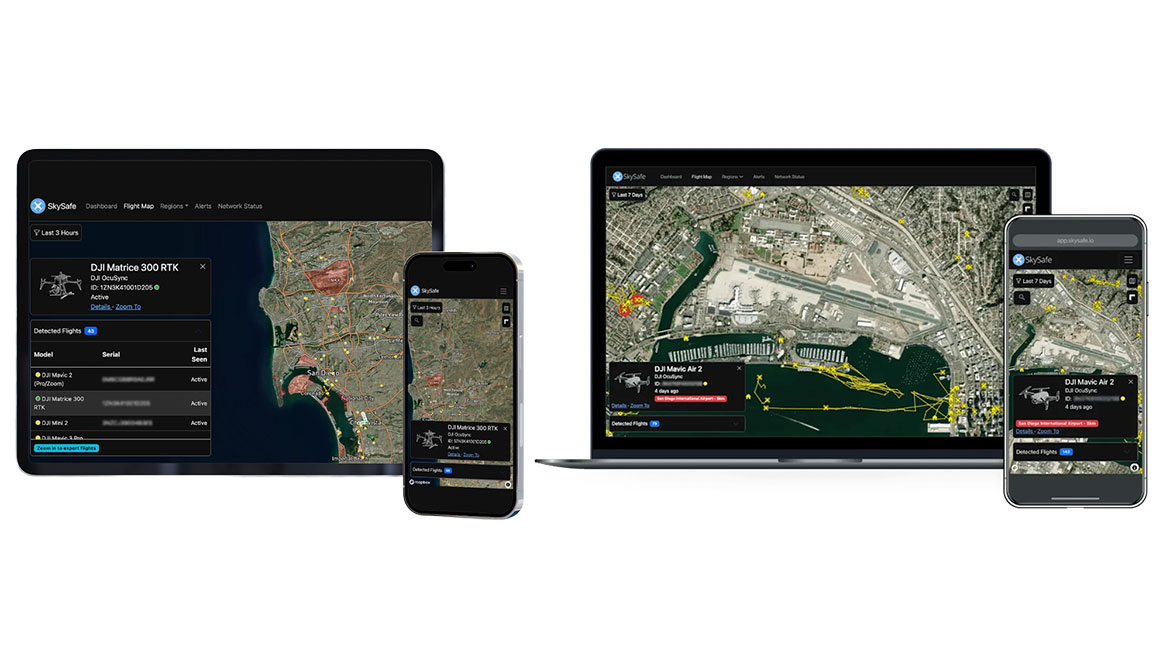
Swisher: During a sold-out football game at Memorial Stadium, SkySafe detected an unauthorized drone operating in the restricted airspace over the 50-yard-line. The platform identified the drone in real time, tracked its flight path, and pinpointed the operator's location approximately half a mile from the stadium. Campus police were able to respond directly to that location within minutes and apprehend the individual.
What followed is what makes this case so significant. The operator was arrested and charged with reckless conduct, and the case held up in a court of law because SkySafe's forensic evidence was irrefutable. Detailed flight records and geolocation data from the platform documented exactly where the drone had been and when, and who was operating it. Without that record, a detection alone would have produced an observation, but no consequence. With it, the university was able to make a prosecutable case that sent a clear message.
Security: How has the unauthorized drone situation evolved at large venues such as stadiums and arenas?
Swisher: The evolution has been dramatic.
A few years ago, most organizations viewed drones as an occasional nuisance. Today, they are a routine operational consideration for many security teams. Drones are more affordable, more capable, and more widely available than ever before, which has significantly increased the volume of activity around public venues and campuses.
What we're seeing across colleges, universities, stadiums, and large public gatherings is that organizations are moving beyond asking whether drone activity exists and focusing instead on how they can effectively manage it.
The conversation has shifted from awareness to accountability. Security leaders want to know who is flying, where they are operating from, whether the activity is authorized, and what evidence exists if an incident requires investigation.
As major sporting events, concerts, and international events continue to grow in scale and complexity, airspace security is becoming an increasingly important component of overall venue security planning.
Security: What was it about this case study that stood out as one to submit for this award?
Swisher: What made the University of Illinois case study particularly compelling was that it demonstrated the complete operational value of airspace intelligence.
The university wasn't simply detecting drones. They were able to identify activity in real time, locate operators, support investigations, improve resource allocation, and ultimately establish accountability when incidents occurred.
More importantly, the case illustrated a model that can be replicated across higher education. The challenges Illinois faced are not unique. Universities across the country are experiencing increasing levels of drone activity around campuses, athletic facilities, research centers, and special events.
The case study demonstrated how a security organization can move from reactive monitoring to proactive airspace management, which is exactly where the industry is heading.
Security: Anything else you would like to add?
Swisher: This award reflects a broader shift taking place across the security industry.
Organizations are increasingly recognizing that airspace is now an operational domain that requires the same level of awareness and intelligence as the physical environment. Colleges and universities have been among the most forward-thinking adopters because they manage complex environments that combine public events, research facilities, residential areas, and critical infrastructure.
We're proud to partner with institutions that are leading the way and helping define best practices for the future of campus and venue security.
Ultimately, this recognition belongs not only to SkySafe but also to the security professionals who are embracing innovative approaches to keep their communities safe. Their willingness to evolve alongside emerging threats is what makes progress possible.
Looking for a reprint of this article?
From high-res PDFs to custom plaques, order your copy today!