Security Magazine logo
search
cart
facebook twitter linkedin youtube
  • Sign In
  • Create Account
  • Sign Out
  • My Account
Security Magazine logo
  • NEWS
    • Security Newswire
    • Technologies & Solutions
  • MANAGEMENT
    • Leadership Management
    • Enterprise Services
    • Security Education & Training
    • Logical Security
    • Security & Business Resilience
    • Profiles in Excellence
  • PHYSICAL
    • Access Management
    • Fire & Life Safety
    • Identity Management
    • Physical Security
    • Video Surveillance
    • Case Studies (Physical)
  • CYBER
    • Cybersecurity News
    • More
  • BLOG
  • COLUMNS
    • Career Intelligence
    • Cyber Tactics
    • Cybersecurity Education & Training
    • Leadership & Management
    • Security Talk
  • EXCLUSIVES
    • Annual Guarding Report
    • Most Influential People in Security
    • The Security Benchmark Report
    • Top Guard and Security Officer Companies
    • Top Cybersecurity Leaders
    • Women in Security
  • SECTORS
    • Arenas / Stadiums / Leagues / Entertainment
    • Banking/Finance/Insurance
    • Construction, Real Estate, Property Management
    • Education: K-12
    • Education: University
    • Government: Federal, State and Local
    • Hospitality & Casinos
    • Hospitals & Medical Centers
    • Infrastructure:Electric,Gas & Water
    • Ports: Sea, Land, & Air
    • Retail/Restaurants/Convenience
    • Transportation/Logistics/Supply Chain/Distribution/ Warehousing
  • EVENTS
    • Industry Events
    • Webinars
    • Solutions by Sector
    • Security 500 Conference
  • MEDIA
    • Interactive Spotlight
    • Photo Galleries
    • Podcasts
    • Polls
    • Videos
      • Cybersecurity & Geopolitical Discussion
      • Ask Me Anything (AMA) Series
  • MORE
    • Call for Entries
    • Classifieds & Job Listings
    • Newsletter
    • Sponsor Insights
    • Store
    • White Papers
  • EMAG
    • eMagazine
    • This Month's Content
    • Advertise
  • SIGN UP!
CybersecuritySecurity Leadership and ManagementSecurity Education & Training

5 Minutes With

Breaking Down “The Mosaic Effect”
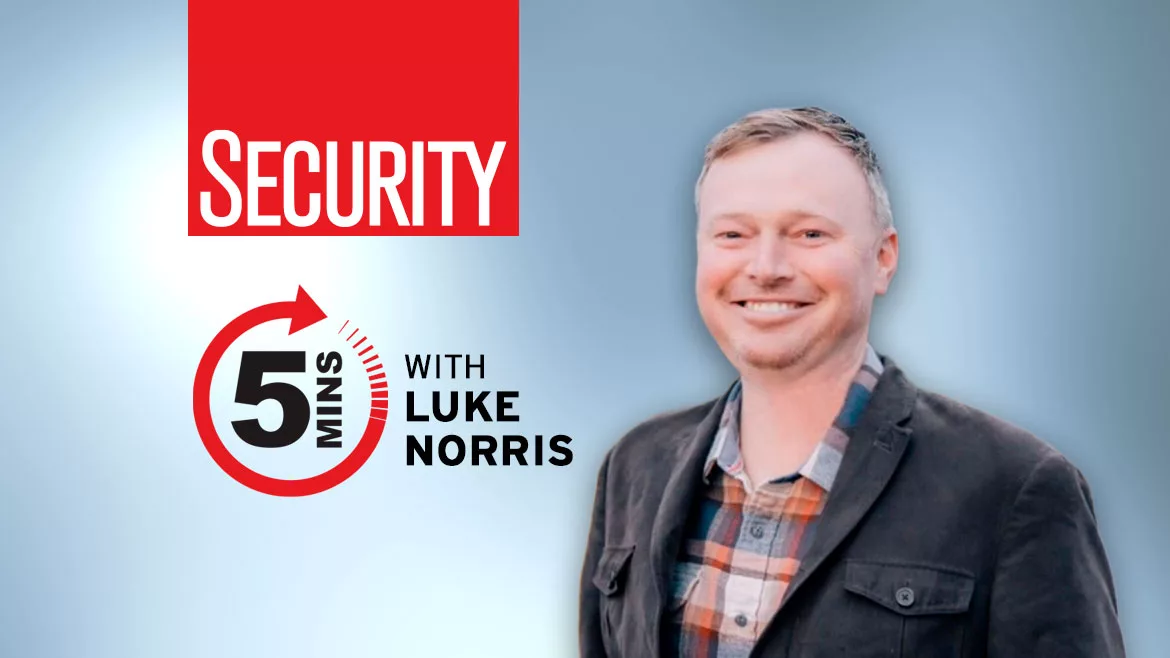
By Jordyn Alger, Managing Editor
5 Minutes with Norris
Image courtesy of Norris
March 26, 2026

Artificial intelligence (AI) has changed the cybersecurity game, and this can be seen in its impact on something called “the mosaic effect.” Here, Security magazine talks with Luke Norris, Co-Founder and CEO of Kamiwaza, about “the mosaic effect” and how AI is shaping it today. 

Security magazine: Tell us about your background and experience within the security industry.

Norris: I’ve spent more than two decades working in infrastructure, operations, and security roles where scale, reliability, and governance were core requirements.

Earlier in my career, I built and ran security programs for regulated financial organizations, with direct responsibility for audit controls, business continuity planning, and third-party risk. I also led large-scale operations environments, including integrated operations centers supporting global infrastructure and disaster recovery systems.

Over time, my work shifted toward distributed and multi-cloud architectures, where security and data sovereignty had to function consistently across cloud providers and on-prem environments. As founder and executive chairman of Faction, I focused on data-first architectures that exposed the limits of traditional access control at scale.

Today, as Co-Founder and CEO of Kamiwaza, my focus is on how AI changes the security model itself: how inference and autonomous systems introduce new, emergent risks like the mosaic effect that existing controls were never designed to handle.

Security: What is “the mosaic effect”?

Norris: The mosaic effect describes a situation where individual pieces of information are each permissible to access on their own, but when combined, reveal something more sensitive than any single piece would suggest.

This concept originated in the intelligence and privacy disciplines, where analysts recognized that aggregation itself can create risk. What’s changed is scale and speed. Modern AI systems can correlate thousands of low-risk data points in seconds, uncovering patterns that they were never explicitly instructed nor authorized to find.

The risk doesn’t live in any one dataset. It emerges from how data is combined, inferred, and contextualized, often across systems and over time.

Security: Why is “the mosaic effect” a concern?

Norris: Because most security controls were designed to evaluate access in isolation.

Traditional access control answers questions like: Is this user allowed to see this dataset? That framing assumes each access can be evaluated independently. But AI systems correlate data faster and more broadly than humans ever could, generating inferences across previously unrelated inputs in real time.

That means you can have a system that is technically compliant at every step, with the right roles and permissions in place, and still produce an outcome that violates policy or regulatory intent. This is especially critical in federal, defense, and regulated enterprise environments where data fusion itself can cross classification or sensitivity boundaries.

As organizations deploy AI into operational workflows, this gap becomes impossible to ignore. The system can do exactly what it was allowed to do, and still do the wrong thing.

Security: If traditional access control can’t manage this issue, how can “the mosaic effect” be mitigated?

Norris: Mitigating the mosaic effect requires shifting from static permission checks to contextual authorization. Even when extended with attribute-based or relationship-based models, most access control systems still evaluate decisions on a per-request basis.

That limitation becomes critical when AI systems chain actions, inherit authority, and combine context across time and systems. Consider an AI agent with legitimate access to employee directories, project assignments, and calendar data. Each query is authorized. But when the agent correlates all three to infer organizational restructuring plans or upcoming layoffs, it crosses a boundary that no single permission covers.

Instead of asking only who is accessing what, systems need to evaluate why access is occurring, how it relates to previous actions, and what the combined effect is likely to be. That includes understanding purpose, delegation, time, and relationships between data, agents, and decisions.

This becomes especially critical in distributed environments where inference happens across multiple systems. Authorization decisions can’t live in a single database or policy engine — they must account for what’s being combined and where the inference occurs.

In practice, this means authorization decisions need to be made with awareness of inference context. It also means treating AI agents as first-class actors with constrained authority, rather than as neutral tools operating under a single service account.

This doesn’t eliminate risk entirely, but it turns mosaic effects from an invisible failure mode into something that can be actively governed.

Security: Is there anything we haven’t discussed that you would like to add?

Norris: One important clarification is that the mosaic effect isn’t a reason to slow down AI adoption. It’s a signal that our security models need to evolve alongside our systems.

We’ve seen this pattern before. When systems moved from centralized to distributed, perimeter security stopped working. When humans were no longer the only actors, identity models had to change. AI is another step in that progression.

What makes AI different is velocity. Authorization decisions that were evaluated quarterly or during policy reviews now need to happen in real time for every inference request. That means security can’t be a static snapshot. It has to be a living system that updates continuously as permissions change, new data is added, users are onboarded, or projects are restructured.

Organizations that treat this as a systems problem, where contextual authorization adapts dynamically to every add, move, change, and delete, will be able to deploy AI more safely and more confidently than those who try to paper over it with static controls.

KEYWORDS: 5 minutes with access control artificial intelligence (AI) data compliance data concerns

Share This Story

Looking for a reprint of this article?
From high-res PDFs to custom plaques, order your copy today!


Jordynalger

Jordyn Alger is the managing editor for Security magazine. Alger writes for topics such as physical security and cyber security and publishes online news stories about leaders in the security industry. She is also responsible for multimedia content and social media posts. Alger graduated in 2021 with a BA in English – Specialization in Writing from the University of Michigan. Image courtesy of Alger

Recommended Content

JOIN TODAY
To unlock your recommendations.

Already have an account? Sign In

  • Cyber tech background

    Security’s Top Cybersecurity Leaders 2026

    Security magazine’s Top Cybersecurity Leaders 2026 award...
    Security Leadership and Management
  • Iintegration and use of emerging tools

    Future Proof Your Security Career with AI Skills

    AI’s evolution demands security leaders master...
    Security Education & Training
    By: Jerry J. Brennan and Joanne R. Pollock
  • The 2025 Security Benchmark Report

    The 2025 Security Benchmark Report

    The 2025 Security Benchmark Report surveys enterprise...
    The Security Benchmark Report
    By: Rachelle Blair-Frasier
Manage My Account
  • Security Newsletter
  • eMagazine Subscriptions
  • Manage My Preferences
  • Online Registration
  • Mobile App
  • Subscription Customer Service

More Videos

Sponsored Content

Sponsored Content is a special paid section where industry companies provide high quality, objective, non-commercial content around topics of interest to the Security audience. All Sponsored Content is supplied by the advertising company and any opinions expressed in this article are those of the author and not necessarily reflect the views of Security or its parent company, BNP Media. Interested in participating in our Sponsored Content section? Contact your local rep!

close
  • critical event management
    Sponsored byEverbridge

    Why a Unified View Across IT, Continuity, and Security Makes or Breaks Crisis Response

Popular Stories

Fingerprint on computer board

Enhancing Incident Response with Integrated Access Control and Video Verification

Iran on map

Iran Conflict and Cybersecurity: What to Expect in the Next 30 Days

World Cup trophy beside goal

World Cup Safety and Security Is About More than Just Crime

Woman in suit

Can the Industry Do More for Women in Security?

An Opened Lock Standing Out From Locked Locks

From the Outside In: A Smarter Approach to Vendor Access

SEC 2026 Benchmark Banner

Events

April 8, 2026

The Future of Executive Protection: Layering Technology, Intelligence, and Response

Digital threats to executives and other high-profile employees are evolving faster than most corporate protection programs. Learn why modern executive protection programs require data-driven, intelligence-led strategies to keep pace with the magnitude of today’s threats.

April 15, 2026

How AI is Closing the Decision Gap in Leading GSOCs

Learn how modern security teams are evolving from alert-driven workflows to outcome-driven operations and how AI is enabling faster, more confident decisions at every stage of the incident response lifecycle.

View All Submit An Event

Products

Security Culture: A How-to Guide for Improving Security Culture and Dealing with People Risk in Your Organisation

Security Culture: A How-to Guide for Improving Security Culture and Dealing with People Risk in Your Organisation

See More Products
SEC 2026 Top Cybersecurity Leaders

Related Articles

  • Football on field

    Breaking Down the Security, Risk of Recent University Firing

    See More
  • Person looking at flight schedules

    REAL ID Enforcement in Effect — What Does This Mean for Biometric Data Security?

    See More
  • Padlock on laptop with neon lights

    27 DDoS-for-hire operations shut down by law enforcement

    See More

Related Products

See More Products
  • 9780367030407.jpg

    National Security, Personal Privacy and the Law

  • Risk Analysis and the Security Survey, 4th Edition

  • The Database Hacker's Handboo

See More Products
×

Sign-up to receive top management & result-driven techniques in the industry.

Join over 20,000+ industry leaders who receive our premium content.

SIGN UP TODAY!
  • RESOURCES
    • Advertise
    • Contact Us
    • Store
    • Want More
  • SIGN UP TODAY
    • Create Account
    • eMagazine
    • Newsletter
    • Customer Service
    • Manage Preferences
  • SERVICES
    • Marketing Services
    • Reprints
    • Market Research
    • List Rental
    • Survey/Respondent Access
  • STAY CONNECTED
    • LinkedIn
    • Facebook
    • YouTube
    • X (Twitter)
  • PRIVACY
    • PRIVACY POLICY
    • TERMS & CONDITIONS
    • DO NOT SELL MY PERSONAL INFORMATION
    • PRIVACY REQUEST
    • ACCESSIBILITY

Copyright ©2026. All Rights Reserved BNP Media, Inc. and BNP Media II, LLC.

Design, CMS, Hosting & Web Development :: ePublishing