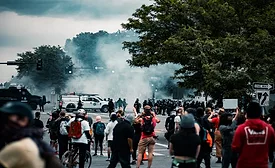
De-escalation is a key frontline security strategy in a range of situations, from hospitals to retail settings to office environments. Many sectors, such as travel and airlines, healthcare facilities, retail and more, have seen an increase in agitated behavior or violent incidents in recent years, some spawned from tensions rising regarding mask mandates and COVID-19 protocols. Here, we take a look at de-escalation strategies and training that security leaders can implement within their organizations to keep security, staff and visitors safe.
The University of Chicago Police Department was re-accredited with Advanced Law Enforcement Accreditation by the Commission on Accreditation for Law Enforcement Agencies, Inc. (CALEA).
The Department of Homeland Security (DHS) Small Business Innovation Research (SBIR) program recently awarded funding to two companies to develop an in-building coverage analysis system (ICAS) that leverages existing first responder radio and smartphone technology to enhance accessibility to wireless service.
Specific cases in Turkey, Chile, and the United States speak to a shift in riot and civil disorder risk, along with consequences for risk transfer decision-making. New sources of capital may be able to help communities prepare more effectively for post-event recovery.
The University of Utah Police Department joins the 30x30 initiative, which aims to increase the representation of women in police recruit classes to 30% by 2030.
The truth is, the roles of security workers have become more crucial to public safety than ever, and their voices need to be heard. We must take this time as an opportunity to drive change and improve the livelihood of our forgotten frontline workers.
Surveyed facility managers cite campus access control, site security and occupant safety as key focus areas
According to a report released by Honeywell, 93% of surveyed facility managers within the education vertical say they have experienced at least one emergency incident stemming from infrastructure malfunction during the last 12 months, and 43% report a physical site or cybersecurity breach in that time. Nearly half (45%) say they rank site security (video surveillance and campus access control) or fire and life safety systems as a top priority over the next 12 to 18 months.