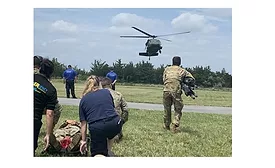
Understanding and implementing these two best practices will save precious time and successfully lead an organization and communities through a major hurricane.
Riverside County in California's Emergency Management Department received a $2.57 million federal grant to distribute to local entities for disaster preparedness and response training and activities.
Beebe Healthcare system in southern Delaware partnered with the Delaware National Guard and other agencies to simulate two emergency drills as part of its preparedness planning.
The U.S. Department of Homeland Security Cybersecurity and Infrastructure Security Agency (CISA), private sector partners, local first responders, and state and federal partners held a tabletop exercise to test emergency response and recovery operations in preparation for the U.S. Olympic Team Trials – Track & Field, which will be held June 18-27 at Hayward Field on the University of Oregon campus.
Rave Mobile Safety (Rave) announced the results of its fourth annual 2021 Workplace Safety and Preparedness Survey. The findings show that employers are reevaluating how to best protect employees both on-site and remotely in a year of unprecedented change.
To comply with Alyssa's Alert requirements for the upcoming school year, both Citrus County and Lee County school districts are implementing badge-based panic alarm systems.
Artificial intelligence (AI) is the most disruptive innovation in a generation. It is quickly becoming an essential component in many industries, including public safety. However, these are still the nascent stages of AI adoption, and with that, come challenges.
Is your organization struggling with false alarms? If so, consider artificial intelligence-based video analytics using machine learning technology to spot and virtually eliminate false alarms. But before selecting an advanced analytic software offering, ask yourself these seven questions.
The City of New Orleans, the State of Iowa and Hamilton County, Indiana have replaced their legacy emergency mass notification systems to improve emergency communication within their communities.
A recent survey conducted by Rave showed that only 22% of respondents completely trust the information they receive from local officials. Many factors – such as the spread of disinformation, social unrest and the ongoing pandemic – likely contribute to this low level of trust. However, it still poses a big problem to local leaders who are trying to keep residents safe – especially during the ongoing pandemic. We connected with Todd Miller, SVP of Strategic Programs at Rave Mobile Safety, to talk about how local governments and organizations can go about re-building trust in their communities by communicating effectively with residents.