Enterprise Security Must Prepare to Respond
An Effective Emergency Response Program is the Heart of Exceptional Service.

At the 2 million-square-foot Marina Heights campus in Tempe, Ariz., Transwestern regularly conducts preparedness drills with tenants and emergency personnel. Photo courtesy of Transwestern
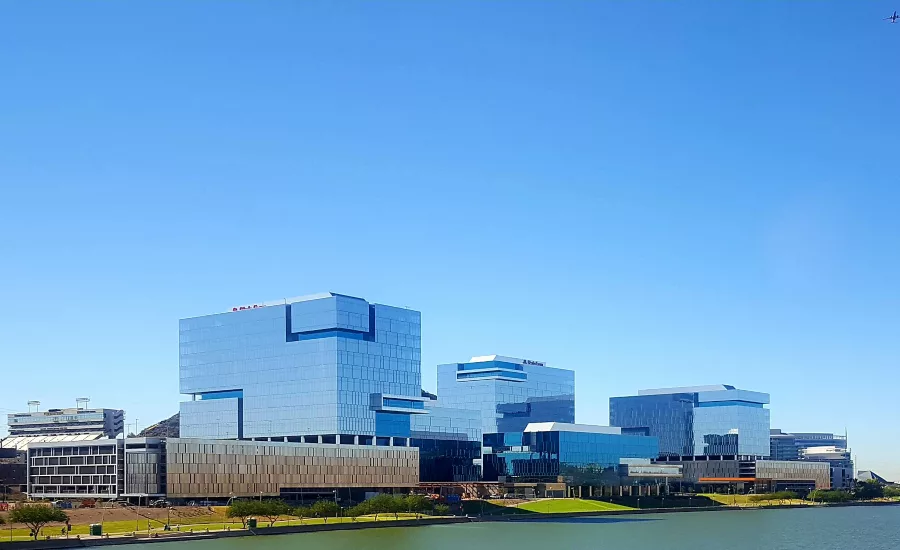
The 2 million-square-foot Marina Heights campus in Tempe, Ariz. Photo courtesy of Transwestern
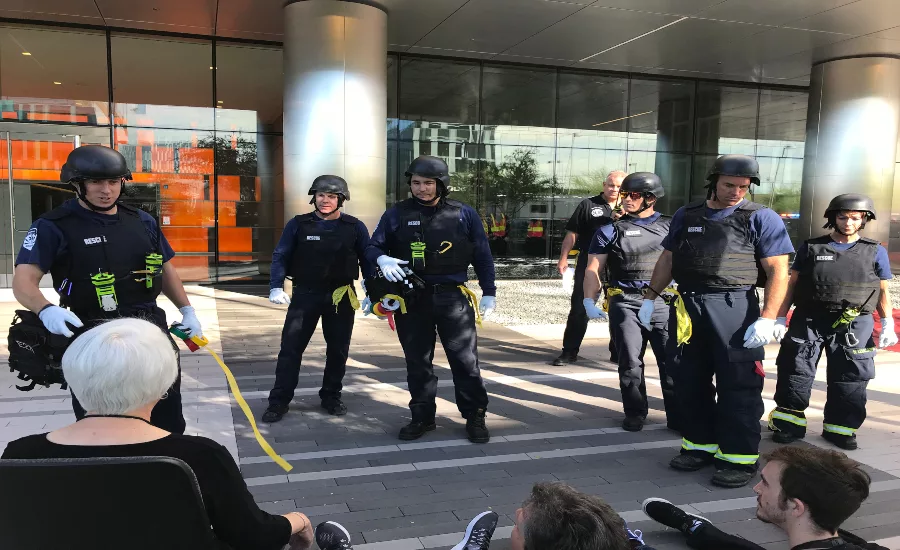
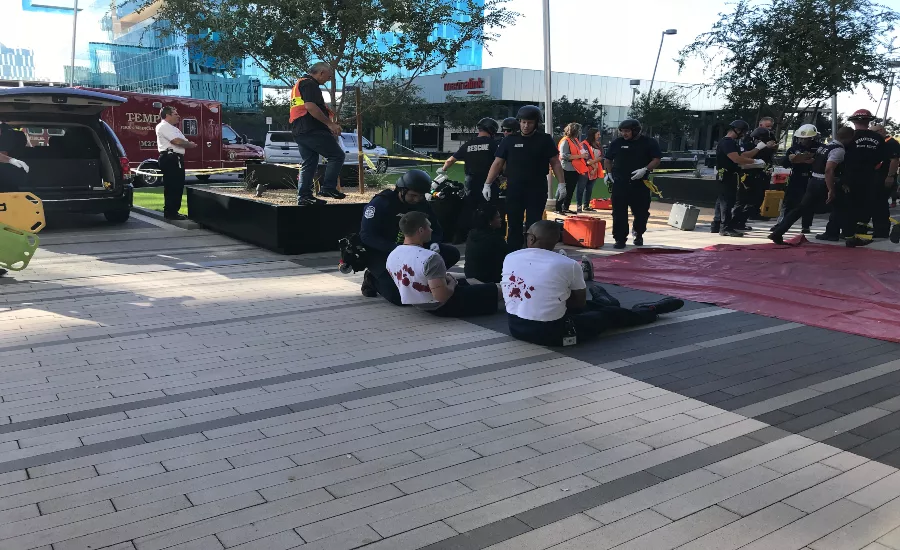
Each step of the event was simulated, from the 911 call to respondents entering the five-building property, setting up a command center and ascending to an upper floor to rescue stranded tenants. Fire and ambulance services even set up triage stations complete with “injured” individuals. Photo courtesy of Transwestern
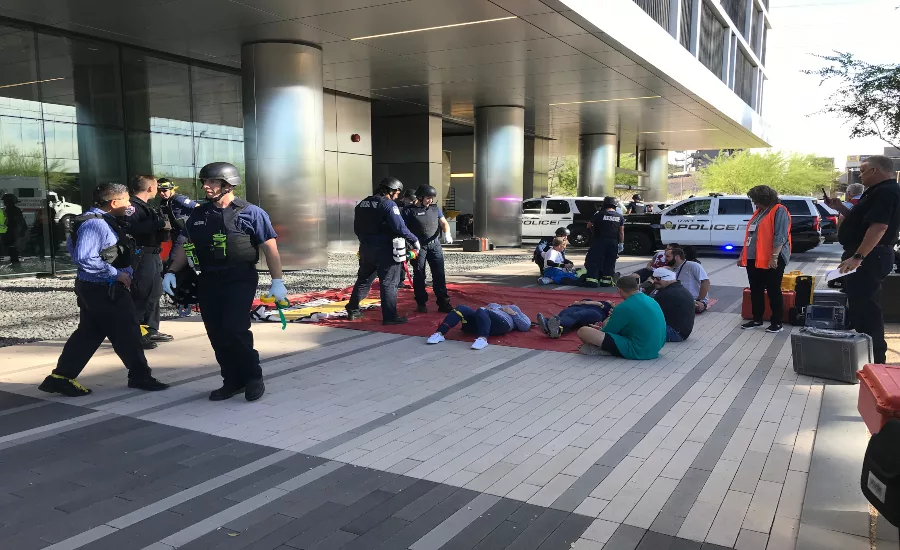
The exercise allowed both the property management team to test their preparations for crisis management with the property’s state-of-the-art technology, equipment and systems, such as elevators and fire pumps, and for the external parties to gain experience and build muscle memory that may someday save lives. Photo courtesy of Transwestern
An asset services provider’s chief responsibility is to protect a client’s physical assets and ensure the safety of tenants within. As the COVID-19 virus has once again brought to the forefront, anticipating potential dangers is essential to meeting this challenge in an environment full of new and evolving risks.
Significant time, capital and resources must be committed to protect people and operations across a managed portfolio, which for Transwestern includes 220 million square feet of commercial space in nearly 800 U.S. properties. While considering the needs of each client and the intricacies of each asset, dedicated expertise combined with technological innovations establish and reinforce best practices.
Bespoke Backup and Top-Tier Tech
Emergency Response and Recovery Procedures (ERRP) are a comprehensive, customizable set of guidelines addressing any potential hazard that could befall a property. ERRP enables property managers or specially trained staff, including local, regional and national experts, to manage disruptive events in the most efficient and effective way possible.
Many property and security experts agree that a matrix works best to help identify the types of disruptive events—such as violence/terrorism, illness, property and/or environmental matters, or legal/reputation issues—and the levels of potential impact. ERRP should also provide information on recommended actions for each phase of an incident, from preparation to response to recovery to post-event evaluation. Procedures, roles, responsibilities and resources should be outlined and supplemented with preparation checklists; lists of emergency equipment and supplies; and copies of forms and documentation needed during and after an event. Instructions on how to operate automated systems, complete with messaging templates for staff, vendors, first responders and local/regional agencies, and how to set up and run an Emergency Operations Center, are also valuable.
Innovation in technology resources has significantly broadened a property manager’s skillset. While the nature of some potential threats has not changed over the years, the ability to anticipate, respond and react to those threats has evolved dramatically. Emergency notification tools allow for real-time communication between staff and tenants, making a monumental difference in keeping everyone informed and maintaining order before, during and after an emergency. Moving key systems from multiple data centers to cloud-based technology minimizes the risk of having to shut down operations due to storms, property damage or other incidents, and supports business continuity and recovery – something every property owner and tenant demands.
Drilling It in
Of course, ensuring a plan operates as intended requires ongoing training, reviewing ERRP guidelines and how to use them, while ensuring all parties are aware of their responsibilities. Training also introduces new technology and focuses on media relations preparation for employees who may be used to serving behind the scenes.
Functional and full-scale drills at the property level serve a number of purposes: they help identify deficiencies in planning and resources; test new or changed procedures; clarify roles and responsibilities; obtain feedback from participants and responders; improve coordination between internal and external teams and entities; and validate and reinforce awareness and education.
For Transwestern, this training has prepared teams across the country to respond to a variety of anticipated and real dangers – from a bomb scare at a building near the White House to an active shooter around a Denver property. When preparing for potential civil unrest in Chicago in response to a police-related shooting, property managers followed protocol and worked with city agencies and law enforcement to keep ownership and tenants apprised of street closures, the location of active protest groups and the progress of safety measures such as building lockdowns.
At the 2 million-square-foot Marina Heights campus in Tempe, Arizona, Transwestern regularly conducts preparedness drills with tenants and emergency personnel. The most recent exercise at the state’s largest office complex, an active shooter drill, drew 200 first responders, including local SWAT, fire and police departments; the Arizona State University police department; Scottsdale and Mesa first responders; and ambulance teams from surrounding cities.
Each step of the event was simulated, from the 911 call to respondents entering the five-building property, setting up a command center and ascending to an upper floor to rescue stranded tenants. Fire and ambulance services even set up triage stations complete with “injured” individuals. The exercise allowed both the property management team to test their preparations for crisis management with the property’s state-of-the-art technology, equipment and systems, such as elevators and fire pumps, and for the external parties to gain experience and build muscle memory that may someday save lives.
Gut Decisions and Ingenuity
While the importance of advanced planning and training drills cannot be overstated, flexibility is an integral part of a property manager’s role. Finding the right balance between standard protocol and ingenuity is what makes property management an artform.
In the Pacific Northwest, earthquakes historically have been the greatest threat to buildings, but in recent years wildfires have become a more prevalent concern. Tied to the fires is California’s electric utilities’ practice of “de-energization,” or Public Safety Power Shutoffs. The decision in late 2019 by Pacific Gas & Electric to extend these measures to a wider area left millions without power and impacted millions of square feet of commercial space.
When massive blackouts paralyzed much of California, it sent property managers into protocol mode. The most pressing issue across the board was business continuity; with power no longer a reliable resource, attention was placed on emergency backup generators to keep critical infrastructure up and running. But operating once-automated systems with minimal power can be difficult. For instance, if key card access is unavailable, security teams must move to a manual system of checking identification against a tenant log. Furthermore, power shutoffs can be detrimental to building systems. A building doesn’t always respond well when the plug is suddenly pulled; not only do the systems experience an abrupt shutdown, but there’s also the danger of elevator entrapment and sudden business disruption.
To guard against these issues during the 2019 wildfires, Transwestern decided to preemptively shut down power to inessential or fragile building systems, including sensitive HVAC systems and elevators, at properties within PG&E’s planned de-energization zones. The rationale was that the property management team had no control over the wildfires or power going out but could guard itself as much as possible against the impact. By controlling the timing and pace of shutoffs, tenants knew what to expect and when to expect it, and they were able to plan with staff accordingly.
An advantage of a national platform is the extensive collaboration between teams in various markets. As a gateway city, San Francisco has been hit hard with concerns over a potential coronavirus pandemic, and property managers are familiar with the latest developments and safeguards. But while cleaning crews can double down on efforts and staff can provide larger supplies of hand sanitizer, education is a landlord’s best defense. Positively influencing human behavior is an equally important part of the job that contributes to the overall health of the building, and sharing lessons learned come from a multitude of past experiences.
The level of excellence demanded by all parties in the commercial real estate space will continue to be raised, and the obligation to respond with increased resilience and resourcefulness should evolve to meet the challenge. EERP is where it begins.
Looking for a reprint of this article?
From high-res PDFs to custom plaques, order your copy today!