Security Magazine logo
search
cart
facebook twitter linkedin youtube
  • Sign In
  • Create Account
  • Sign Out
  • My Account
Security Magazine logo
  • NEWS
    • Security Newswire
    • Technologies & Solutions
  • MANAGEMENT
    • Leadership Management
    • Enterprise Services
    • Security Education & Training
    • Logical Security
    • Security & Business Resilience
    • Profiles in Excellence
  • PHYSICAL
    • Access Management
    • Fire & Life Safety
    • Identity Management
    • Physical Security
    • Video Surveillance
    • Case Studies (Physical)
  • CYBER
    • Cybersecurity News
    • More
  • BLOG
  • COLUMNS
    • Career Intelligence
    • Cyber Tactics
    • Cybersecurity Education & Training
    • Leadership & Management
    • Security Talk
  • EXCLUSIVES
    • Annual Guarding Report
    • Most Influential People in Security
    • The Security Benchmark Report
    • Top Guard and Security Officer Companies
    • Top Cybersecurity Leaders
    • Women in Security
  • SECTORS
    • Arenas / Stadiums / Leagues / Entertainment
    • Banking/Finance/Insurance
    • Construction, Real Estate, Property Management
    • Education: K-12
    • Education: University
    • Government: Federal, State and Local
    • Hospitality & Casinos
    • Hospitals & Medical Centers
    • Infrastructure:Electric,Gas & Water
    • Ports: Sea, Land, & Air
    • Retail/Restaurants/Convenience
    • Transportation/Logistics/Supply Chain/Distribution/ Warehousing
  • EVENTS
    • Industry Events
    • Webinars
    • Solutions by Sector
    • Security 500 Conference
  • MEDIA
    • Interactive Spotlight
    • Photo Galleries
    • Podcasts
    • Polls
    • Videos
      • Cybersecurity & Geopolitical Discussion
      • Ask Me Anything (AMA) Series
  • MORE
    • Call for Entries
    • Classifieds & Job Listings
    • Newsletter
    • Sponsor Insights
    • Store
    • White Papers
  • EMAG
    • eMagazine
    • This Month's Content
    • Advertise
  • SIGN UP!
CybersecurityArenas / Stadiums / Leagues / EntertainmentBanking/Finance/Insurance

The Identity Theft Risk Profile of NBA and NFL Draft Prospects

By Dr. David Maimon
Basketball on yellow and green floor
Vino Li via Unsplash
January 12, 2026

Professional athletes live much of their lives in public. Headlines highlight new contracts, milestones, home purchases, and relationship updates, while personal details quietly enter the public record — birthdates, hometowns, addresses, and family information. Images of athletes circulate across social media and sports sites. With so much information so accessible, alongside publicly known lucrative contracts, superstar athletes routinely face identity theft attempts. These athletes understand the risks and typically have teams and tools in place to monitor and safeguard their identities. Organizations also apply extra scrutiny when their names appear in financial or commercial transactions.

But what about the athletes who haven’t “made it” yet? Are fraudsters already exploiting the identities of up-and-coming prospects?

Data and Methodology

We assembled two datasets representing exposure vectors within the online fraud ecosystem:

  • NBA Draft Lists (2020–2024): Every ESPN-published list, totaling 288 player names.
  • NFL Draft Lists (2020–2024): Every Wikipedia-published list, totaling 1,292 player names.

We matched each identity against application records submitted to SentiLink partners since 2020. These records included legitimate applications and suspected identity theft attempts, as identified by SentiLink’s fraud-detection models. We relied on SentiLink’s proprietary ID Theft score, which ranges from 1 to 999; applications scoring 600 or above signify a high likelihood of identity theft.

Results

Does Making an NBA or NFL Draft List Increase the Risk of Identity Theft Attempts?

We identified 138 identities from the NBA list and 814 from the NFL list with application activity. We then measured the prevalence of high-risk applications. For the NBA list, the identity theft attempt rate was roughly 10% across all identities and more than 20% among identities with applications. For the NFL list, the rate was about 10% across all identities, increasing to nearly 15% among identities with applications.
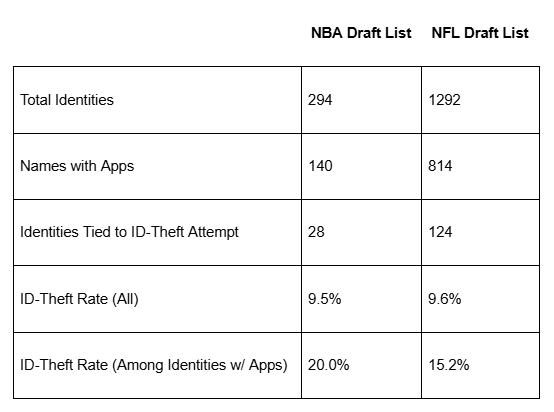
NBA and NFL Draft List ChartChart courtesy of Maimon of SentiLink

These elevated rates sharply contrast with typical identity theft rates among United States consumers, which fall in the 2 to 3% range for credit cards, auto loans, and consumer-lending applications. By comparison, identity theft rates for NBA and NFL draft prospects are roughly five times higher.

To evaluate trends over time, we charted quarterly rates of high-risk applications for both lists across four years and computed a Last Twelve Months (LTM) rolling average. The results show a clear upward trend. Even the smoothed rolling average stays well above the low single-digit baseline typically observed in consumer populations.

Which Types of Organizations Are Most Targeted?

We analyzed the distribution of high-risk applications across major financial and service sectors. For NBA draft identities, Consumer Lending and Demand Deposit Accounts (DDA) were the most frequently targeted, followed by Telecommunications and Auto loans. For NFL draft identities, Auto loans and DDA were most targeted, followed by Telecommunications.
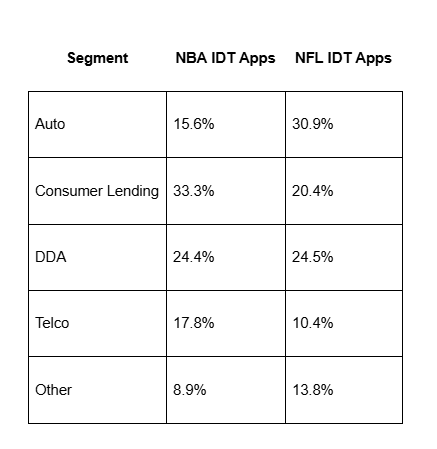
High-risk application distributionChart courtesy of Maimon of SentiLink

Why Is This Happening?

Several factors contribute to the disproportionately high targeting of NBA and NFL draft prospects:

1. High Public Exposure and Easy Accessibility

Draft lists are widely published on ESPN, Wikipedia, social media and sports databases. They provide structured lists of real individuals’ names, offering fraudsters an easy alternative to purchasing stolen data or scraping datasets. Draft prospects also have extensive biographical details online — birthdates, hometowns, schools — which help fraudsters complete applications or pass identity checks.

2. Young Adults Are Prime Targets

Prospects are typically 18 to 23 years old and often have short credit histories, fewer financial accounts, and inconsistent digital footprints. These traits make fraudulent applications less likely to trigger alerts tied to established behavior.

3. Low Likelihood of Early Detection

College athletes and draft prospects move frequently — campus to training facility to combine to draft events — and may not actively monitor credit reports or mail. This delay in detection gives fraudsters more time to operate.

4. Perceived High-Value Identity Association

Identities linked to major collegiate programs or professional pipelines may seem credible to automated underwriting systems. Even without high income, the association with reputable institutions can reduce scrutiny.

5. Use of AI Tools to Manipulate Public Athlete Images

Fraudsters increasingly use AI to manipulate high-quality athlete photos available online. These tools can fabricate IDs appearing to be held by the athlete or create animated “liveness” images to defeat authentication systems.

A Growing Fraud Pattern

Identity thieves are not waiting for athletes to become stars before exploiting their information. Draft prospects — young, visible and digitally exposed — are becoming prime targets long before they play professionally. Their public profiles supply fraudsters with birthdates, hometowns and high-resolution images that can be manipulated using AI.

The rising trend in high-risk applications across recent draft classes shows this is a growing fraud pattern, not a one-off phenomenon. As more athlete data moves online, barriers to impersonation continue to shrink. Financial institutions, platforms and verification providers will need to adjust accordingly — because fraudsters already have.

KEYWORDS: identity fraud identity security identity theft research

Share This Story

Looking for a reprint of this article?
From high-res PDFs to custom plaques, order your copy today!


David maimon headshot

Dr. David Maimon is the Head of Fraud Insights at SentiLink, and Professor in the Department of Criminal Justice and Criminology at Georgia State University (GSU), where he directs the Evidence-based Cybersecurity Research Group. Image courtesy of Maimon 

Recommended Content

JOIN TODAY
To unlock your recommendations.

Already have an account? Sign In

  • Iintegration and use of emerging tools

    Future Proof Your Security Career with AI Skills

    AI’s evolution demands security leaders master...
    Security Leadership and Management
    By: Jerry J. Brennan and Joanne R. Pollock
  • The 2025 Security Benchmark Report

    The 2025 Security Benchmark Report

    The 2025 Security Benchmark Report surveys enterprise...
    The Security Benchmark Report
    By: Rachelle Blair-Frasier
  • The Most Influential People in Security 2025

    Security’s Most Influential People in Security 2025

    Security Magazine’s 2025 Most Influential People in...
    Most Influential People in Security
    By: Security Staff
Manage My Account
  • Security Newsletter
  • eMagazine Subscriptions
  • Manage My Preferences
  • Online Registration
  • Mobile App
  • Subscription Customer Service

More Videos

Sponsored Content

Sponsored Content is a special paid section where industry companies provide high quality, objective, non-commercial content around topics of interest to the Security audience. All Sponsored Content is supplied by the advertising company and any opinions expressed in this article are those of the author and not necessarily reflect the views of Security or its parent company, BNP Media. Interested in participating in our Sponsored Content section? Contact your local rep!

close
  • critical event management
    Sponsored byEverbridge

    Why a Unified View Across IT, Continuity, and Security Makes or Breaks Crisis Response

  • Charlotte Star Room
    Sponsored byAMAROK

    In an Uncertain Economy, Security Is a Necessity - Not an Afterthought

Popular Stories

Man in suit

How to Safeguard Executives Through Proactive Planning and Managing Online Presence

2026

What Security Leaders Could Expect in 2026

Coding

Epstein File Data Security Update: Raw Code Found in Emails

Man coding

The Copilot Problem: Why Internal AI Assistants Are Becoming Accidental Data Breach Engines

NFL footballs

Security Risks Around Super Bowl LX: What Security Leaders Should Be Watching

SEC 2026 Benchmark Banner

Events

September 18, 2025

Security Under Fire: Insights on Active Shooter Preparedness and Recovery

ON DEMAND: In today’s complex threat environment, active shooter incidents demand swift, coordinated and well-informed responses.

February 26, 2026

Zero Incidents vs. Zero Tolerance – Workplace Violence Prevention Best Practices that Work

Workplace violence remains one of the most complex challenges facing healthcare organizations today. For executive security professionals, the stakes have never been higher: protecting staff, patients, and visitors while preserving a culture of compassion, dignity, and service.

View All Submit An Event

Products

Security Culture: A How-to Guide for Improving Security Culture and Dealing with People Risk in Your Organisation

Security Culture: A How-to Guide for Improving Security Culture and Dealing with People Risk in Your Organisation

See More Products

Related Articles

  • NFL-logo.jpg

    Public-private partners tackle security at the 88th Annual NFL Draft

    See More
  • DOJ charges two men for involvement in hacking of NFL and NBA players social media accounts

    See More
  • Smartphone Users at Higher Risk of Identity Theft

    See More

Related Products

See More Products
  • Risk Analysis and the Security Survey, 4th Edition

  • 1119490936.jpg

    Solving Cyber Risk: Protecting Your Company and Society

  • 9780367339456.jpg.jpg.jpg

    Cyber Strategy: Risk-Driven Security and Resiliency

See More Products
×

Sign-up to receive top management & result-driven techniques in the industry.

Join over 20,000+ industry leaders who receive our premium content.

SIGN UP TODAY!
  • RESOURCES
    • Advertise
    • Contact Us
    • Store
    • Want More
  • SIGN UP TODAY
    • Create Account
    • eMagazine
    • Newsletter
    • Customer Service
    • Manage Preferences
  • SERVICES
    • Marketing Services
    • Reprints
    • Market Research
    • List Rental
    • Survey/Respondent Access
  • STAY CONNECTED
    • LinkedIn
    • Facebook
    • YouTube
    • X (Twitter)
  • PRIVACY
    • PRIVACY POLICY
    • TERMS & CONDITIONS
    • DO NOT SELL MY PERSONAL INFORMATION
    • PRIVACY REQUEST
    • ACCESSIBILITY

Copyright ©2026. All Rights Reserved BNP Media.

Design, CMS, Hosting & Web Development :: ePublishing