Security Magazine logo
search
cart
facebook twitter linkedin youtube
  • Sign In
  • Create Account
  • Sign Out
  • My Account
Security Magazine logo
  • NEWS
    • Security Newswire
    • Technologies & Solutions
  • MANAGEMENT
    • Leadership Management
    • Enterprise Services
    • Security Education & Training
    • Logical Security
    • Security & Business Resilience
    • Profiles in Excellence
  • PHYSICAL
    • Access Management
    • Fire & Life Safety
    • Identity Management
    • Physical Security
    • Video Surveillance
    • Case Studies (Physical)
  • CYBER
    • Cybersecurity News
    • More
  • BLOG
  • COLUMNS
    • Career Intelligence
    • Cyber Tactics
    • Cybersecurity Education & Training
    • Leadership & Management
    • Security Talk
  • EXCLUSIVES
    • Annual Guarding Report
    • Most Influential People in Security
    • The Security Benchmark Report
    • Top Guard and Security Officer Companies
    • Top Cybersecurity Leaders
    • Women in Security
  • SECTORS
    • Arenas / Stadiums / Leagues / Entertainment
    • Banking/Finance/Insurance
    • Construction, Real Estate, Property Management
    • Education: K-12
    • Education: University
    • Government: Federal, State and Local
    • Hospitality & Casinos
    • Hospitals & Medical Centers
    • Infrastructure:Electric,Gas & Water
    • Ports: Sea, Land, & Air
    • Retail/Restaurants/Convenience
    • Transportation/Logistics/Supply Chain/Distribution/ Warehousing
  • EVENTS
    • Industry Events
    • Webinars
    • Solutions by Sector
    • Security 500 Conference
  • MEDIA
    • Interactive Spotlight
    • Photo Galleries
    • Podcasts
    • Polls
    • Videos
      • Cybersecurity & Geopolitical Discussion
      • Ask Me Anything (AMA) Series
  • MORE
    • Call for Entries
    • Classifieds & Job Listings
    • Newsletter
    • Sponsor Insights
    • Store
    • White Papers
  • EMAG
    • eMagazine
    • This Month's Content
    • Advertise
  • SIGN UP!

NCS4 Show Coverage

Measuring the Risk in High–Low Frequency Tasks
August 13, 2012


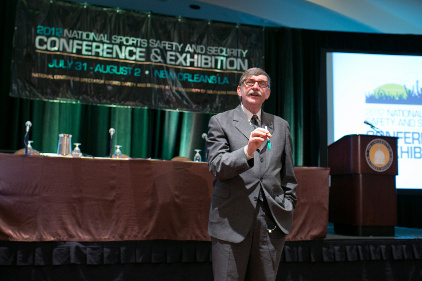
Gordon Graham speaks on risk management at the NCS4 Conference 2012.
Gordon Graham delivers his keynote speech at the NCS4 Conference on August 2, 2012. Photo: Chris Williams/Chris Pike/Zoeica Images New Orleans

How do you determine the level of risk associated with a particular task?

According to Gordon Graham of Graham Research Consultants, you check the box.

Check out the grid here: 

High Risk High Risk, High Frequency High Risk, Low Frequency
Low Risk Low Risk, High Frequency Low Risk, Low Frequency
  High Frequency Low Frequency


Now, Graham says, while error and risk appear in every section of the box, problems most rarely occur in high-frequency tasks.Each task can be assigned to a different box – high-frequency, low-risk; high-frequency, high-risk; low-frequency, low-risk; and low-frequency, high-risk.

“Everything you do goes into one of these four boxes,” Graham says during his keynote lecture at the National Center for Spectator Sport Safety and Security Conference 2012. “Personally and professionally – where are errors most likely to occur? Rarely do we make mistakes on high-frequency events. Things we do a lot, we tend to do very well.

“You give me a good employee in any occupation, in any profession – this is a universal concept – you give me a good woman or man, and put that person in a high-frequency task, you get a phenomenon called RPDM: Recognition Prime Decision-Making,” he says. “The theory is: the brain is an accumulation of past experiences. When the brain gets involved in a task, it scans the hard-drive, looks for memory markers.

“That employee thinks: ‘Have I ever done this task before? A bunch of times. Did it end up going right? Every time. So why don’t I just do it the same way I did it last time, I bet it goes right. If it goes right I stay out of trouble.’

“That whole process is known as RPDM,” Graham says.

For the Five Exceptions for High-Frequency Decision Making, See This Security Exclusive Video from the NCS4 Conference

Low-frequency events are the main problem, he says. And low-frequency, low-risk events aren’t particularly worrisome either – even if they go wrong, he says, the consequences are minimal.

“High-risk, low-frequency events worry me in every occupation,” Graham says. “Things that are very risky and done very rarely, the employee does not have the memory markers to deal with these. This is a universal concept.”

“Every time you give your people a new piece of equipment: a new toy, a new tool, a new vehicle, for a while they’re playing in the top right box – high-risk, low-frequency,” he says.

Graham continues to note that there are two kinds of high-risk, low-frequency events:

  • Discretionary Timed Tasks
  • Core Critical Tasks

In timed tasks, employees have time to think about what they’re going to do, and Graham recommends taking every bit of that time to consider the best course of action (“If you have a minute, take 59 seconds!” he says).

For core critical tasks, the most risky, Graham says, there is no time to think, but these happen rarely.

In these tasks, he recommends ensuring that employees are able to rely on memory markers formed from consistent and continuous training, forming what is essentially a taught reflex.

“Every day you need to train,” he says. “You start studying tragedies and tragedies that were averted – training.

“What about Sully Sullenberger” – the pilot who crash-landed his plane in the Hudson River in 2009 – “have you read his book?” Graham asks. “He says that every day he made a small deposit of training or experience in his memory bank, knowing full well that someday he would have to make a massive instant withdrawal. That was a core critical task, and he pulled it off.”

“Every day you’ve got to train,” he says. “That’s how you mobilize a program.” 

KEYWORDS: NCS4 security risk management

Share This Story

Blog Topics

Security Blog

On the Track of OSAC

Blog Roll

Security Industry Association

Security Magazine's Daily News

SIA FREE Email News

SDM Blog

Manage My Account
  • Security Newsletter
  • eMagazine Subscriptions
  • Manage My Preferences
  • Online Registration
  • Mobile App
  • Subscription Customer Service

More Videos

Popular Stories

Opened padlock on computer keyboard

10 Data Breaches to Know About (April 2026)

Laptop with desktop screen showing

Research: Microsoft Edge Loads Stored Passwords in Cleartext

SEC Podcast Header Podcast

Credential Management in High Turnover Environments

Glowing police siren

Security Isn’t a Commodity. Neither Is Off-Duty Law Enforcement

Two women consulting with a group in background

5 Skills That Will Serve You in Your Security Career

SEC 2026 Benchmark Banner

Events

June 10, 2026

Applying Agentic AI in Security Operations for Faster Decisions & Better Outcomes

Security teams have never had more visibility. We’ll explore how a new decision layer is helping security teams move from detection to decision. Turn alerts into decision-ready context, reducing reliance on manual triage and enabling faster action.

View All Submit An Event

Products

Security Culture: A How-to Guide for Improving Security Culture and Dealing with People Risk in Your Organisation

Security Culture: A How-to Guide for Improving Security Culture and Dealing with People Risk in Your Organisation

See More Products


The Role of AI and Video - Free Webinar - June 3, 2026
×

Sign-up to receive top management & result-driven techniques in the industry.

Join over 20,000+ industry leaders who receive our premium content.

SIGN UP TODAY!
  • RESOURCES
    • Advertise
    • Contact Us
    • Store
    • Want More
  • SIGN UP TODAY
    • Create Account
    • eMagazine
    • Newsletter
    • Customer Service
    • Manage Preferences
  • SERVICES
    • Marketing Services
    • Reprints
    • Market Research
    • List Rental
    • Survey/Respondent Access
  • STAY CONNECTED
    • LinkedIn
    • Facebook
    • YouTube
    • X (Twitter)
  • PRIVACY
    • PRIVACY POLICY
    • TERMS & CONDITIONS
    • DO NOT SELL MY PERSONAL INFORMATION
    • PRIVACY REQUEST
    • ACCESSIBILITY

Copyright ©2026. All Rights Reserved BNP Media, Inc. and BNP Media II, LLC.

Design, CMS, Hosting & Web Development :: ePublishing