The US Secret Service hosted a virtual Cyber Incident Response Simulation for financial services, real estate, retail and hospitality executives who trained on mitigation strategies for a simulated business email compromise (BEC) attack. Business Email Compromise is a sophisticated scam targeting both businesses and individuals performing a transfer of funds. The scam is frequently carried out when a subject compromises legitimate business e-mail accounts through social engineering or computer intrusion techniques to conduct unauthorized transfers of funds.
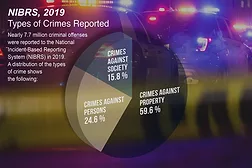
The FBI released detailed data on nearly 7.7 million criminal offenses reported via the National Incident-Based Reporting System (NIBRS) in 2019. The Uniform Crime Reporting (UCR) Program’s latest report, NIBRS, 2019, presents data about victims, known offenders, and relationships for offenses reported in 23 categories with 52 offenses. It also presents arrest data for those crimes, as well as 10 additional categories for which only arrest data is collected.
The town of Oxford, Connecticut and its public schools will receive a grant from the U.S. Department of Justice, Community Oriented Policing Services to create a security operations center (SOC) with three personnel monitoring the district's four school campuses.
The Cybersecurity and Infrastructure Security Agency (CISA) issued an Emergency Directive 21-01, in response to a known compromise involving SolarWinds Orion products that are currently being exploited by malicious actors.
Hackers working on behalf a foreign government are believed to be behind a highly sophisticated attack into a range of key government networks, including in the Treasury and Commerce Departments, and other agencies. The hackers had free access to their email systems.
After a successful launch earlier this year, Carnegie Mellon researchers introduced the latest version of the IoT Privacy Assistant, an app and digital infrastructure that enables users to discover IoT devices nearby, learn about the data they collect and any controls they might possibly give, such as opting in or out of their data collection and use practices.
In a joint plea to Congressional leadership and Treasury Secretary Steven Munchin this week, the American Association of Port Authorities (AAPA) — the unified and collective voice of America’s seaports — and a host of other maritime transportation entities, asked that $3.5 billion in COVID-19 relief funding be made available for the U.S. maritime transportation sector, citing “significant hardships” and “unique and unexpected challenges” posed by the COVID-19 pandemic.
The prototype serves as an educational resource available at no cost for enterprise security leaders evaluating how to deploy the latest technology and design to affordably upgrade their existing workplaces for enhanced safety and collaboration. The Workplace 2030 initiative also includes a free online resource center with epidemiologically-reviewed academic data sources and original content from expert advisors.
 RSS