A new national survey from the Center for Data Innovation finds that just one in four Americans (26 percent) want government to strictly limit the technology, and that support drops to fewer than one in five (18 percent) if it would come at the cost of public safety.
Though the manufacturing sector does not attract the sheer volume of total cyberattacks as other areas of the economy, research has shown that coordinated cyber espionage targets manufacturing more than any other sector.
Sen. Mark R. Warner (D-VA) and Committee member Sen. Marco Rubio (R-FL) introduced bipartisan legislation to help combat tech-specific threats to national security posed by foreign actors like China and ensure U.S. technological supremacy by improving interagency coordination across the U.S. government.
The state of Ohio has implemented its Data Protection Act to encourage businesses to voluntarily adopt strong cybersecurity controls to protect consumer data.
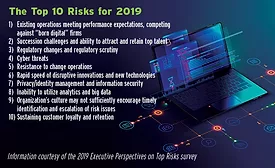
Business leaders around the globe are most concerned about their company to transform its operations and infrastructure to compete with organizations that are “born digital,” according to the 2019 Executive Perspectives on Top Risks survey conducted by Protiviti and North Carolina State University Poole College of Management’s Enterprise Risk Management (ERM) Initiative.
 RSS