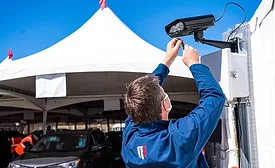
The Council Bluffs Community School District in Iowa has approved an investment in security upgrades across its school system, including video surveillance, access control and intrusion detection.
Is your organization struggling with false alarms? If so, consider artificial intelligence-based video analytics using machine learning technology to spot and virtually eliminate false alarms. But before selecting an advanced analytic software offering, ask yourself these seven questions.
As the light at the end of the tunnel becomes brighter, rethinking the hiring and onboarding process for security talent can be the difference between recovering out-of-work employees, getting them up to speed, and enduring unnecessary difficulties.
The University of Arizona vaccination site is using ALPR technology to help track vehicles into and out of the POD as well as identify issues in distribution and efficiency.
The nonprofit National Center for Missing & Exploited Children (NCMEC) will provide focused training on missing and exploited children, correct reporting, and signs of trafficking to more than 100,000 security officers.
Two common options for surveillance and perimeter protection are visible cameras with near infrared illumination capabilities and thermal imaging cameras—both are optimal for distinct situations. However, optimal lighting isn’t always available or guaranteed, especially when a scenario calls for 24-hour awareness for security applications, including outdoor, remote, or rural locations, or if there is need to see beyond the fence line to identify and react to incoming threats.
Breakthroughs in artificial intelligence (AI) and other digital technology, including faster, more affordable bandwidth, are revolutionizing the ways cities conduct surveillance and provide security. Major cities throughout the U.S. are utilizing turnkey systems that integrate video footage, access management, traffic monitoring and body-worn cameras into central high-speed networks.
Each year, National Missing Children’s Day draws attention to the importance of developing greater protection for vulnerable children. Since more than 40 percent of all infant abductions occur in hospitals, it is crucial for security officers and directors to continue augmenting safety protocols and systems to protect newborns and their parents.
 RSS
RSS