Security Talk
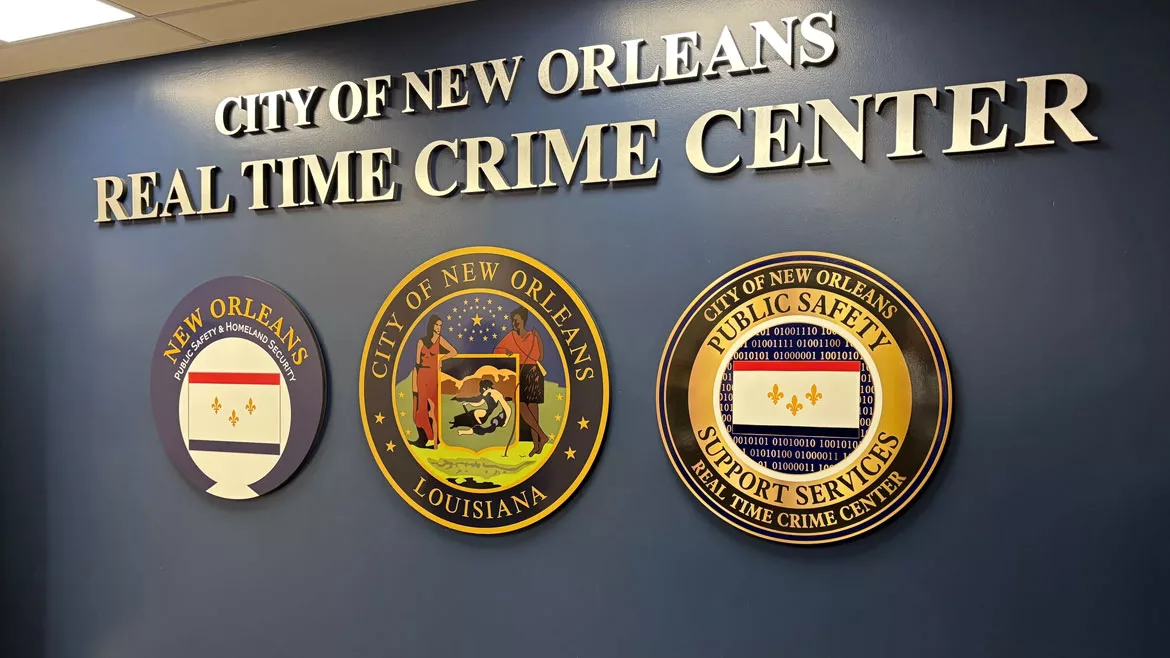
Inside New Orleans’ Real Time Crime Center
Director Ross Bourgeois explains how New Orleans built a 24/7 real time crime center that fuses video, CAD, LPR, and strict governance.
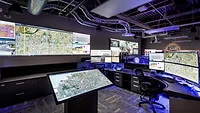
Ross Bourgeois has been with the New Orleans Real-Time Crime Center from the beginning, not only has the director, but also as the first employee.
“I go all the way back to when this was simply a concept,” Bourgeois says during a recent media tour of the facility.

Public Safety Support Services
Real Time Crime Center in City of New Orleans Bio image courtesy of Bourgeois
The 24/7 New Orleans Real-Time Crime Center (RTCC) was created as a part of the 2017 $40 million Citywide Public Safety Improvement Plan and is housed in the New Orleans Office of Homeland Security and Emergency Preparedness. Bourgeois recalls stepping into the role in May 2017, with the RTCC opening in November of that year after extensive renovations to the building – which had stood vacant since 2005. The facility became a full-time 24-hour operation in February 2018.
The RTCC leverages technology to provide critical information to first responders in the field and assist with investigations of criminal activity or quality of life concerns. In 2019, the Crime Center fielded over 5,000 requests for assistance from public safety agencies, provided relevant footage for over 70% of requests, and saved an estimated 6,500 NOPD manpower hours.
“We utilize a host of different technologies to make our law enforcement and public safety partners, more efficient and more effective,” Bourgeois says. “Success to us is efficiency and effectiveness… how we measure our success is primarily through hours saved. The total number of hours saved is an impressive number, north of 50,000 since we opened.”
Throughout the city of New Orleans, the RTCC is responsible for more than 1,500 cameras and an equal number the RTCC has access to that are federated into their system. Keeping watch of nearly 3,000 cameras can be a challenge for any team, however Bourgeois says his team of four to five individuals are able to do so efficiently and effectively utilizing software that alerts them to which cameras to watch based on the incidents that are being called in to the 911 center.
“If you imagine that our video management system is one island, and the computer aided dispatch over the 911 center is another island, we have a piece of software that serves as the bridge between them,” he says.
Being able to quickly have “eyes” on the scene can make all the difference during an emergency situation, Bourgeois says.
“We're here when seconds count and when moments matter,” he says.
Bourgeois says New Orleans is facing many of the same challenges as other municipalities and organizations, including recruitment and retention and the RTCC is helping to fill in the gaps as well as be another tool in the law enforcement tool belt.
“At the end of the day, New Orleans is unique in a lot of things, but we're not unique in terms of suffering, just like every other major city police department in America, we're seeing recruitment and retention woes,” he says. “So, we leverage technology in order to make the ones we do have more efficient and more effective. We have to be that artificial force multiplier.”
Looking for a reprint of this article?
From high-res PDFs to custom plaques, order your copy today!