Mission 500 will host a golf tournament this fall. Proceeds raised at the event will benefit the New York Firefighters Burn Center Foundation Children’s Camp
Risk Based Security's Q1 2020 Vulnerability report, for the first time in years, saw a decline in the quantity of vulnerabilities being reported. However, the latest trends indicate we may be back on track to see the same amount of vulnerabilities, or even more, than last year. Why might this be the case? One possible reason: the Vulnerability Fujiwhara Effect.
A developer error caused the leak of 150,000 to 200,000 patient health records stored in productivity apps from Microsoft and Google that were recently found on GitHub.
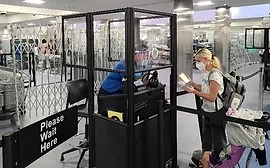
The Transportation Security Administration (TSA) has completed installation of new acrylic barriers at security checkpoints throughout Chicago O’Hare International Airport (ORD) in the agency’s ongoing efforts to contain the spread of COVID-19.
New York Mayor Bill de Blasio and Schools Chancellor Richard Carranza announced a multi-pronged approach to addressing, monitoring, and reporting air quality and ventilation in every building by the first day of school.
The Center for Internet Security, Inc. (CIS®) released its Community Defense Model (CDM). The model shows that the CIS Controls® (Controls) – a prioritized and prescriptive set of safeguards that mitigate the most common cyberattacks against systems and networks – mitigate approximately 83 percent of all attack techniques found in the MITRE ATT&CK Framework.
Miami Dade College has launched its new, state-of-the-art Cybersecurity Center of the Americas, a facility designed to mimic what a Security Operations Center (SOC) looks and feels like.
New Digital Shadows research provides a breakdown of the traffic data behind the top cybercriminal forums and how they square up against each other. The research was inspired by a June 2020 post on the English-language cybercriminal carding forum Altenen announcing a “big victory” for the site in terms of its website traffic rank statistics. This piqued the interest of the Digital Shadows research team who compared how the statistics aligned with their pre-existing perceptions of these sites, whether they show any trends they were previously unaware of, and if there was anything that would indicate deceptive tactics behind these numbers.
The Cybersecurity and Infrastructure Security Agency (CISA), the Department of the Treasury (Treasury), the Federal Bureau of Investigation (FBI) and U.S. Cyber Command (USCYBERCOM) are issuing a joint technical alert about an ongoing automated teller machine (ATM) cash-out scheme by North Korean government cyber actors – referred to by the U.S. government as “FASTCash 2.0: North Korea's BeagleBoyz Robbing Banks.”
The unfolding COVID-19 crisis has been the most significant test of the world’s internet infrastructure to date. With employers and schools moving to remote environments, the expectation was that the expanded use of Software-as-a-Service (SaaS) tools like video conferencing would lead to crippling levels of web traffic. On top of that, experts anticipated the increase in internet use would prompt a corresponding rise in network attacks from cybercriminals. Many in the industry were concerned that the internet would not be able to sustain these unseen levels of duress.
 RSS
RSS