Skyfire Consulting, a public safety UAS consulting group, announced the appointment of Michael Briant as Chief Security Officer (CSO) and Michael Rogers as Director of Public Safety. Both will team up and bring their experience to the Skyfire Academy, as they lead a robust training programs in the industry.
The Cybersecurity and Infrastructure Security Agency (CISA) and the Department of Defense (DOD) Cyber National Mission Force (CNMF) have identified a malware variant — referred to as SLOTHFULMEDIA — used by a sophisticated cyber actor. In addition, U.S. Cyber Command has released the malware sample to the malware aggregation tool and repository, VirusTotal.
The U.S. Department of Commerce’s National Institute of Standards and Technology (NIST) has launched a crowdsourcing challenge to spur new methods to ensure that important public safety data sets can be de-identified to protect individual privacy. The Differential Privacy Temporal Map Challenge includes a series of contests that will award a total of up to $276,000 for differential privacy solutions for complex data sets that include information on both time and location.
Charles Burns, head of global security and engagement at Uber, opened day two of ISC West with a keynote titled, “How Uber is Scaling Enterprise Risk Management at the Speed of Global Transportation.”
Brigham Young University (BYU) announced the formation of the new BYU Security Department, which will function separately from and alongside the BYU Police Department. The BYU Security Department will oversee on-campus security for buildings, such as the Museum of Art and the Harold B. Lee Library, as well as campus properties, such as the Motion Picture Studio and West Campus (former Provo High School). The department will also have responsibility for campus parking.
The Cybersecurity and Infrastructure Security Agency (CISA) joined with public and private-sector partners to conduct an interagency Tabletop Exercise (TTX) called “National Harbor 2020 – Recovery Phase Exercise,” September 29 – 30, to test the processes and plans required by regional government and business partners following a notional catastrophic incident at National Harbor outside of Washington, D.C.
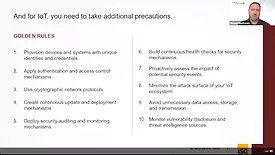
According to new data released by Cybersecurity Insiders, 72% of organizations experienced an increase in endpoint and IoT security incidents in the last year, while 56% anticipate their organization will likely be compromised due to an endpoint or IoT-originated attack with the next 12 months.
Why is having a cybersecurity framework so important? When it comes to cybersecurity, a framework serves as a system of standards, guidelines, and best practices to manage risks that arise in a digital world. A cybersecurity framework prioritizes a flexible, repeatable and cost-effective approach to promote the protection and resilience of your business; it’s also important to realize that cybersecurity helps with the growth of your business.
As with any new disruptive innovation, we must strive to strike a balance between risk and reward. While it’s exciting to ponder the possibilities of a world powered by 5G and an constellation of connected things, we must first establish a secure foundation to support these innovations. A software-based, Zero Trust security framework represents our best chance at securing the Edge from the connected things of tomorrow.
 RSS
RSS