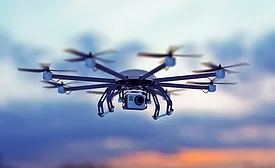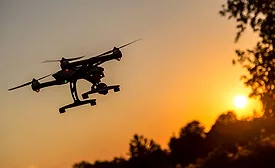
It’s a scenario that isn’t hard for security professionals to imagine: Someone spots a drone hovering inside your secure facility’s perimeter, over your event, or during your emergency response operation. The drone’s presence is at best a nuisance, and at worst, might damage people or property, or interfere with your principle mission. What options do you have?
As part of a multi-institution Federal Aviation Administration (FAA) study focused on unmanned aerial systems, researchers at The Ohio State University are helping quantify the dangers associated with drones sharing airspace with planes.
The contract security industry continues to boom in the U.S. and worldwide, although security officers are finding an increasing number of technological devices patrolling alongside them.
Commercial use of drones for tasks like surveillance and aerial photography/videography creates business efficiencies and new opportunities, but it’s important to understand drones’ inherent security risks and their potential impact on a company.
Researchers at Virginia Tech have found that small consumer drones are unlikely to cause severe head injuries if they fall out of the sky and strike people.
There are a number of legislative committees and groups working on counter drone legislation, evaluating existing technology and supporting the development of new technology. Here are some of the major highlights in counter drone research and legislation since the early 2000s.
Drones are beginning to populate the skies: Recent estimates suggest that this year’s global drone market will reach nearly three million units with tens of billions of dollars in revenue