Business-tech Twofer: Demystifying Fiber, Wireless
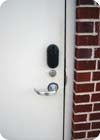
Access readers are doors can communicate wirelessly at historic buildings or where hardwiring would not work or would be more costly.
Sometimes, stubborn problems require innovative solutions.
For Kelly Hall, video systems manager at the Las Vegas Hilton Hotel and Resort, the problem was distance. While he describes the hotel/casino as “pretty small” by Las Vegas standards, there are still three separate gaming areas, plus the hotel, both of which employ about 2,500 employees.
Obviously a casino relies heavily on security video. But in Hall’s case, there were a couple of areas in the building that would require cabling of around 1,000 feet. “If we tried to run video over that length, we would have to use multiple amplifiers, ground loop isolators and high frequency compensators, just to get it back to the surveillance room and look halfway normal,” Hall says. Not only would that be cost-prohibitive, but the quality just wouldn’t be there.
The Parker Fire Protection District in Parker, Colo., and the University at Albany, N.Y., had different challenges. In both cases, they needed to expand their existing access control, but the design of their facilities and buildings did not allow for easy wiring of new doors.
“The biggest issue for us was access to the doors,” says Robert Krause, director of technology for Parker Fire Protection District. “Physically trying to get cable pulled to those doors was nearly impossible. It could be done -- for a cost. But it was an old building with a lot of concrete and brick. It wasn’t going to be an easy task.”
Similarly, the university was facing the same problem on its main campus, built in the 1960s. “We are a large, cement structure built when we didn’t have wiring issues,” says Ryan Webb, systems administrator, SUNYCard, University Auxiliary Services at the University at Albany. “To go back and retrofit and do wiring would be extremely expensive. Pulling the wiring would be very, very expensive.”
FIBER OPTICS FOR VIDEO
In Hall’s case, the answer was to use fiber optics. “We looked at the cost of all this equipment, and compared it to the cost and quality of fiber and we went with the fiber install,” he says.Fiber optics is an increasingly workable option in situations like these, says distributor Tim Holloway, vice president of technology for security solutions, Anixter, Glenview, Ill. “Fiber optics is used to extend the distance between camera and recording or encoding device,” he says.
This transmission mode works because the fiber doesn’t actually conduct electricity, but light, explains Jeremy Barndt, low voltage designer, JBA Consulting Engineers, Las Vegas, Nev.
While fiber has been around for a long while, in the past few years, it has become a more viable and cost-effective option for video transmission, although it is still more costly than standard copper cables for everyday applications.
“Fiber is being much better received lately,” says distributor Paul Koebbe, national market manager, security, Graybar, St. Louis, Mo. “It was considered to be the choice of last resort for some period of time because of the cost. But prices are coming down now, making it more viable.”
Another development enhancing the acceptance of fiber optics is the rise of IP video.
Some IT networks already use fiber, so as video systems move more into that environment, they will either be sharing that network (and therefore using fiber) or developing their own network.
“If a client really wants to do 100 percent IP cameras, they are limited to 300 feet (with copper),” Barndt says. “That means you have to put a network switch within 300 feet of your camera. In that case, if you go to a fiber solution and extend the distance of the cameras, fiber becomes much more cost effective.”
Koebbe agrees. “Absolutely fiber will be used more as IP cameras come in. Should people choose to deploy a separate network for IP security, they should seriously consider fiber to overcome the distance limitations of copper.”
FIBER BENEFITS
For Hall, the advantages of using fiber optics were many.“With fiber there are no ground loop problems,” he says. “What that means is when you are trying to send a video signal from one area of the building to another, these two areas are fed from different power sources. When this difference is applied to video you get what is called hum, a visual problem that interferes with the picture. The fiber, because it is not conductive, doesn’t pass this hum so that problem completely goes away.”
The quality of the video was the main advantage, Hall says. “It was a little more expensive to install, but it was well worth the quality. Basically we have not had to touch it in the four to five years it has been in.”
Hall plans to expand the casino’s use of fiber in the future. “We do have a couple of upcoming projects that we are definitely going to use the fiber on. One project is a parking garage that is well over 2,000 feet. Right now we are using coax that was installed a long time ago. The quality is really bad, so we want to replace that with fiber.”

There are literally millions of miles of unused fiber already installed in building campuses across the United States. Check out availability.
WIRELESS ACCESS CONTROL
For both the fire department and university, the solution they chose was to use wireless access control – an increasingly popular option in tough access situations.“Wireless access control means there is no physical connection between the head end and the point of control,” Barndt says. “We are just now starting to see it within the last year become a viable product.”
For the right application, wireless access control can be a perfect solution to an extremely challenging (and common) problem.
“The main benefit is I don’t have to run cable and conduit back to my head end,” Barndt says. “It’s a cost savings issue. It makes retrofits very easy. All I have to do is get it into wireless access range. The expense has gone way down.”
The typical wireless access system involves a reader at the door that is battery operated. It communicates wirelessly with a receiving device that is located in an easy-to-wire location.
“Ease of installation is the chief benefit,” Holloway says. “Pulling cables, getting cables from panels to doors can be a pain. You have to tear up walls, get up in the ceiling. It’s expensive, so it can be a lot easier to communicate wirelessly.”
Koebbe agrees. “The amount of time you spend installing is significantly reduced. There are usually four to five devices at a door that require wiring back to the panel. A door is typically a very unfriendly wiring environment. It is not unusual to see four to eight hours per door for an install. With wireless, the time installing at the door is 45 minutes to an hour. It doesn’t require a change in door prep.
“The thing I think motivates wireless access is the ability to deploy it quickly and cost effectively.”
WIRELESS FIT
For Krause, going wireless was just the right solution.“We’re kind of tech savvy to the wireless solution already because we run our entire infrastructure via wireless,” he says.
“We have been doing that for about three years now.”
And with the system they chose, they were able to use a software program to communicate seamlessly with an existing HID hardwired system. “That was one reason we went with it, because it was compatible and we didn’t need a separate interface to control that hardware,” he says. “We manage it all through the same system. It tells use when a battery is low in a door. There is no difference in use between our hardwired and wireless locks.”
Webb found wireless to be the perfect fit for expansion plans.
“When I came here in 2003, there were 350 doors with access control. The campus wanted to expand. Wireless provided that opportunity. We’ve added a lot of classroom doors because the wireless fit that application. On an interior door, you don’t have wire molds and power sources. These fit nicely.”
Like the fire department, the university also had an existing hardwired system they had installed in the mid-1990s. They, too, were able to use both to create a single, integrated card access system using both wireless and hardwired technology.
“We added the wireless readers in 2004, and so far they have really met the need,” she says. “They have done very well. Sometimes we have to stop ourselves from adding too many doors.”
SIDEBAR: Key Reasons for Using Fiber Optics
- Distance – Fiber versus Coax. In security video applications, copper coax can carry video signals a limited number of feet without amplification, whereas the same signals can be transmitted tens of miles on a fiber optic strand.
- Immunity to EMI and RFI. Because the signals in fiber optics are light waves, they are immune to interference that can distort electrical signals. As such, fiber optic systems can provide the highest picture quality over long distances, retaining quality images for DVR storage. This assumes, of course, that the picture quality was acceptable before it was transmitted on the fiber; optical transmitters will not improve a poor input signal.
- Security of Signal. Where it is fairly easy to tap or intercept electrical communications in copper cables, due to the magnetic field generated by electron movement, fiber optics is a much more secure communications link. This is increasingly important in applications where secured video, data and voice are stressed.
SIDEBAR: Turn the Dark into Light
It makes sense to consider fiber for security video, access control and security communications, according to Ed Miskovic of Meridian Technologies.The executive sees value in fiber at numerous applications where multi-functionality or higher security (nuclear plants, for example) is a must. In retrofit situations, Miskovic urges chief security officers to see if their facilities have what is called “dark fiber.” Many buildings installed fiber during construction that was not originally used. In that case, there may be unused infrastructure over which security solutions can run. “Check with your IT department or the facility manager,” adds Miskovic.
Firms such as Meridian offer single or multiple video channels with pan, tilt and zoom functions using only a single fiber, for instance. Such technology is used in conjunction with access control systems to monitor perimeter intrusion and detection, access control, alarm points or biometrics using fiber as a backbone. Laser-based systems are used for transmission of signals. In support of the Homeland Security initiative program, Meridian is an active member of the GSA task force with its products on the official GSA schedule.
SIDEBAR: The “Pull” of Wireless Access
The business bottom line – there is no pull, that is, the chief security officer or facility manager doesn’t have to pay for an integrator or installer to pull wires for access readers and devices.There is a promising wireless future, but opinions vary on whether the technology is only suitable for niche applications or ready for use throughout an access control system.
Pulling wire is one of the most labor-intensive activities of a security system installation. With the growing use of access control systems in facilities, secure ways of avoiding that expense should be welcomed by customers.
Besides not having to pull wires, wireless access control systems can be advantageous for retrofitting in existing buildings where wiring installation might be difficult, such as concrete block or historic buildings, and for connecting to remote locations such as guard houses or gates and other buildings.
Looking for a reprint of this article?
From high-res PDFs to custom plaques, order your copy today!