Seven Steps to Save Lives & Protect Property
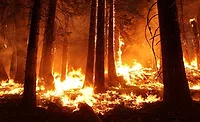
The Station Nightclub fire in West Warwick, R.I., which took 99 lives and resulted in more than 150 injuries, is just one example of the roughly 500,000 structure fires that take place each year, according to the National Fire Protection Association (NFPA).
The Fire Equipment Manufacturers' Association (FEMA) has put together these Seven Simple Steps to Life Safety.
1 Know the codes
“Codes and standards are bare minimum requirements for buildings,” said Mike Laderoute, FEMA’s Code Consultant. “Meeting the codes does not mean that building owners are doing enough. Good life safety planning relies upon creating a program where building owners are doing more than what is asked of them – especially when people’s lives are at stake.”Fire protection equipment is legislated by city, state and federal laws, many of them directly adopted or adapted from model code-making organizations, such as the International Code Council (ICC) and the NFPA. Building owners and facilities managers must comply with the fire codes of their area; however, considering the history of fires and the potential severity of future ones, they may want to evaluate their fire protection plan and exceed the requirements of local codes for added protection.
Who is responsible for a building’s life safety plan and following the codes? Good life safety planning typically is the role of a building owner, business manager or security/facilities manager. These individuals should be providing their occupants with the highest level of safety and security possible.
2 Assess the Building
Security must know and understand the functions of their buildings. When designing an effective life safety plan, it is important to consider what type of building it is, what it is used for, and how it was built. Here are some important questions to ask:What types of people come into this building? Are people with respiratory concerns housed here? Are there elderly, handicapped, or children on the premises?
Does it include an operating room or other care unit that has an oxygen-enriched environment?
Does the building contain flammable or combustible materials?
Does the building contain telecommunications, data centers, or other storage rooms?
Does it have commercial cooking appliances in a kitchen or eating area?
Is the building constructed with a steel or wood frame?
How many floors does it have? Does it have a basement with laundry or other large pieces of equipment?
All these questions are critical in determining the necessary components of a building’s life safety plan. For example, a commercial kitchen will require a pre-engineered suppression system over the cooking appliance whereas a health care facility will require a specific type of portable fire extinguisher.
“There are many different hazards associated with different types of buildings or occupancies,” said Laderoute. “Every work area, every piece of equipment involved, and every individual – whether it be elderly occupants or children – needs to be considered when planning for life safety.”
A life safety plan should address the various fire scenarios that could occur in a facility. For example, the commercial kitchen of a hotel will have a specific life safety plan to address a cooking fire versus a wastebasket fire that may occur in a guest room.
3 Portable fire extinguishers
The first step is to check “NFPA 10,” which is the standard for portable fire extinguishers. NFPA 10 mandates the type, size, placement and number of extinguishers required for a building. The code requires the minimum number of extinguishers. Security should take a good assessment of their buildings and the hazards involved, and consider exceeding these requirements to create a good, solid life safety plan.Statistics show that 94 percent of the times a portable fire extinguisher is used, it puts out the fire – typically within the initial two minutes.
In addition, extinguishers are cost-effective. In commercial occupancies, the current cost for portable fire extinguishers is less than one cent per square foot.
When it comes to fire extinguishers, maintenance is critical. The pressure gauge should be monitored to ensure that the extinguisher is pressurized and the extinguisher should be checked regularly for cracks, leaks or vandalism. NFPA 10 provides guidelines for regular inspection and maintenance of portable fire extinguishers and manufacturers can offer additional product information, if needed.
4 Standpipe fire hose stations
A life safety plan should include on-site, defend-in-place fire protection equipment designed to protect individuals against initial developing fires. In addition to portable fire extinguishers, standpipe fire hose stations are designed exactly for that purpose and could be a key component in a life safety plan.Comprised of a fire hose, rack and nozzle, and typically secured on the wall in hallways and stairwells, a standpipe station works to allow a fast response to fire before the fire has time to spread – once the fire department has been called and everyone is safe. This equipment is needed in buildings, such as offices, dormitories, schools, airports, hotels, hospitals and anywhere else where fire department response time may exceed five minutes. NFPA 14-2003 Ed. (3.3.23) says the standpipe system is "...for the purpose of extinguishing a fire, thereby protecting a building or structure and its contents, in addition to protecting its occupants.”
“Know the type of standpipe fire hose station that is right for your building,” said Laderoute. “The three classes of standpipe systems are all equally important and designed for a specific purpose and trained individual. Classes 2 and 3 are best for occupant use, and Class 1 is necessary for the fire department to provide heavy water streams.“
5 Fire suppression systems
A pre-engineered fire suppression system is mandated by NFPA standards in special hazard situations, which can involve restaurants and industrial areas. Fire suppression systems provide fast, on-site protection at the earliest stage of a fire.Since fire suppression systems activate automatically, their operation is safe for all employees and do not require human intervention. However, they can be manually activated if needed in an emergency.
Designed to NFPA and Underwriters Laboratories Inc. (UL) standards, fire suppression systems are pre-tested to effectively extinguish specific types of fires in special hazard situations.
6 Evacuation Plan
Exit signage and emergency communications are important components of escape planning. Every building should have well lit and visibly placed signs to indicate where exits are located, and building occupants should practice escape planning regularly – from knowing where the primary and secondary exits are located to learning how to crawl on the floor to avoid toxic smoke.
According to the NFPA, some important things to remember include: practicing the evacuation and using the stairs, staying low to the ground to avoid smoke, staying by a window to protect yourself from smoke, and signaling to firefighters with a light or colored cloth so they know where you are located. More information on this topic can be found at www.nfpa.org.

7 Training and education
Training is critical, according to industry experts. Key personnel must be properly trained according to their specified responsibilities and all training documentation must be kept on file within the human resources department of each business. While fire protection training is a key component of a life safety plan, other training should also be included, such as CPR and first aid, which can often go hand-in-hand with fire protection preparedness.There are several ways to go about education and training for building occupants and security. One is to host in-house safety seminars by manufacturers for engineers and security to educate occupants on exactly what should be done on a daily basis. Another option is to bring in the local fire department for hands-on fire extinguisher training or evacuation plan safety tips.
If a company or facility cannot dedicate the time or resources to holding an event, there are numerous sites online where education and training can be found. For fire extinguisher training, visit www.fireextinguisher.com and for an overview of standpipe fire hose operation and procedures check out www.rackhosetraining.com.
Suppression system information can be located on the FEMA website at www.femalifesafety.org. And www.nfpa.org includes an abundance of fire safety materials that could be helpful in training employees or designing a life safety plan. Other useful materials that should be used to educate tenants and occupants about balanced fire protection include evacuation maps, floor monitors and after-hours contact information.
Sidebar: Tech Solutions: Emergency Lighting and Guard Tour
A variety of technologies can assist in providing solid facility security and life safety, ranging from guard tour systems to audit maintenance of fire extinguishers and standpipe stations as well as new emergency lighting in case of loss of electricity.A guard tour example is the Proxiguard Guard Tour Management System from ProxiGuard USA (Security Trend Corp., Miami, Fla.). It works on Windows-based PCs for the processing, verification, display and printout of guard tour data obtained from guard tour readers. Routes can be easily setup using a graphical design and can include fire extinguishers, standpipe stations and other life safety needs. More information at www.proxiguard.com.
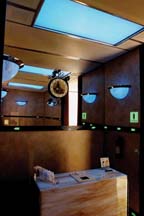
There are new products beyond typical emergency lighting in stairwells. An innovative example comes from Acrilex, Inc., of Jersey City, N.J. Its Acriglo provides illumination without a back-up power source. Acriglo is charged completely by the luminosity from the normal operation of a light. The glow emitted from a fixture with Acriglo lasts several hours, while providing a lighting capacity equivalent to that of moonlight. In addition, Acriglo can be charged and discharged indefinitely, without any degradation to the acrylic. More information at www.acrilex.com.
Looking for a reprint of this article?
From high-res PDFs to custom plaques, order your copy today!