Web Exclusive -- NCS4
Returning to Constant Vigilance in Event Security
Is security still as vigilant as it needs to be? Has it relaxed too much after 9/11? At the annual convention for the National Center for Spectator Sport Safety and Security (NCS4), these and many more questions were posed of speakers and attendees alike.
“Terrorists are still here. At Fort Dix, they studied their target – when the pizza delivery vehicles came up, the guards at the front gate waved them right through,” says Gordon Graham, of Graham Research Consultants. “Did we wave them through on September 12, 2001?
“No, we did not – we were vigilant. We’ve got to bring back the vigilance,” he says during a keynote speech at the 2012 National Sports Safety and Security Convention and Exhibition in New Orleans. We could learn a lesson from our friends in Israel – We’ve got to bring back the vigilance.”
For an example, we turn to Doug Thornton, Senior Vice President, Stadiums and Arenas at the Superdome Management Group, at the Mercedes-Benz Superdome for a refresher on how security changed after the September 11 terrorist attacks.
The Superdome hosted the first post-9/11 Super Bowl only months after the attacks, and government officials were worried. The threat of terrorism at this inherently American event – which could be easily argued as symbolic of our national culture – was high, and the design of the Superdome itself was called into question as a security risk.
During a tour around the Superdome following the NCS4 awards dinner, Thornton gave the group access to a variety of areas – showing us the security control room, the Saints locker room (“A whole lot bigger than the visiting team’s room,” he remarks with a little grin), and the fan rooms. No, not Saints fans – huge air circulators that pull air away from the first level and push it up through the multiple levels of seats.
Adding security officers, metal detectors and bomb-sniffing dogs was one thing – this posed a threat that concerned the Department of Homeland Security greatly. The idea was: if one person, just one, slipped back into the lower concourse and threw a lipstick-sized bottle of a bio-hazardous material, such as anthrax, into the fan room, the material would immediately be pushed up and distributed into the entire dome, contaminating the entire event.
The shape of the Superdome itself – an enclosed space with a single air circulation system – was revolutionary, but it also came with its share of problems. While sports fans don’t have to worry about rain ruining the game, there is nowhere for a biological agent like anthrax to go except throughout the arena.
The DHS agents felt so concerned on this point that they considered moving the Super Bowl elsewhere. Thornton and his team had to come up with a plan.
They could have poured resources into surveillance around the fan rooms, but that would only detect after someone had already tossed the object in. Placing a guard at the gate to the room could be a more effective deterrent, but that’s also expensive.
Instead, Thornton moved to hire someone from the local university to come in and swab the air filters for toxins and contaminants every week – checking carefully for any sign of foul play – while the room was monitored closely. No anthrax was ever found.
Is that the kind of vigilance that modern event security requires?
But what about today? When it gets close to kick-off time at football games, do security screeners at entrances maintain the same level of investigation or do they begin to wave people through with a cursory glance and a hurried “you’re good?”
What about the canvas bag that was stashed for three weeks under a guard desk in a Detroit government building after a security officer didn’t screen it effectively or view it as suspicious, even though it did in fact carry a bomb?
What about the three activists who cut through wire fencing around the Y-12 National Security Complex – the facility holding the U.S.’s primary supply of enriched uranium?
“I don’t care how many times you do a high-risk task,” says Graham, “Every time you do it is as risky as the first time. The level of risk never changes – the acclamation to risk does change. As soon as security operations become routine, you have a problem.”
But the week of the conference, one far from routine event had the attendees buzzing – 90,000 Jews packed into MetLife Stadium in New Jersey to read the final page of the Talmud together, after seven and a half years of reading one double-sided page a day.
The event – Siyum Hashas – held August 1, was billed as the largest celebration of shared Jewish learning in history by NewJersey.com, and the celebrants, mostly Orthodox Jews from across the U.S. and beyond, read aloud portions of the 2,711th page of the biblical commentary that, written over centuries, serves as a guide to spirituality and practical life.
Danny DeLorenzi, Director of Security for MetLife Stadium (formerly New Meadowlands Stadium), had to coordinate the massive, interdepartmental effort that overtook the stadium for this event.
“We were facing challenges with sheer numbers,” he says. “Plus we faced significant homeland security concerns toward the Jewish and Israeli peoples. We were looking closely at the weather (there were reports of thunderstorms), so we were on the phone with a meteorologist every 30 minutes. We were in a heat wave – with a row of 90+ degree days, so we were staffed to deal with hundreds of medical patients,” he adds.
“This was like a pilgrimage – people were coming no matter what, so we had to be ready.”
Security at MetLife Stadium was as tight as it would be for the Super Bowl – good practice for 2014, DeLorenzi says – and 71 different agencies, including the FBI and DHS, were involved with securing the facility.
“We were hosting the top 1,000 rabbis in the world,” he says, “There was a need for a unified effort, and we rose to the occasion.”
Four days before the event, the building was locked down – K-9 sweeps were held in every space, no one was allowed inside without being searched and all bags were screened.
Indeed, 70 additional police dogs were called in from agencies across New Jersey and New York, and every vehicle coming onto the premises was searched. The airspace around the stadium was a designated no-fly zone. The Attorney General and the colonel for the state police were both in attendance. Postal police screened every piece of mail onsite for the whole week.
Almost 500 buses drove onto the premises, carrying children from upstate summer camps and groups from various parts of the country – every one of them had to be screened.
DeLorenzi reported that everything was carried off smoothly, and indeed the celebrants celebrated the end of their journey with song and dance as tens of thousands of others watched the event via satellite from 15 other countries.
Is this the level of vigilance required now? As Graham says, it is the high-risk, low-frequency events – such as ones that happen every seven years – that bring the most chances for error, but with extensive training and forethought, one can develop vigilance.
“Things that go wrong in life are predictable,” Graham says. “And predictable is preventable – you just have to pay attention.”
|
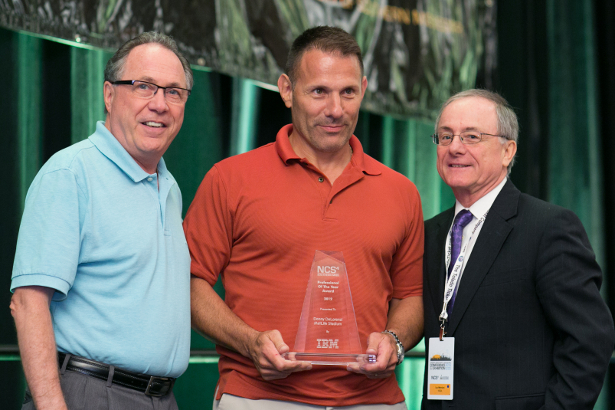
| DeLorenzi (center) accepts his award for Professional of the Year at the 2012 NCS4 conference in New Orleans. Also pictured: Lou Marciani (right), director of NCS4, and Bill Squires, owner of The Right Stuff Consultants and former president of the Stadium Managers Association. |
Photos courtesy of Chris Williams/Chris Pike/Zoeica Images New Orleans