Security Magazine logo
search
cart
facebook twitter linkedin youtube
  • Sign In
  • Create Account
  • Sign Out
  • My Account
Security Magazine logo
  • NEWS
    • Security Newswire
    • Technologies & Solutions
  • MANAGEMENT
    • Leadership Management
    • Enterprise Services
    • Security Education & Training
    • Logical Security
    • Security & Business Resilience
    • Profiles in Excellence
  • PHYSICAL
    • Access Management
    • Fire & Life Safety
    • Identity Management
    • Physical Security
    • Video Surveillance
    • Case Studies (Physical)
  • CYBER
    • Cybersecurity News
    • More
  • BLOG
  • COLUMNS
    • Career Intelligence
    • Cyber Tactics
    • Cybersecurity Education & Training
    • Leadership & Management
    • Security Talk
  • EXCLUSIVES
    • Annual Guarding Report
    • Most Influential People in Security
    • The Security Benchmark Report
    • Top Guard and Security Officer Companies
    • Top Cybersecurity Leaders
    • Women in Security
  • SECTORS
    • Arenas / Stadiums / Leagues / Entertainment
    • Banking/Finance/Insurance
    • Construction, Real Estate, Property Management
    • Education: K-12
    • Education: University
    • Government: Federal, State and Local
    • Hospitality & Casinos
    • Hospitals & Medical Centers
    • Infrastructure:Electric,Gas & Water
    • Ports: Sea, Land, & Air
    • Retail/Restaurants/Convenience
    • Transportation/Logistics/Supply Chain/Distribution/ Warehousing
  • EVENTS
    • Industry Events
    • Webinars
    • Solutions by Sector
    • Security 500 Conference
  • MEDIA
    • Interactive Spotlight
    • Photo Galleries
    • Podcasts
    • Polls
    • Videos
      • Cybersecurity & Geopolitical Discussion
      • Ask Me Anything (AMA) Series
  • MORE
    • Call for Entries
    • Classifieds & Job Listings
    • Newsletter
    • Sponsor Insights
    • Store
    • White Papers
  • EMAG
    • eMagazine
    • This Month's Content
    • Advertise
  • SIGN UP!

Post-Sept. 11th, Security Re-evaluates; Expects Impact Through 2002
By Bill Zalud
January 3, 2002
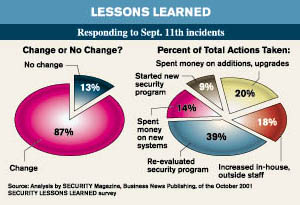
Nearly nine in ten security executives say they have taken some action in the aftermath of the September 11 tragedy.
While high profile incidents often impact security operations, the tragic September 11th terrorist attacks will prove enormously influential, according to a mid-October survey of security directors and managers at a diversity of U.S. and worldwide organizations. And the fallout will last a longer time than other incidents in the past, including the 1993 bombing of the World Trade Center, which itself lead to billions of dollars of spending for security equipment and services.

Most Operations Took Action

The exclusive SECURITY Magazine survey, conducted through the Web, found that almost nine in ten (87 percent) of security departments have taken action to re-evaluate their operation, upgrade or buy new systems, increase staff or start a new program.

And almost as many security executives (85 percent) say the tragic incidents will continue to influence their security operations as well as their business through 2002.

To match such an enormous reaction by private security, and the need for information on which to make better decisions, SECURITY Magazine has committed significant editorial space to a series, LESSONS LEARNED - Securing America, composed of articles on technologies and applications, expert commentary, research and white papers - all related to re-evaluating security after September 11th. The series will run through September 2002.
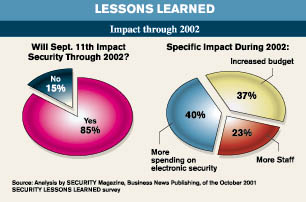
A vast majority of security executives believe that their organizations will be impacted by September 11th throughout 2002. Most expect larger budgets and more spending on gear.

Re-evaluating Security

Many operations have taken a diversity of actions. The most common: a full-fledged re-evaluation of security programs. About 39 percent of those security executives who say that have taken some type of action report they have are in the process of re-evaluating their security program. Such a re-evaluation could lead to actions now and through 2002. One of five say they have spent money of security upgrades and additions to current technology, while a little less (18 percent of those taking some type of action) say they have increased their in-house or outside security staffs.

A respectable 14 percent have purchased a new security system and about nine percent say they have started a new, major security program.

When it comes to the impact of September 11th on security operations throughout 2002, of the 87 percent of respondents who say they will continue to see an impact, 40 percent believe it will translate into more spending on electronic security.

A little more than one in three (37 percent) report they will see an increase in their budgets beyond the typical while 23 percent say they will see even more staff hired or contracted.

The SECURITY Magazine LESSONS LEARNED survey also asked security executives to identify the one greatest risk the organization faces that's related to the September 11th tragedy and its aftermath.

Results show that security execs continue to be concerned about people and facilities. The top two risks? Facility security, say 33 percent of respondents. And 30 percent pick employee travel. Ironically, only seven percent feel that a terrorist attack of some kind could specifically impact their organization or business. Still 16 percent of SECURITY respondents see the one greatest risk as bioterrorism, thanks to the growing number of incidents and confusion surrounding anthrax threats.

Hidden in the bushes: about 13 percent say the biggest threat is cybercrime.

The survey then turned to solutions by type of security technology.
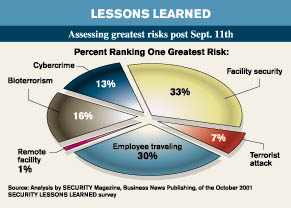
Security executives see the greatest risks to their main facilities and to employees traveling in the aftermath of the September 11th tragedy.

Video, Cards Most Effective

When asked to identify the one type of security technology that will make the greatest difference by private security fighting terrorism, video surveillance turned out to garner the largest support with 24 percent. About 19 percent find electronic card access control systems to make the greatest difference, while emergency communications gear pulled in 15 percent of respondents in support.

Two solutions - biometrics and physical barriers - got about 12 percent each in support while about 4 percent saw bomb and metal detection making a anti-terror difference. In follow-up interviews, SECURITY found the interest in bomb and metal detection may change as corporate mailrooms readjust their operations following the bioterror scare.

There has been a diversity of commentary related to the communications between law enforcement and private-sector security executives during the attacks and in their aftermath. So SECURITY asked if this communications was effective. A surprisingly high 29 percent of respondents report that they feel the communication between law enforcement and private security was not effective.

Share This Story

Looking for a reprint of this article?
From high-res PDFs to custom plaques, order your copy today!


Zalud 2016 200px

Bill was the editor emeritus of Security Magazine, and he can be reached at (773) 929-6859.

Recommended Content

JOIN TODAY
To unlock your recommendations.

Already have an account? Sign In

  • Cyber tech background

    Security’s Top Cybersecurity Leaders 2026

    Security magazine’s Top Cybersecurity Leaders 2026 award...
    Security Leadership and Management
  • Iintegration and use of emerging tools

    Future Proof Your Security Career with AI Skills

    AI’s evolution demands security leaders master...
    Security Leadership and Management
    By: Jerry J. Brennan and Joanne R. Pollock
  • The 2025 Security Benchmark Report

    The 2025 Security Benchmark Report

    The 2025 Security Benchmark Report surveys enterprise...
    The Security Benchmark Report
    By: Rachelle Blair-Frasier
Manage My Account
  • Security Newsletter
  • eMagazine Subscriptions
  • Manage My Preferences
  • Online Registration
  • Mobile App
  • Subscription Customer Service

More Videos

Popular Stories

Man on laptop

Healthcare Executives Face a New Era of Personal Risk

Man walking with briefcase

The Rising Tide of Executive Protection: Corporations Ramp Up Security in an Era of Heightened Threats

Stadium

Physical Security in Global Arenas: How AI Improves Security at Scale

Four people in suits

Mexico Security Crisis: Never Waste a Crisis

Digital Information Protected Secured

Taming the Threat Beast: Building a Threat-Led Cybersecurity Program

SEC 2026 Benchmark Banner

Events

April 21, 2026

The Blind Spot in Enterprise Security: Managing Workforce Risk Post-Hire

Organizations continuously monitor their networks and systems for risk, yet the people with legitimate access are often the least monitored part of the model. Discover a Workforce Risk Intelligence Framework that adds a dedicated layer focused on workforce risk.

April 30, 2026

Building a Campus-Wide Culture of Security and Shared Responsibility

In today’s higher education environment, where institutions face evolving and multifaceted incidents, safety must be embedded into the fabric of campus culture. Learn strategies for generating collective buy-in from faculty, staff, students and senior leadership. 

View All Submit An Event

Products

Security Culture: A How-to Guide for Improving Security Culture and Dealing with People Risk in Your Organisation

Security Culture: A How-to Guide for Improving Security Culture and Dealing with People Risk in Your Organisation

See More Products
SEC 2026 Top Cybersecurity Leaders

Related Articles

  • SEC0918-checks-feature-slide1_900px

    Reducing the Impact of Unmanaged Insider Risk Through Continuous Evaluation

    See More
  • Managers expect health safety and security protocols to remain in place post COVID-19

    Management expects health, safety and security protocols to stay in place after COVID-19

    See More
  • 2002 Industry Forecast Study Security Yin-Yang: Terror Push, Recession Drag

    See More

Related Products

See More Products
  • 9780367259044.jpg

    Understanding Homeland Security: Foundations of Security Policy

  • security culture.webp

    Security Culture: A How-to Guide for Improving Security Culture and Dealing with People Risk in Your Organisation

  • Hospitality Security: Managing Security in Today's Hotel, Lodging, Entertainment, and Tourism Environment

See More Products

Events

View AllSubmit An Event
  • April 21, 2026

    The Blind Spot in Enterprise Security: Managing Workforce Risk Post-Hire

    Organizations continuously monitor their networks and systems for risk, yet the people with legitimate access are often the least monitored part of the model. Discover a Workforce Risk Intelligence Framework that adds a dedicated layer focused on workforce risk.
View AllSubmit An Event
×

Sign-up to receive top management & result-driven techniques in the industry.

Join over 20,000+ industry leaders who receive our premium content.

SIGN UP TODAY!
  • RESOURCES
    • Advertise
    • Contact Us
    • Store
    • Want More
  • SIGN UP TODAY
    • Create Account
    • eMagazine
    • Newsletter
    • Customer Service
    • Manage Preferences
  • SERVICES
    • Marketing Services
    • Reprints
    • Market Research
    • List Rental
    • Survey/Respondent Access
  • STAY CONNECTED
    • LinkedIn
    • Facebook
    • YouTube
    • X (Twitter)
  • PRIVACY
    • PRIVACY POLICY
    • TERMS & CONDITIONS
    • DO NOT SELL MY PERSONAL INFORMATION
    • PRIVACY REQUEST
    • ACCESSIBILITY

Copyright ©2026. All Rights Reserved BNP Media, Inc. and BNP Media II, LLC.

Design, CMS, Hosting & Web Development :: ePublishing