ZALUD REPORT: Homeland Security Bucks Go IT

Enough with the convergence talk already. Except there are things happening out there. Cisco, Sun Microsystems, IBM, Northrop Grumman, among others, are rapidly betting their IT money on the combo of physical and logical security.
The Bush Administration’s also playing both ends.
The President’s fiscal year 2007 (FY07) budget released by the Office of Management and Budget will favor information technology requests in support of the war on terror and homeland security, according to INPUT, the Reston, Va., government business research firm.
The Department of Homeland Security’s IT budget increase is the most significant with an increase of 21 percent to over $4.4 billion. The President’s budget adds $772 million to DHS; it remarkably represents 44 percent of the new money added to federal IT spending overall. Federal agencies plan to spend $64.3 billion on IT in FY07 which represents a 3 percent increase over the FY06 budget. Cybersecurity has also been elevated as a priority area with a budget increase to $5.2 billion.
While government concentrated on physical security after the Oklahoma City bombing and then the September 11th incidents – bollards, airport detectors, barriers, better card access, more security video – the shift is to improved infrastructure in support of digital security, information security, emergency communications, identity and incident management.
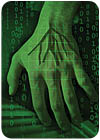
A biosciences firm used a patent to turn hospital technology into a physical way to biometrically identify a person using vein patterns.
And the business battleground is getting rough and tumble.
Security firms are buying up patents; they are fighting over equipment designs; and many are fast-tracking the economics of scale thanks to government directives and mandates into enterprise solutions and consumer conveniences.
Probably no where do patents mean as much as with biometrics solutions. Firms protect their algorithms like they are golden Blackberrys. Finger, hand geometry, iris, retinal all are patent-protected. New approaches often need new patents, which can be licensed, too. A case in point:
Memphis, Tenn.-based Luminetx Corporation, in the bioscience technologies arena with a patented infrared vein-imaging system, VeinViewer, recently acquired the patent for biometric identification of individuals through the use of subcutaneous vein patterns. The patent addresses the use of subcutaneous vein patterns, unique to each individual, as a biometric for the registration and verification of individual identity.
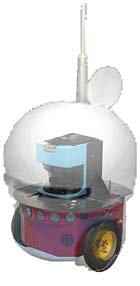
Robot battle? A security firm contends that a new machine from Japan looks like one they designed four years ago.
Wow! Can a robot lawyer be in the works?
And traditional security and new-age security vendors are licking their chops over the hoped-for fallout of HSPD-12, which mandates the establishment of a standard for identification of Federal Government employees and contractors. It requires the use of a common identification credential for both logical and physical access to Federally-controlled facilities and information systems. FIPS 201 provides guidance for implementing the HSPD-12 requirements for a common Federal identification credential.
The federal effort should prove to be the Viagra for smart card implementation in large enterprises and even for bank consumers.
Blog It With Zalud
Security Magazine Editor Bill Zalud Webcasts a blog from this month’s International Security Conference in Las Vegas. Post-conference coverage also will be blogged at www.securitymagazine.com.Looking for a reprint of this article?
From high-res PDFs to custom plaques, order your copy today!