Sport Event Safety and Security: The Importance of Training Your People
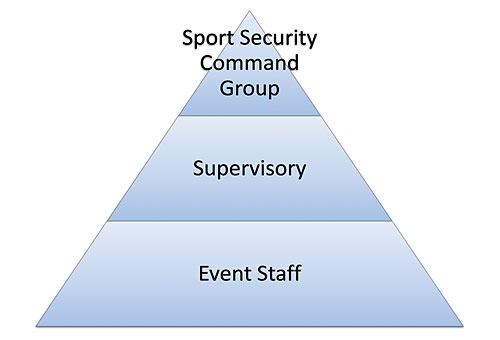
A key component in protecting critical infrastructures such as stadiums and arenas is the effective training of staff members. Training has been defined as “an educational, informative, skill-development process that brings about anticipated performance through a change in comprehension and behavior.” Training should center on incident management strategies, risk management practices, safety and security plans, policies, protective measures, and business continuity and recovery principles. Basically there are three things management wants employees to understand: 1) what management wants them to do, 2) why management wants them to do it, and 3) how management wants it done. According to the National Center for Spectator Sports Safety and Security (NCS4), training should be conducted at three main levels: sport security command group (multi-agency leadership team), supervisory leaders and event security staff.
The Sport Security Command Group
Most of your training should be directed toward effective communication and cooperation among the various agencies represented in the sport security command group (CG). The CG is composed of specialists from five distinct areas: sport facility management, police, emergency management, fire/HazMat and emergency medical services. They should be trained in basic concepts relative to multi-agency collaboration, risk assessment, planning and response/recovery principles. The expectation is that the leadership team will be knowledgeable and skilled to coordinate the development of a sport event security management system at their respective venue, including security operations, planning and implementation. The main responsibilities for the supervisory staff are enforcing the policy and procedures, overseeing the training program, and evaluating personnel. For an effective security plan to achieve its objectives, a qualified and trained event staff is essential. The following outline provides an overview of each staff position:
• Parking Attendant:
ensures the ingress and egress from facility parking areas. They generally
perform the following duties: vehicle screening, pre-event parking lot sweep
procedures, control traffic flow and parking pass/credential control measures.
• Gate Security: prevent unauthorized entrance to the venue and will perform the following duties: keep prohibited items out of the venue; secure perimeters around the venue; conduct security inspections; and verify tickets/credentials.
• Ticket Taker: verify tickets (tearing or scanning) and credentials when turnstiles are not in use.
• Usher: maintain a safe, orderly environment, and guide spectators to their seats.
• Concessions/Maintenance: maintain a clean and safe venue, sell food, beverage and merchandise, and respond to spills and incidents.
• Field (Playing area) Staff: maintain a safe and orderly environment and prevent unauthorized entrance to playing area. They will normally observe and report problems in crowd, protect the field, resolve problems for teams, and evacuate playing area if necessary.
• Security Force: police officers and/or security guards employed to protect physical (facility) and human (people) assets.
Volunteers
are an essential addition to event staff for major sporting events, typically
representing more than 50 percent of all event personnel. For example, it is
projected that 71,000 volunteers will be recruited for the London 2012
Olympics. The integration of full-time staff, part-time staff, temporary
workers and volunteers is critical to the success of the event. There must be
an understanding of roles and responsibilities. When determining the number of
staff required for an event, several factors need to be considered, including
1) anticipated attendance, 2) number of events (for example, multi-sport vs.
one-time event, 3) level of knowledge and expertise required for each specific
role, 4) scheduling of shifts for personnel, 5) staff composition, i.e.
full-time, temporary, and volunteer, and 6) potential threats.
Sport
organizations should conduct exercises to test plans and promote awareness of
staff roles and responsibilities during an incident scenario. An exercise is a
focused practice activity that places the participants in a simulated situation
requiring them to function in the capacity that would be expected of them in a
real event. Next, developed necessary plans and policies and trained their
staff members, they should consider testing their operational plans to assess
their level of preparedness. Exercises improve readiness by evaluating
operations and plans and reinforcing the concept of teamwork. Exercises help
facility managers to:
• Clarify roles and responsibilities
• Improve interagency coordination and communication
• Reveal resource gaps
• Develop individual performance
• Identify opportunities for improvement
There are
seven types of exercises defined by the U.S. Department of Homeland Security
Exercise and Evaluation Program (HSEEP) (2007) and they are considered either
discussion-based or operations-based. Discussion-based exercises familiarize
participants with current plans and policies, or may be used to develop new
plans and policies. Types of discussion based exercises include: seminars, workshops,
table-top exercises, or game simulations. Operations-based exercises are more
complex that discussion-based exercises.
Operation-based exercises validate plans and
policies, clarify roles, and identify resource gaps in security operations.
Operations-based exercises normally involved the deployment of resources and
personnel. Types of operations-based exercises include drills, functional
exercises, and full scale exercises.
Training should be ongoing and conducted
pre-season, during season, and post-season. The sport organization may utilize
training resources available to plan and manage sport event security training.
Federal and state agencies provide free training, including FEMA’s Emergency
Management Institute (EMI) and Department of Homeland Security. The
for Spectator Sports Safety and Security (NCS4) recommends that trainees
consider completing the following courses:
• IS-100, Introduction to Incident Command System (ICS): This course describes the history,
features and principles, and organizational structure of the Incident Command
System. It also explains the relationship between ICS and the National Incident
Management System (NIMS). The primary audience for this course is persons
involved with emergency planning, response or recovery efforts
(http://training.fema.gov).
• IS-200, ICS for Single Resources and Initial Action Incidents: ICS 200 is designed to enable personnel to operate efficiently during an incident or event within the Incident Command System (ICS). ICS-200 provides training on and resources for personnel who are likely to assume a supervisory position within the ICS. The primary audience for this course is persons involved with emergency planning, response or recovery efforts (http://training.fema.gov).
• IS-700, National Incident Management System (NIMS), an Introduction: This course introduces and overviews the National Incident Management System (NIMS). NIMS provides a consistent nationwide template to enable all government, private-sector, and nongovernmental organizations to work together during domestic incidents. The primary audience for this course is individuals with emergency management responsibilities including prevention, preparedness, response, recovery and mitigation (http://training.fema.gov).
• IS-800B, National Response Framework, an Introduction: The course introduces participants to the concepts and principles of the National Response Framework. This course is intended for government executives, private-sector and nongovernmental organization (NGO) leaders, and emergency management practitioners (http://training.fema.gov).
• AWR 167 – Sport Event Risk Management: The for Spectator Sports Safety & Security (NCS4) in conjunction with the Department of Homeland Security and with cooperation from the National Association of Collegiate Directors of Athletics (NACDA) developed a Sport Event Risk Management Workshop to be delivered to NCAA institutions. The workshop is focused on building multi-agency collaboration capabilities among university sport security command groups (http://www.ncs4.com/workshop.php).
• Sports Venue Safety and Security Training for Event Staff (for ushers, gate security, ticket takers, and parking attendants): NCS4 developed training courses to enhance safety and security efforts by building security awareness and improving capabilities for planning, emergency response, and evacuations. The Sport Venue Safety and Security Staff Training program can serve as a primary training program, supplemental training program which serves as a compliment to existing training, and as screening device for potential venue staff (http://www.ncs4.com/training.php).
Sources: Sennewald, 2003, Sport Event Risk Management, 2009, Sport Event Risk Management, 2009; Stevens, 2007; Contemporary Services Corporation, 2007, Introduction to Exercise Design, 2008.
Looking for a reprint of this article?
From high-res PDFs to custom plaques, order your copy today!