High Flying Prox
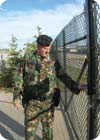
Air
Force Senior Airman Gary Resta checks the access gate by the Air Force Academy
visitor’s center.
When commercial airplanes slammed into the World Trade Center and the Pentagon on September 11th, 2001, things in Colorado Springs, Colo. changed rapidly.
For John and Nancy Palmer, 9/11 gave them the chance to add an additional focus to their successful electrical contracting business by moving into a lateral market – access control systems. Five years later, Palmer Electric is now managing one of the largest academic educational access control system accounts--the United States Air Force Academy. The attack on the Twin Towers in New York City and the Pentagon in Washington, D.C. also caused tremendous changes for those visiting the Air Force Academy.
INITIAL POLICY CHANGES
Considered one of Colorado’s leading year-round tourist attractions and a recruiting tool for the Air Force, the academy allowed anyone to visit without some form of security check prior to the terrorist attacks on New York and Washington, D.C.After 9/11, the academy’s leadership team decided to tighten security measures for those visiting the 18,000-acre facility. Visitors to the academy were still welcome, but they had to present a valid driver’s license and insurance card to security officials before being allowed to access the facility to watch the cadet’s lunchtime parade, take pictures of the chapel or tour the visitor’s center.
“With the help of our database, we could quickly verify the identity of visitors from the 50 U.S. states,” said Staff Sergeant Aaron Eaton, the noncommissioned officer in charge of the 10th Security Forces Squadron Pass and Registration Section.

Cadet
Second Class Brett May opens an Air Force Academy gate with his ID card.
UPGRADING SYSTEMS
Along with changing its visitor’s policy, the academy also upgraded its access control points. A fence now separates the tourists who watch the noontime cadet parade or take pictures of the school’s academic facilities. Cadets now move from their classrooms to the athletic fields and chapel by using their ID card.“Every once in awhile before 9/11, you would see an unescorted visitor coming down to the cadet area to get a picture of a cadet, and we as cadets would tell them they would have to go back up to the visitor’s overview,” said Captain Uriah Roberson, a 2002 Academy graduate and now the school’s chief of media relations. “The fence has changed all of that,” said Roberson.
When a new class of cadets reports to the Academy for its orientation, they are given a military ID card that allows Palmer Electric, with the help of the school’s administrative staff, assign access classes. The proximity card has a tiny transmitter inside that allows access through doors when held within a few inches of a proximity card reader. Contractors, such as the dining staff or janitorial services, are given a Magstripe card to provide access.
“Our cadets know they can’t lose their ID card, because they have to get their commander to authorize them a new one,” said Major Brent Maguire, the 10th Security Forces Squadron deputy commander.
With the help of software vendor MDI Security Systems of San Antonio, Palmer Electric has created more than 60 classes of access points for the cadet wing and the support staff. Using MDI’s SAFEnet system, Palmer now works with almost 30,000 users and helps the Academy control 151 doors or traffic gates. The software is currently monitoring and reporting on 1,476 individual alarm points.
Palmer has the contract to help the Academy administrate and maintain the system. “We have a full time staff that issues every badge by taking their picture and giving each user access rights in the system according to their status, rank and unit,” said Cary Gulsby, Palmer’s business development manager. “Our maintenance team weekly checks every single card reader and control point on the academy to ensure the system’s stability. And, if there’s a problem, we have someone who responds 24 hours a day, seven days a week.”
“We are able to quickly make changes to each cadet or staff member’s badge depending on their class schedule,” said Chris Combs, the Palmer Electric project manager at the Air Force Academy.
Combs said the cadet administrative staff could request changes for the cadet’s access privileges based upon their course requirements or relocation to their new cadet squadron after their freshman year.
“For example, a select number of senior engineering students are allowed 24-hour access to an aeronautics lab,” Combs said. “We’re able to update their access based on their course requirements so if a student decides to drop a class, we can easily change the access to a specific facility.”

Proximity
ID cards are used when entering or exiting an Air Force Academy access point,
as Air Force Senior Airman Gary Resta demonstrates.
FUTURE IMPROVEMENTS
The Academy has issued several contracts for Palmer Electric to update their access control platform, most notably the 6,600-seat John Clune Field House this past fall. Palmer contractors anticipated adding 18 new access control doors as well as 10 new traffic gates under this contract.“With our SAFEnet system, which is part of the ONE Unified Technology platform, we’re able to quickly provide access points and assign accessibility to students and staff who require it at any time,” said Gulsby. “The system allows our electrical and security contractors to easily add access points within a large facility such as the cadet field house.
MDI has helped Palmer change from the older system they also managed for the Academy for the past five years. Palmer Electric works under Multimax, a government NETCENTS contractor. When the Air Force Academy contracting office reclassified the project as a NETCENTS contract, Palmer was able to provide a complete turnkey operation for Multimax and the Air Force Academy.
“The folks at MDI have been great in helping us update and improve the security system for the Academy,” said Gulsby. “The beauty of the SAFEnet system is that it allows us to quickly make changes and to work within the existing security infrastructure of the Academy’s access points and security cameras.”
Major Maguire said the system has also been useful in several investigations, noting one recent case where an Academy staff member claimed an access gate struck her car. According to the Academy security officer, the log showed the accuser did not use her access card to leave a secured parking area, thus disproving her story.

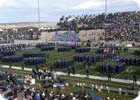
Visitors
of the Air Force Academy stand for the singing of the National Anthem before an
Air Force football game. Visitors are still welcome, but they have to present a
valid driver’s license and insurance card to security officials before being
allowed to access the facility.
POLICY ALTERATIONS
In the fall of 2006, the Academy decided to change its visitor policy, allowing guests to visit some areas without visiting the pass and registration center. However, the addition of the new security system allows security professionals like Maguire and Eaton to monitor the arrival of staff, cadets and other visitors.“We realize that the cadets are still vulnerable, but the access control system allows us to monitor them in a specified area,” said Maguire.
He added Air Force security police could also change the security of the 18,000-acre facility for special events. When the Air Force Academy football team hosted Notre Dame for a football game in November 2006, the 10th Security Forces moved their secured area back to allow free public access before the game. Still, the 46,000 visitors that saw the Irish defeat the Falcons, 39-17 had to have their bags and personal items checked before entering the stadium.
Once the game was over, the security forces moved the stadium back into a restricted area, allowing only staff and personnel authorized to work in the stadium with the required access codes.
DAY-TO-DAY VALUE
“The value of SAFEnet is that it allows our customers like Palmer Electric to help their clients manage day-to-day security operations plus specific events such as the Air Force football game with Notre Dame,” said Mike Garcia, vice president of marketing at MDI. “We’re helping academic institutions like the Air Force Academy realize that with the right system in place, they can easily manage their security platforms and expand its as needed in the future.”Gulsby added his company helped the academy add third party devices such as CCTV cameras and digital video recorders. “SAFEnet’s flexibility and ONE’s open architecture platform will allow us to seamlessly integrate with the academy’s existing devices without the purchase of costly new equipment,” he said.
Looking for a reprint of this article?
From high-res PDFs to custom plaques, order your copy today!




