SECURITY SERVICES: Additional Training: Is It Necessary?

Public relations should be part of additional officer training. Many posts include the need to interact with employees, visitors and the general public. Photo courtesy: Kastle Systems
A category most overlooked within security companies today is the amount and type of training that each individual officer receives. That is not to say that they are not being trained in one form or another.
What needs to be addressed is the officer receiving an extra amount of training at a specific post or job site. Many will ask why should there be any further need of instruction since they have experience or completed the required training. The answer to this would be many answers. For starters, there is need to ensure that they are knowledgeable of specific considerations requested by the client. They must have a grasp of any safety concerns. They need to have an understanding of any laws and ordinances; know how to respond in situations not covered in instructions or post orders; and why it is important for public relations.
Let us look at each of these reasons.
In most cases, a client will have some request of what and how they want a security officer to perform his duties. This should not be taken lightly and is why the client has hired the security firm. Such missions should be taught to the new officer, even if the officer is experienced and has been working with the company for many years, and just transferred in. Every client company will have its own different idiosyncrasies. And there is always a possibility that policy, procedures or even ownership has changed recently. For example: Know what type of forms, reports, sign-in list that the client will require.For security officers working at a factory, industrial plant, chemical warehouse, petroleum refinery or other sensitive facility, it will be imperative, and probably mandated by federal and state Occupational Safety and Health Agency officials to receive some type of “awareness” training. In these locations, an officer will need to know what to do if there is a chemical spill, gas release or any other type of hazardous situation. The officer will need to know what the client company’s Standard Operating Procedures states, know how to read a Material Safety Data Sheet and know whom to call. He or she will need to know where these publications are kept.
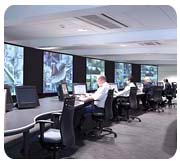
As security officers must view more surveillance video, technology advances have expanded the size of command center displays.
There may come a time when the officer has to deal with a problem or situation that is not covered in the post orders or in any training session. Then he or she needs to know whom to contact and how to contact them. Even something trivial could lead up to larger problems, and all because no supervisor or trainer took time to inform a new officer of a small procedure. They need to be instructed to the type of communication equipment (radio, land line phone, cell phone) and how to use it. If there is a secondary form of communication available, officers need to be informed and how to operate it. If there is an alternate person to contact or the person they were trying to contact is not available or if a situation or emergency arises and the security officer is required to contact a second person, then this information needs to be passed on to him or her.
Not all security officers will be dealing with the public. Yet it would probably be correct to say that most of them will interact with the public. It boils down to common courtesy. An officer should also maintain a good personal appearance. The officer’s uniform should look good and “sharp.”
If an officer is constantly coming across situations about which he or she was never instructed, this can create morale problems. If an officer has been fully trained for his or her job and the specific area, a sense of strong confidence will grow. This will lead to good morale, which produce positive work habits. When the client sees that officers are performing well, this renews a trust in the company.
There are different operational and training formats to use. One type is the “Brief Sheet.” This is the shortest and used when instructing just one or a couple of individuals.
The lesson plan is for much lengthier sessions. Ensure that the lesson plan covers all the subjects that the officers will need to know. It should not be equal to or a substitute of the post orders.

GPS Trackable Security Bags
Technology’s now available that allows enterprise organizations to track security bags being carried by security officers and delivery firms.An example: A. Rifkin Co. of Wilkes-Barre, Pa., has a new generation security bag that allows users to pinpoint moving bags anywhere across the United States using GPS technology. The security bag is equipped with a miniature tracking device that requires no external power and is covertly placed or sewn directly into the bag. Upon user request, bags are “found” by the tracking satellites and location data is instantly relayed to the security end-user via an Internet-enabled computer or SMS-enabled cellular phone.
Looking for a reprint of this article?
From high-res PDFs to custom plaques, order your copy today!