A Fire on the Sixth Floor
A firefighter once said, “Being a fireman is the greatest job in the world, until there is a fire.” Chief security officers can relate.
A fire is an unpredictable monster. In some fires the firefighters can actually see it gasping for air so it can grow. It’s not anything that a security manager wants to face, especially in a high-rise environment.
As tall buildings become the norm in an urban environment, the odds of a major catastrophe increase. Dallas currently has 246 high-rise buildings and is ranked 8th in the United States.
For high-rise training the Dallas Fire Department practices at its own facility, using a five story concrete bunker. But it was trying to put together a program where they could train firefighters and involve building management and security executives in an actual high-rise facility.
High-rise, Big Challenge
Renaissance Tower, managed by CB Richard Ellis, is located in downtown Dallas and is the second tallest building in the city. The building’s security director, David Talley, heard of the fire department’s desire and went to the building’s management with a proposal that they allow them to conduct an exercise using their skyscraper. Cheri Wafford, real estate manager, approved the exercise. It was an ideal situation for both groups to train together using an actual, fully-equipped, modern day structure to test both of their response plans.
The security staff joined with the Dallas Fire Department and the Dallas Police Department in planning a full scale exercise to simulate an out-of-control fire on the sixth floor of Renaissance Tower.
The commitment to the exercise by both of these organizations was tremendous. For the fire department it required organization, planning, a considerable dedication of time, manpower and equipment and the support of many other city service organizations.
On the Renaissance Tower side, Talley needed the support of building management, the tenants and his security staff for this full-scale assault on the building he was assigned to protect. They had written plans and procedures. They had systems and equipment, all hidden from view. Now was the chance to see if it all came together in a simulated disaster.
Exercise with Surprises
In late March, officers from the fire department began to prepare the building. Much of the exercise scenario was standard but the script was planned with flexible elements, which could be injected as the action unfolded to both surprise and test elements that could occur and would need to be dealt with.
The first step was to secure the scene to allow full involvement by the participators and, at the same time, protect the public and allow the city to function. Several blocks of downtown Dallas were cordoned off to vehicle traffic, while pedestrians and Saturday morning shoppers went about their business, wondering what was happening around them.
Talley had his staff remind the occupants of the building of the exercise as they checked in at the security station at the building’s north entrance. Although the tenants had been brought into the event early and had agreed to the drill, Talley knew that reminders and information were an easy way to avoid confusion and hard feelings. There were signs, phone calls, memos and the last-minute reminder. Though it was weekend to most city residents, it was work as usual for many of the occupants of the Renaissance.

All of the equipment and participants to be used for the event were staged a block from the building to limit the interaction between civilians and the participants as they rushed to the scene.
The fire alarm was activated. The building security officer on duty called the temporary fire dispatch number. A city dispatcher, on assignment to the exercise for the day, answered the call. “This is the Renaissance Tower, 1201 Elm Street. We have a fire on the 6th floor.”
It had been agreed that the building occupants would not have to evacuate during the exercise. It just so happened that floors 5, 6, and 7 were vacant and waiting for a new tenant. This allowed for the standard high-rise evacuation protocol scenario – which is to immediately evacuate the floor with the fire, the floor above, and the floor below. The fire alarms were actively sounding on these floors.
All elevators were recalled to the lobby and became inactive.
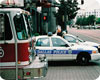
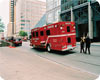
The fire equipment began arriving. First six fire engines stationed around the building. None of the training firefighters had ever been in the building prior to the exercise. The emergency responders began to pull out their equipment. The new mobile emergency command vehicle appeared on the scene, as did a canteen from the Salvation Army to serve coffee and snacks to the firefighters.
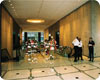
Wearing 45 pound bunker gear and Scott Packs (SCBA – self-contained-breathing apparatus), the firefighters entered the building carrying everything they needed. The interior of the building was so artfully designed that the firemen faced their first test. Where are the stairs? The entrance to the stairways were discretely hidden from the public by movable panels designed to blend into the wall design and able to be swung open if needed. Small lettering identified the panels with operating instructions.
Security Knows Best
The firefighters finally asked one of the security officers for directions. In a fire, the first responders carry everything up the stairs. The stairway incident points out one of the advantages of a collaborative exercise. If the fire department responds to an actual fire at this location, they will know where the stairways are in this building. This will save time and possibly lives.
The firefighters simulated connecting hoses to the stand-pipe system. One team was assigned fire fighting duties and another search and rescue. There were teams at each of the two stairwells. The teams searching for victims crawled on their hands and knees, staying close to the floor where maximum visibility would be in a smoke-filled area. They clung to ropes so that they could be rescued if the situation turned bad, as it often does in a real fire situation. In a black, smoke filled building, no one knows where they are.
Supervisors acted as facilitators/evaluators, recording actions, problems and suggestions as the event unfolded.
After the exercise was completed, building security and firefighters met for a debriefing in the lobby. First the administrators and planners discussed the logistics of the set up and execution of the exercise. Then the officers and chiefs met to discuss the day’s events.
Currently the Dallas Fire Department plans two high-rise exercises each year, to be held in a different downtown high-rise facility each time, if other buildings are willing to volunteer time and space.
When Security Director David Talley was asked if it was worth it, he responded, “Absolutely. Just being able to interact with the fire department and know what they expect from us was a valuable lesson. We had a plan but the exercise showed us that a good plan is one that interfaces with responding forces. It’s not just one-sided action.”
Looking for a reprint of this article?
From high-res PDFs to custom plaques, order your copy today!