IP Centric Calls for Scalable Compression
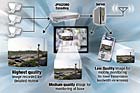
JPEG2000 can provide resolutions and picture sizes to suit the application. Click image for larger view
Video compression, the shrinking of a video file to a fraction of its original size by reducing redundancies in the image, is an essential part of digital surveillance systems.
Though all compression algorithms accomplish this in one way or another, the choice of compression techniques used for a given surveillance system largely determines its performance capabilities, features and limitations. As such, a myriad of algorithms exist – Motion JPEG (MJPEG), MPEG2, MPEG4 and H.264, to name a few.
A more recent compression “player,” JPEG2000, uses wavelets for its compression. It’s configured differently than the others in that the structure of the compressed data allows it to provide flexible mechanisms to access different representations of the original image. In this author’s view, video encoding in the MJPEG or MPEG format is analogous to a TV program being recorded on an analog tape (a form of compression in the analog domain). By itself, the recorded tape is completely useless, and only becomes useful when it is put into a video player. Only when the tape is being played back on a player can the video be reprocessed or scaled. In the case of JPEG or MPEG, digital imaging has not advanced beyond the capabilities of analog imaging. A JPEG2000 codestream, on the other hand, is scalable, allowing it to be restructured, without recoding, to deliver the aspects of the image required by each of the target display environments.
Advantages over similar technologies
JPEG2000 has several advantages over MPEG4/H.264. The first is latency; temporal compression schemes such as MPEG have longer encode and decode times compared to JPEG2000. While this may not be important in applications where video is stored for playback at a later time, it is critical with video over IP and when interactive camera control is required during a live security video feed. For example, it would be very difficult for an operator to accurately track a moving person or object with a pan and tilt camera if there existed even a-half second delay between the operator’s control and the camera’s actual movement.Another advantage is image quality. MPEG encoders usually filter or scale the image before encoding to ease the enormous processing task required. This degrades the image quality of the video. Rapid movement may also blur images, further reducing image quality. JPEG2000, which compresses image on a frame-by-frame basis, does not have these issues and is perceived by many to have superior image quality, especially in still images. In addition, the Spectrum Coalition for Public Safety – a national coalition of cities, states and public safety associations organized to support critical public safety wireless applications – has indicated that “MPEG4 is not admissible in court” in a recent document submitted to the FCC.
The right compression fit
Despite these drawbacks compared to JPEG2000, MPEG4 and H.264 have the distinct advantage of being more efficient in compressing video than JPEG2000, making them appropriate for use in surveillance applications that have lower bandwidth and storage requirements, the need for continuous 30-fps video and limited image quality needs. However, surveillance applications that require low latency, high image quality, image scalability and the assurance of court admissibility may be better suited with a surveillance system that uses the JPEG2000 (or wavelet) algorithm.It is imperative for end-users to understand what the surveillance system is required to capture (Still image? 30-fps video?), and the limitations involved in its implementation (budget, network bandwidth, wireless necessity, court admissibility, etc). v
Looking for a reprint of this article?
From high-res PDFs to custom plaques, order your copy today!