Suddenly More Storage Options

DVRs such as this
one are still extremely popular options for many end-users.
Today and beyond, end-users have more choices than ever before to store their video.
In the past decade, the “hot” video storage technology has been the digital video recorder (DVR). Replacing the VHS tape system, the DVR revolutionized the CCTV industry. In the last few years, however, a new type of storage has come onto the scene. With the advent of Internet Protocol (IP) cameras, the need to take analog video and “convert” it to digital goes away, and the network video recorder (NVR) can take and store the video directly over a company’s network.
When you talk to end-users today, however, many are still looking at DVRs or “hybrid” DVRs (which accept IP cameras) as the way to go. But NVRs are certainly on the horizon, and offer many advantages. When and how this technology will become standard is the subject of much debate.
For the present, companies such as the high-end retail company Saks can decide for themselves which of these technologies has the most to offer them. “Right now we are using DVRs,” said Anthony Montes, director of physical security for Saks’ 110 or so locations, including Saks 5th Ave and Saks Off 5th stores. “We have been using DVRs for the past eight or nine years. Within the past three years we have outfitted a lot more stores so that now about three-quarters of the stores have a DVR.”
Other facilities, such as Teradyne (Nashua, N.H.), which makes testers for the semiconductor industry, plan on looking into NVRs in the future and view hybrids as the way to go.
What anyone considering these technologies needs to know is what do these technologies really offer? How do they work? And what will the future hold for the various video storage options?
“The ability for the end-user to understand the difference between innovation and confusion will play a big role,” said Steve Surfaro, group manager, strategic technical liaison for Panasonic Security Systems, Secaucus, N.J. “End-users will demand technology that improves their workflow and is not just the latest ‘toy.’ Make the business case for video and you wind up getting multiple departments in your organization to contribute payment for the video system. If the technology contributes to this trend, end-users will buy in.”

NVRs are the
up-and-coming technology, especially as IP cameras grow in popularity.
HOW THEY WORK
“DVRs by nature do two things,” said Guy Arazi, manager, digital video systems for Vicon, Hauppauge, N.Y. “They take analog video from an analog source, make it digital using compression cards that are part of the DVR box and then they store them.”DVRs are typically “one box” solutions, added John Minasyan, senior product manager for digital systems, Pelco, Clovis, Calif. “The concept is everything you need enclosed in one box. You don’t have to worry about extensive networks and you don’t need multiple pieces of equipment to capture, record and view video.” DVRs allow you to play back and conduct searches, all while continuously recording new video.
But Surfaro cautioned that there can be some confusion among end-users about what classifies a DVR. “To the consumer, any video or image captured digitally and stored may be classified as a DVR. But to the security industry, a DVR is a multi-channel analog input device that captures composite video, stores it on digital media and permits search, playback and video analysis functions for single or multiple users.”
NVRs, on the other hand, are much more “computer-like” in many ways. “NVRs are very much like computers,” Arazi said. “They do not accept analog directly, but they do get it from somewhere, usually on the network, via a network connection. Everything happens through the network. IP cameras and encoders that are similar to DVRs send their information directly through the network.”
NVRs are not “all-in-ones” the way DVRs are, Minasyan contended. “The NVR doesn’t have the capture or, typically, the viewing mechanism. The NVR itself takes a pre-digitized and compressed video and stores it onto its own hard drive, and some other piece of software or hardware is used to view it. The NVR is the DVR’s storage system and not much else.
“The NVR tends to be a much higher performing function from a hardware perspective,” he added. “It normally deals with many more screens of video than a DVR. It typically offers a higher density of storage than a DVR and usually has more fault tolerance.”
Put simply, Minasyan said, “In my mind, what classifies a DVR is something that has its own local interface and ability for the user to interact locally with that box. An NVR is almost always two different systems: a recording box and a separate system for viewing.”
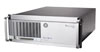
Hybrid DVRs,
which incorporate some of the features of NVRs, are a great way to transition
from the old to the new.
BENEFITS AND DRAWBACKS
For many end-users, the advent of the DVR represents a huge benefit over what it replaced.“We had VHS tapes before, which were just too archaic and slow,” said Danny Crawford, security manager, Skyline Medical Center and Skyline Medicine Campus, Nashville, Tenn. “The times weren’t accurate. Storage was terrible. Now I can store three and four weeks of traffic for observation and go back and look at them and review them.”
Bernard Bourne, security manager, Palmetto Baptist Hospital, Columbia, S.C., agreed. “With DVRs, if I see something on the screen I can right click my mouse, bring the playback screen up and play it back, while watching live video at the same time.”
Another benefit the DVR offers end-users is a proven track record, Arazi said. “DVRs have been here for a while. Most problems have been corrected, and they do offer stability and very good and valid solutions for legacy-type solutions. If someone wants to upgrade from analog, DVRs are a great fit. Another advantage is the all-in-one solutions. You just take a box and a camera and it is a one-step solution.”
Because of this feature, many DVRs offer local display, allowing the user to record and play back with just one box.
Unlike NVRs, DVRs do not depend on a network, infrastructure or protocols to get real-time video to the recording device, Surfaro said. “The analog-to-digital conversion takes place right in the recorder, so we’re capturing as fast as the coaxial, twisted pair or fiber cable is transporting the analog signal.”
On the downside, DVRs are physically large, Arazi says. “These are not small units. They are heavy and require air conditioning. You do need to run video cables to connect the cameras, and the fixed inputs represent a limitation sometimes.”
NVRs, on the other hand, allow the user much greater flexibility and scalability than a DVR, Arazi said. “Most DVRs have a fixed number of inputs. NVRs are essentially unlimited. They don’t suffer from the same physical limitations as DVRs.
“If you need to add more cameras, NVRs can start recording without having to do many changes. There is enormous flexibility in terms of storage. At the end of the day, an NVR is a PC or a server. Adding memory can be done on a daily basis by the same IT manager that manages your e-mail and Websites.”
Minasyan agreed: “The fact that the NVR is simply a network recorder means it is inherently more scalable. You can add hundreds or thousands of cameras with the NVR installed on the network.”
NVRs also accommodate larger images, Surfaro commented. “NVRs will accept images and streams sent from high-definition cameras, which are larger than the analog input on the DVR can accommodate.”
NVRs present a bit of a quandary in the format they use: the internet. “Pushing stuff across the Internet is both an advantage and a disadvantage,” said Al Burton, business systems analyst for Teradyne. “NVRs can reside anywhere in the world, where DVRs are local.”
But on the other hand, the NVR is dependent on the network. “DVRs by nature take video and put it right on a hard drive, Arazi pointed out. “NVRs require the network to obtain that information. The NVR will always use the network more, even if the DVR is a networking animal. Plus, DVRs without the network keep recording. NVRs without the network don’t record. That might be a significant disadvantage, depending on the system.”
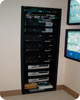
Hybrid DVRs work
well for some end-users. “We will always have the NVR option if we need it,”
said Bernard Bourne, security manager, Palmetto Baptist Hospital.
THE IP CONNECTION
Even if many end-users seem happy with their DVRs, the forward march of technology favors the NVR heavily.“The only question mark is the timeframe for DVRs stagnating,” Arazi said. “It is obvious that DVRs will be with us for the next few years because there are so many legacy systems out there. But the new trend in CCTV is edge-based devices – like IP cameras and servers, which are right off the network.
“The IT influence over this market is growing. The responsibility for purchasing, maintaining and controlling budgets for security is slowly shifting to the IT department. We are probably still seeing some advantages to the analog/DVR systems, but that is slowly going to change. As the numbers of IP cameras grow, users will eventually want to go with an NVR.”
That doesn’t mean that DVRs will go away any time soon, however. Legacy systems, smaller installations and hybrid DVRs (see sidebar) will keep the technology alive for many years to come.
Saks, for example, plans on outfitting all stores with DVRs within the next two to three years. “I think the DVR will be around for a long time,” Montes said. “Just like tapes. I still see a lot of people using VCRs. The NVR will be beneficial for companies that want to do remote recording or don’t have on-site security.”
But even as they go forward with DVR installation plans, Montes is looking ahead to a more network-based technology. “We are planning on testing IP cameras on a network in New York. I think that is the future.”
Arazi added, “The latest trends do show NVRs starting to grow where DVRs are stagnating. It’s not shrinking now, but the entire industry is making the move from pure analog systems to IP-based cameras. If you are designing a purely IP-based system, you don’t need a DVR. It makes more sense to use NVRs. There is a lot of design and thought going into the IP-based world, and it is causing the DVRs to start shrinking in number.”
Minasyan agreed. “I don’t think the DVR will go away. People will just sell fewer units. Hybrid DVRs will continue to flourish, especially in applications where you have a smaller camera count. But NVRs will continue to come down in price as the technology matures. You will start to see entry-level NVRs as well as high-end enterprise class NVRs that support different numbers and resolutions. Over time, especially as the trend to IP cameras continues to increase, the units sold will really just be NVRs and hybrid DVRs.”
In the end, transitioning from one to the other will mostly be a matter of practicality, Minasyan added. “If you have a small set of cameras, everything in one box (DVR) makes sense. As the number of (IP) cameras grow, all of a sudden you have a bunch of these local boxes. At that point an NVR with a workstation makes a lot better sense. You can view every camera simultaneously.”
SIDEBAR: Making the Transition: The Hybrid Solution
As IP camera use increases, the need to move to a more network-savvy storage solution is necessitating a transition technology. Legacy systems never go away instantaneously in favor of the new technology, and hybrid DVRs are designed to recognize that fact.The hybrid DVR is a DVR with some NVR capabilities, says Guy Arazi, manager, digital video systems for Vicon. It allows the user to upgrade to IP cameras as they add or replace analog cameras, while still using their legacy systems.
“It’s part of the transition,” Arazi said. “Why would end-users expand cameras with old technology? They will do it with the new. We realized that NVRs are going to be very dominant, but we allowed some of our stronger computer capability DVRs to open up to the network. They do not offer the same capabilities as NVRs, but they will allow recording of some extra IP cameras. Users can add an IP camera and still keep their existing DVR box. It’s a solution that keeps DVRs still out there and still selling.”
It’s also a solution end-users like.
“I actually have a hybrid DVR that I am testing,” said Anthony Montes, director of physical security for Saks. “With this I can use both analog cameras, and go one step above and start using IP cameras on that same recorder. IP cameras are coming. I don’t know how quickly. But the fact that there is a hybrid out there helps the transition. You can start a transition of network cameras and still keep the analog cameras functional. That is something I am working with.”
Manufacturers, too, recognize the potential of these transitional products.
“We are continuing to develop NVRs, and on the DVR side we are investing fairly heavily in hybrid recorders,” said John Minasyan, senior product manager for digital systems, Pelco. “I think hybrids will be around for a long time. There are way too many analog cameras in use today that still have a useful life ahead of them for them to just go away. People will always need that single box solution.”
Arazi agreed. “We are focusing on IP-based solutions right now. Anything we develop today goes toward a solid NVR management software that can control both older analog equipment as well as IP cameras. We want to sell digital video systems, not just NVRs or DVRs. There is a demand to entertain this transition with a product that allows either or both at the same time. That lets the end-user choose when he wants to transition.”
And that is something that Bernard Bourne, security manager, Palmetto Baptist Hospital, Columbia, S.C., appreciates. “Right now, our hybrid system will run IP cameras. It’s a technology that is there and working well for us. With this system, we will eventually have the NVR option. We haven’t had the need so far.”
Looking for a reprint of this article?
From high-res PDFs to custom plaques, order your copy today!