Security Magazine logo
search
cart
facebook twitter linkedin youtube
  • Sign In
  • Create Account
  • Sign Out
  • My Account
Security Magazine logo
  • NEWS
    • Security Newswire
    • Technologies & Solutions
  • MANAGEMENT
    • Leadership Management
    • Enterprise Services
    • Security Education & Training
    • Logical Security
    • Security & Business Resilience
    • Profiles in Excellence
  • PHYSICAL
    • Access Management
    • Fire & Life Safety
    • Identity Management
    • Physical Security
    • Video Surveillance
    • Case Studies (Physical)
  • CYBER
    • Cybersecurity News
    • More
  • BLOG
  • COLUMNS
    • Career Intelligence
    • Cyber Tactics
    • Cybersecurity Education & Training
    • Leadership & Management
    • Security Talk
  • EXCLUSIVES
    • Annual Guarding Report
    • Most Influential People in Security
    • The Security Benchmark Report
    • Top Guard and Security Officer Companies
    • Top Cybersecurity Leaders
    • Women in Security
  • SECTORS
    • Arenas / Stadiums / Leagues / Entertainment
    • Banking/Finance/Insurance
    • Construction, Real Estate, Property Management
    • Education: K-12
    • Education: University
    • Government: Federal, State and Local
    • Hospitality & Casinos
    • Hospitals & Medical Centers
    • Infrastructure:Electric,Gas & Water
    • Ports: Sea, Land, & Air
    • Retail/Restaurants/Convenience
    • Transportation/Logistics/Supply Chain/Distribution/ Warehousing
  • EVENTS
    • Industry Events
    • Webinars
    • Solutions by Sector
    • Security 500 Conference
  • MEDIA
    • Interactive Spotlight
    • Photo Galleries
    • Podcasts
    • Polls
    • Videos
      • Cybersecurity & Geopolitical Discussion
      • Ask Me Anything (AMA) Series
  • MORE
    • Call for Entries
    • Classifieds & Job Listings
    • Newsletter
    • Sponsor Insights
    • Store
    • White Papers
  • EMAG
    • eMagazine
    • This Month's Content
    • Advertise
  • SIGN UP!

Vehicles, Drivers In Security Sync

June 5, 2006
Utility terminals now are a terrorist target and deserve enhanced security technologies to identify people and vehicles.


A combination of long range barcode readers and proximity tags have brought together vehicles and their drivers to provide better identification at Hawaiian terminals serving a local utility.

From satellite images by NASA, the balmy Hawaiian Islands rise like turquoise stepping stones in the vast Pacific Ocean. The tiny city of Hilo appears nestled at the foot of the Mauna Loa range, and Maui blinks with a timeless charm. Kauai looms as green as Eden, invoking a laid-back atmosphere, and Oahu, the most populated island, erupts like a modern volcanic metropolis slowly encroaching the domain of the forested Nuuanu Pali peak. Miles of shoreline and bustling seaports are visible, bringing supplies and travelers to the islands.

Yet, in these higher security days, business as usual ceased. The U.S. Department of Homeland Security (DHS) has guidelines for disaster response. To govern port and vessel security, Congress enacted the Maritime Transportation Act (MTSA), which also covers the U.S. Petroleum Industry’s coastal operations. The U.S. Coast Guard conducts maritime assessments to bring everyone into MTSA federal security compliance.

One utility company scrambling to upgrade security plans is The Gas Company of Hawaii. The synthetic natural gas and liquefied propane gas producer operates four remote storage terminals and services 115,000 businesses and residences on Oahu, Hilo, Maui and Kauai. The company operates 1,000 miles of underground pipelines from central storage areas and also delivers cylinders to clients at remote locales.

After inspection, the Coast Guard identified the company’s offloading ports and terminals as a major terrorist target and required implementation of round-the-clock surveillance. Procedures for entering and exiting sites were important to effectively implement the security plan. Vehicles seeking entry and exit, as well as their drivers, needed to be authenticated.
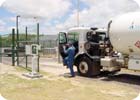
Readers at entrances combine barcode for vehicles and proximity for drivers to identify and link the two together.

Network integration

The utility turned to security systems integrator Tom Keener, president and founder of Keener Technologies Inc. in Hawaii, to come up with a solution. After assessing the geographical area, he proposed an integrated network system, extending it beyond traditional installation.

“So far, no breach has happened,” said Keener. “The system has saved The Gas Company several thousand dollars a year by displacing 24/7 security guards.”

His first job was to secure each of the entry points, where a high volume of tanker trucks, work trucks, service trucks and personal vehicles moved through. He chose a BA-200 Barcode Reader, by Barcode Automation of Winter Springs, Fla., as gatekeeper. The readers integrated with other computer security systems via Wiegand 26-bit output or a RS232 serial port. The reader, which featured a barcode decal that, once attached, could not be lost, stolen or loaned, was designed to ignore barcodes printed on paper or photocopies.

Barcode labels

“Every vehicle has a barcode decal attached for identification in and out of the yard,” said Keener. “Each barcode is entered into a Hirsch Electronics (Santa Ana, Calif.) Velocity database, configured by us.”

The barcode reader also featured a high scanning rate and retained an internal transaction log with the last 2,000 vehicle identification numbers, time and date. It was configured so that as a vehicle passed, the code would be checked against the internal database to see if that vehicle had access.

Keener also configured HID (Irvine, Calif.) proximity tags issued to employees, truck drivers and contractors, to satisfy a two-fold authentication rule set by the Coast Guard. The regulation required the barcode decal and matching HID card be processed at entry and exit; otherwise, access would be denied and alarms would sound, alerting the Honolulu operations center.

“The Gas Company has set a certain protocol for the operators to follow on who and when, to call the authorities in case of a breach,” said Keener.

The integrator also set up the system to respond to DHS threat levels; procedures change and they can set so-called “time zones” by using the system’s command modes to allow only designated persons into the facility. But he did not stop there.

Keener added infrared security video PTZ day/night cameras for surveillance, digital video recorders at each site, high-speed DSL communication, a private WAN to secure the network through firewalls and secured routers, database servers and a high-wattage UPS battery backup system. Upon intrusion, the PTZ camera was set to pan to the alarm zone that was violated on the fence, and alert operators as to exactly where the intrusion took place.

The system runs so smoothly, Keener reported he will install two similar systems for other clients, beginning, of course, with a well-placed barcode reader. V

Share This Story

Looking for a reprint of this article?
From high-res PDFs to custom plaques, order your copy today!

Recommended Content

JOIN TODAY
To unlock your recommendations.

Already have an account? Sign In

  • Cyber tech background

    Security’s Top Cybersecurity Leaders 2026

    Security magazine’s Top Cybersecurity Leaders 2026 award...
    Security Leadership and Management
  • Iintegration and use of emerging tools

    Future Proof Your Security Career with AI Skills

    AI’s evolution demands security leaders master...
    Security Leadership and Management
    By: Jerry J. Brennan and Joanne R. Pollock
  • The 2025 Security Benchmark Report

    The 2025 Security Benchmark Report

    The 2025 Security Benchmark Report surveys enterprise...
    The Security Benchmark Report
    By: Rachelle Blair-Frasier
Manage My Account
  • Security Newsletter
  • eMagazine Subscriptions
  • Manage My Preferences
  • Online Registration
  • Mobile App
  • Subscription Customer Service

More Videos

Popular Stories

SEC Podcast Header Podcast

Credential Management in High Turnover Environments

Glowing police siren

Security Isn’t a Commodity. Neither Is Off-Duty Law Enforcement

Laptop in darkness

Reframing MFA Bypass: Four Identity Gaps Attackers Exploit

Man with covered face

Why Most Workplace Violence Prevention Starts Too Late

Coding

What Security Leaders Say About the First AI-Developed Zero-Day Exploit

SEC 2026 Benchmark Banner

Events

June 10, 2026

Applying Agentic AI in Security Operations for Faster Decisions & Better Outcomes

Security teams have never had more visibility. We’ll explore how a new decision layer is helping security teams move from detection to decision. Turn alerts into decision-ready context, reducing reliance on manual triage and enabling faster action.

July 8, 2026

The 2026 Security Maturity Benchmark Report: Insights From Senior Security Leaders

In this webinar, speakers will share key insights from the report, including why today’s threat environment demands greater maturity and how to evaluate your organization’s current security posture.

View All Submit An Event

Products

Security Culture: A How-to Guide for Improving Security Culture and Dealing with People Risk in Your Organisation

Security Culture: A How-to Guide for Improving Security Culture and Dealing with People Risk in Your Organisation

See More Products


Alertmedia sponsored webinar

Related Articles

  • Uber-driver.jpg

    Uber drivers’ info nabbed in cyberattack

    See More
  • education in security

    Trends in perimeter security

    See More
  • Brains vs. Brawn – Determining New Trends in VIP Security

    See More

Related Products

See More Products
  • Hospitality Security: Managing Security in Today's Hotel, Lodging, Entertainment, and Tourism Environment

  • Physical Layer Security in Wireless Communications

  • security culture.webp

    Security Culture: A How-to Guide for Improving Security Culture and Dealing with People Risk in Your Organisation

See More Products

Events

View AllSubmit An Event
  • June 10, 2026

    Applying Agentic AI in Security Operations for Faster Decisions & Better Outcomes

    Security teams have never had more visibility. We’ll explore how a new decision layer is helping security teams move from detection to decision. Turn alerts into decision-ready context, reducing reliance on manual triage and enabling faster action.
View AllSubmit An Event
×

Sign-up to receive top management & result-driven techniques in the industry.

Join over 20,000+ industry leaders who receive our premium content.

SIGN UP TODAY!
  • RESOURCES
    • Advertise
    • Contact Us
    • Store
    • Want More
  • SIGN UP TODAY
    • Create Account
    • eMagazine
    • Newsletter
    • Customer Service
    • Manage Preferences
  • SERVICES
    • Marketing Services
    • Reprints
    • Market Research
    • List Rental
    • Survey/Respondent Access
  • STAY CONNECTED
    • LinkedIn
    • Facebook
    • YouTube
    • X (Twitter)
  • PRIVACY
    • PRIVACY POLICY
    • TERMS & CONDITIONS
    • DO NOT SELL MY PERSONAL INFORMATION
    • PRIVACY REQUEST
    • ACCESSIBILITY

Copyright ©2026. All Rights Reserved BNP Media, Inc. and BNP Media II, LLC.

Design, CMS, Hosting & Web Development :: ePublishing