Take It Offsite
Keeping up with advances
For every attorney’s attack on video, the industry has managed to develop technology and practices to protect the credibility of their product as evidence. When courts charged that video images couldn’t provide a positive identification, camera manufacturers developed better resolution images. When lawyers pointed out that there was no way to be sure when such video was taken, the industry added time stamps. And as security moves toward digital recording, with all of its advantages, a technology that is all too subject to tampering, security firms have begun to develop legally secure means of storing video images to erase any doubt that the clearly identifiable culprit who broke in at a time-stamped 3:05 a.m. performed the act exactly as shown.That’s the underlying philosophy behind video surveillance security storage concepts from such firms as New York’s VideoSave Inc. From a trial lawyer’s standpoint, basement VCR and DVR image storage is susceptible to tampering or sabotage; and in any event, its provenance is susceptible to legal challenges. To withstand the pressures of a litigious society, that company, among others, developed a secure system of offsite image archival for long-term storage of video surveillance.
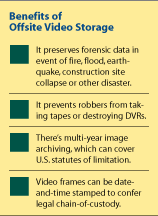
Multi-year archival covers all federal statutes of limitation and represents a great value for companies in thwarting bogus lawsuits and providing evidence for prosecutions. Every video frame is date-and-time-stamped to create legal chain of custody, facilitating the selection of viewing sequences. Offsite archival, with video asset management by IT professionals, establishes ironclad third party provenance.
The offsite archival process effectively rescues video surveillance images from the legal limbo of basement VCRs and DVRs. Surveillance data can be transmitted directly to a secure, offsite video vault. Once safely archived, all surveillance assets come under the management of the IT professionals whose sole responsibility is preserving and managing their clients’ video assets.
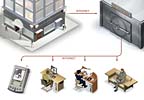
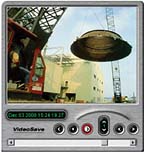
Camera images are fed to a local server, which dates and time stamps individual frames, encrypts and compresses the data, and transmits all images via the Internet to the archival site’s central video vault. This establishes an unambiguous legal chain-of-custody. Frame identification also facilitates image selection for client viewing; clients can view surveillance sequences pinpointed to the second in multi-year storage spans. The password-protected images may be viewed anytime over the Internet by those granted access.
The key to establishing a legal veracity to the captured video is that the entire process of data creation, date/time stamping, encrypting, compressing, transmitting, decrypting and archiving, remain within a closed system, leaving no loopholes for data manipulation or tampering. So long as images never leave the video vault; clients can view the data but can’t touch it. If subpoenaed, the archival company provides CD copies of requisite video sequences with provenance and data integrity intact.
Benefits to offsite storage
Aside from creating ironclad security, freeing video surveillance images from the limitations of VCR and DVR storage has a few additional benefits, particularly in cost-savings – by spreading equipment cost for storage servers over a large client base, collecting the same data costs considerably less for an archival company. In addition, the advanced hard drives and optimal storage conditions inherent in the offsite system can store images in perpetuity without the image degrading or becoming lost to physical damage.Surveillance endeavors have long been subject to a basic image-capturing weakness since the birth of the security camera, namely, the destruction of equipment. Direct image transmission from concealed cameras to the offsite video vault can obviate the problem of vandalism and preserve the surveillance data. This is also true for construction and other unstable sites, where the volatile nature of the site threatens the integrity of complex video storage hardware. On a wider scale, by transferring images offsite immediately, the cameras can be put into dangerous situations without compromising the safety of the images it captures – quite a useful tool in diagnosing origins of a building fire or terrorist attacks, as well as preserving a records generated by (unsuccessful) police bomb diffusing robots.
As with most new technologies, with the ability to automatically capture and store large volumes of high resolution video in perpetuity comes great responsibility. The same motion-sensing camera that can disprove a frivolous injury suit can become a liability to the company if the accident was not so frivolous. While captured video is proprietary to each client, the stored images can be subpoenaed by either side in court.
Looking for a reprint of this article?
From high-res PDFs to custom plaques, order your copy today!