Setting an RFID Paradigm
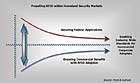
Research and developments concerning radio frequency
identification, as well as commercial developments,
will make enterprises grab at the business advantages
of RFID.
Not so suddenly, radio frequency identification (RFID) has taken on an increased security business and security role in enterprises in home security efforts.
Homeland security initiatives have traditionally had a significant impact on commercial applications looking to adopt similar technology platforms. Early adopters within the commercial corporate markets are basing their smart card applications on the Homeland Security Presidential Directive-12 (HSPD-12) and the Federal Information Processing Standard-201 (FIPS-201) to ensure interoperability. The U.S. government backed initiatives possess the advantage of inciting industry levels standards in light of their operational scale and scope.
CUSTOMIZING FRONTIERS
RFID is one of the technologies considered for authenticating government-issued travel documents in proof of concept programs such as the US VISIT initiative. US VISIT is a continuum of security measures employed to collect biometric and biographic information from visitors upon their arrival in and departure from U.S. air, sea and land border ports. The initiative is focused on testing the ability of the equipment to read information from RFID tags embedded in CBP forms such as I-94A.The Western Hemisphere Travel initiative is another identity management program initiative by the United States federal government that is expected to employ RFID technology. The RFID embedded border crossing cards or laser visas are proposed to be used in lieu of the passport for travel or re-entry within the western hemisphere. However, the relatively high cost of such cards presents a significant challenge for immediate widespread deployment.
SUPPLY CHAIN DISRUPTIONS
Globalization and increasing trade volumes across national borders is a significant factor to be considered in national security initiatives. While there has been an intensified focus on homeland security issues, the emphasis has not permeated to address supply chain disruptions and cargo security. Highly competitive trade margins and legislative factors limiting the liability of carriers have impeded investments in cargo security thus far.Government initiatives such as the Customs Trade Partnership Against Terrorism (C-TPAT), aimed at improving supply chain security, have ensured that almost 40 percent of all imports in 2005 were accounted by C-TPAT members. However, the legislation is yet to meet its initial expectations due to the absence of mandatory compliance requirements and guidance from agencies including the U.S. Customs and Border Protection, Transportation Security Administration and DHS. RFID holds definite promise to meet changing paradigms of supply chain management in terms of enhanced security and business efficiency.
E-PASSPORT INITIATIVE
The U.S State Department proposed the electronic passport initiative in 2005 wherein all U.S. passports issued after October 2006 would include embedded RFID tags. The passports are expected to possess a storage capacity of 64 kilobytes to enable future additions and biometric information. The data encoded are expected to be in compliance with specifications by the International Civil Aviation Organization to ensure interoperability of operations across geographies.Privacy concerns have been a key challenge, especially with the e-passport initiative. There have been significant developments to ensure the security of data encoded within the tags through public key infrastructure and digital signatures. The security features incorporated, as a part of the e-passport initiative, is likely to address similar privacy concerns across different application and vertical markets.
FIRST RESPONDERS AND RFID
The National Institute of Standards and Technology has been researching the potential for RFID applications to enable effective navigation among firefighters and other first responders. The research envisions the use of mobile readers to detect RFID devices at fixed locations thereby indicating the position of the person carrying the reader. The RFID backed system prototype is expected to employ inertial sensors such as accelerometers and gyroscopes to facilitate navigating in hazardous conditions.Security has been the fundamental driver for a majority of government backed initiatives since 2001, and the increasing interest in employing RFID for documents such as passports, national identification cards and visas is likely to enable a pervasive use of the technology. Increased standardization and inter-operability have been positive developments in response to the potential demand expected in homeland security markets.
Looking for a reprint of this article?
From high-res PDFs to custom plaques, order your copy today!