Rapid Reaction Force – From Military to Corporate
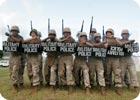
Marines assigned to Camp Foster’s auxiliary security force form a riot control formation during ASF training. Corporate security operations, seeking rapid response forces, see value in mirroring military strategies. The Marines spent a week learning skills necessary to augment military police and Japanese Security Forces responsible for the physical security of the base. U.S. Marine Corps photo by Lance Cpl. Corey A. Blodgett
For business, homeland security and liability reason, enterprises today are embracing combinations of human and technology strategies that go beyond first responders to designate rapid reaction forces.
Corporations often mirror their own reaction forces after military operations. Among the best resides at Camp Foster in Okinawa, Japan.
There, U.S. Marines assigned to the camp’s Auxiliary Security Force (ASF) have assumed an active role in the camp’s security posture since earlier this year. In addition to enhancing security, the force was activated to give the ASF Marines an opportunity to develop their skills through practical application, according to Capt. Bolivar P. Pluas, the ASF commander for Foster.
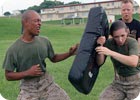
An auxiliary security force Marine at Camp Foster goes through escalation of force after being sprayed with oleoresin capsicum spray. U.S. Marine Corps photo by Lance Cpl. Chelsea D. Terrell
THREAT ACTIVATION
The force is normally activated when the threat condition is elevated. While the current condition remains at Alpha, the lowest level, the Marines are gaining experience in their abilities, said Pluas. “We’re getting the Marines trained because they’ve never done it,” he said. “Even though the conditions may not go higher, the Marines need practice.”Each camp has an ASF comprised of Marines from various units on base who have completed the training requirements to certify them for the mission. The structure is similar to fire and life safety teams established at U.S.-based high-rise building and plant operations. Prior to taking their post, the Foster Marines who were already ASF certified completed a refresher course covering escalation of force tactics, personnel and vehicle searches, shotgun familiarization and riot control. Marines new to the force attended in-depth certification training in these areas before taking an active role in the ASF.
“We train them for the type of situations we’d need them for,” Pluas said. “Their duties include augmenting forces at the gates, conducting vehicle and personnel searches and patrolling.”
Though activating the ASF takes Marines out of their individual work sections and away from their jobs, it is necessary to ensure the base has a well-trained reaction force, Pluas said. For many of those Marines from job fields where helmets and shotguns are rarely used, the ASF is a welcomed change of pace. “It’s good,” said Pfc. Sam G. Sinclair, a recently trained ASF Marine. “It gets us out of the shop, and we get to do something different.”
TRAINING GAINS CONFIDENCE
Pluas said the Marines’ positive attitudes have been evident throughout the training. “A lot of them are excited and motivated,” Pluas explained. “It helps them out with confidence.” Pluas said eventually he would like to put the Marines through advanced training covering all threat conditions they could face as part of the force.“The importance of ASF is enormous, from a military standpoint to family security to overall base security,” he said. “Just putting ASF at the gates as a show of force is a deterrent for hostile activities.”
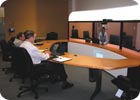
Cisco’s Critical Infrastructure Group, a kind of new-age rapid reaction force, can bring together people through use of the firm’s TelePresense conferencing facility.
SIDEBAR: Critical Infrastructure
The Internet may be as critical as gas, oil and electricity to U.S. and worldwide security.That’s why companies such as Cisco Systems have responded with a kind or corporate rapid response force. At Cisco it’s called the Critical Infrastructure Assurance Group. According to Cisco CEO John Chambers, the group is an integral part of Cisco’s overall security strategy. We’re investing in improved security of global critical infrastructure for three reasons. First, because Cisco is a good corporate citizen. Second, as the security of critical infrastructure improves, so does Cisco’s own security. And finally, customers trust us to have along-term security vision that extends our current product and network security efforts.
SIDEBAR: What’s a Rapid Reaction Force?
A rapid reaction force is a military, police or private security unit designed to respond in very short time frames to emergencies. When used in reference to police and security forces, the timeframe is minutes, while in military applications, such as with the use of paratroops or other commandos, the timeframe is hours to days.Rapid reaction forces are designed to intervene quickly in rather low-intensity conflicts such as uprisings that necessitate the evacuation of foreign embassies. Because they are usually transported by air, such military units are usually lightly armed, but often extremely well trained to compensate for their lower caliber weapons and lack of heavy equipment like tanks.
Looking for a reprint of this article?
From high-res PDFs to custom plaques, order your copy today!