Fiber as Frontrunner
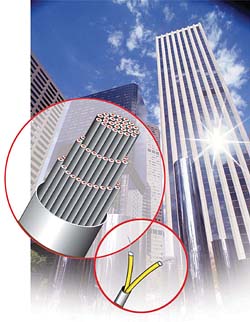
The advantages of using fiber optics as opposed to copper cable for transmission are numerous and proven. In a nutshell, fiber optic cable is faster, lighter, more stable, tougher and more enduring than copper cable. It also costs less to install and maintain. Fiber-optic cable offers a distinct competitive advantage over copper cable when it comes to real-world applications, such as high-performance surveillance systems. This special report, compiled by Darren Nicholson of GE Interlogix Video Systems Group, Corvallis, Ore., looks in depth at these advantages.
The ability to send huge amounts of information along slight strands of high-purity glass optical fiber at the speed of light is revolutionizing communications.
The high signal-carrying capacity of optical fibers makes it possible to provide not only many more, but much more sophisticated signals than could ever be handled by a comparable amount of copper wire. Fiber optics is a relatively new technology used as an alternative to conventional copper wire in a variety of applications such as those associated with security, telecommunications, instrumentation and control and broadcast of audio/visual systems.
For end users, fiber-optic cable offers many practical advantages over copper cable. It’s lighter, easier and less expensive to install and offers much higher bandwidth and better resolution over longer distances. It has virtually no maintenance costs and a working lifespan up to five times longer than that of copper cable. Fiber-optic cable is also harder to tap into and therefore more secure. It even minimizes costly lightning damage.
Fiber offers powerful performance in a small package. Because of the increased performance of light sources and constant advances in fiber performance, few repeaters, if any, are required in a typical transmission application. That’s because fiber cuts down on losses. Current single-mode fibers have losses as low as .2 dB per km. Multimode losses are down to 1 dB (at 850 or 1300nm). This enables transmission over much longer distances than copper cable allows.
With the power of fiber optics at their fingertips, end users can get better pictures over longer distances than they can with copper cable, again eliminating the need for so many costly repeaters. Fiber optics has been bandwidth-tested at more than 4 billion bits per second over a 100km (60 miles) distance, with theoretical rates of 50 billion bits possible.
A fiber-optic transmission system can transmit more signals from the camera to the monitor over greater distances and in more extreme environments than its copper counterpart. With fiber, one can transmit over more than four miles without repeaters or amplifiers. One single fiber can carry broadcast-quality video from 128 cameras more than 600 miles. Video images transmitted using fiber optics keep their high resolution, detail, contrast and color, even over long distances or through other transmission equipment. Plus, there is virtually no limit to the amount of video, audio and data that can be transmitted on fiber-optic cable.
Secure and Efficient
Fiber is a dielectric, meaning it does not conduct electricity. That also means it does not radiate electromagnetic pulses, radiation or other detectable energy. This makes the fiber-optic cable difficult to find. Methods typically used to tap into fiber would create a substantial signal loss, alerting users immediately to a problem.
Unlike wire systems, which require shielding to prevent electromagnetic radiation or pick-up, fiber-optic cable is not affected by electromagnetic or radio frequency interference. That translates into lower bit error rates, potentially increasing circuit efficiency.
Takes the Heat
As a dielectric, fiber has additional advantages over copper cable in a typical transmission configuration. Because the fiber is made of glass, and does not carry electrical current, radiate energy or produce heat or sparks, data is retained in the fiber medium. That means any damage caused by a lightning strike will be localized, greatly minimizing potential network repair costs. For applications in dangerous or explosive environments, fiber provides a safe transmission medium.Fiber-optic cable can also be manufactured to meet temperatures from -40 to 200 degrees Fahrenheit (F). Temperature resistance to 1,000 degrees F is possible.
Fiber is not just physically more flexible than copper cable, but it’s also much more flexible when it comes to the variety of functions it can serve. In most office buildings, there are typically many applications already using fiber-optic networks, such as fire and alarm, building management, security video and even heating, ventilation and air conditioning systems. It’s possible to combine all of these functions onto a single communications network with fiber. That’s because it takes just two kinds of optical cable to cover all possible signals: multimode and single mode. Contrarily, a typical facility may employ dozens of specialized copper cables for applications including audio, video, telephone signals and data, and few of them will be interchangeable.
Fiber Grows
Fiber-optic cable is not going to become obsolete any time soon. It offers expansion capabilities beyond its current technologies, using common fibers and transmission techniques.Fiber can accommodate the changing topologies and configurations necessary to meet operation growth and expansions. With fiber optics, one can also take advantage of technologies such as wavelength division multiplexing, optical multiplexing and drop and insert for system upgrades and redesigns.
When it comes to installation, end users can’t beat fiber-optic cable for ease and speed. Because fiber optic cable is lighter, it’s also faster and less expensive to install. And since it isn’t susceptible to interference, one can cut out the troubleshooting that copper cable installation requires.
Since fiber also resists moisture, it is less susceptible to corrosion and damage. Scheduled maintenance is a thing of the past with fiber-optic cable. What’s more, it lasts at least five times longer than copper cable. Fiber-optic cable can be expected to have a useful life of up to 50 years. With copper cable, you can expect a functional life of 10 years at most.
Costs also are going down for fiber optics as a result of larger manufacturing volumes, standardization of common products, greater repeater spacing and the proven effectiveness of older “paid for” technologies such as multimode. And, last but not least, material (silica glass) required for the production of fiber is available in a virtually endless supply.
Looking for a reprint of this article?
From high-res PDFs to custom plaques, order your copy today!