Door Protection Goes Nuclear
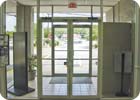
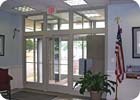
Recently Paul Labarile, a 30-year veteran of the security business, was contacted by high ranking government officials looking for the latest technology in security access systems.
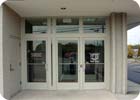
When is a door a portal? When more technology is built into it. An example is a remodeling of the entrance to the Old Line Bank, Crain Highway Branch, in which designers took an integrated security view.
So what are some of the current directions for portal security? Labarile believes that a lot of the equipment that’s out there right now involves automated interlocking doors using a card access system which only allows one person inside the portal at a time.
NEXT GEN SOLUTIONS
But next generation solutions integrate access control, weapons control and materials control systems.“The intent is to build a number of technologies into the same equipment. Currently we’re combining the technology of special nuclear material (SNM) detectors with the weapons control system. This is the first time it’s ever been done and the Department of Energy is looking to upgrade to the integrated systems,” said Labarile.
There are diverse benefits of the new integrated systems.
All such systems are designed with a remote console which can configure how the system operates -- how fast or slow it operates and what level of sensitivity to materials is needed. In some cases, the department is going to want to know what’s coming in, while some want to know what’s going out. Obviously, the Department of Energy doesn’t want someone leaving with nuclear materials. The SNM detectors prevent this. Right now these systems are being proposed for 100+ nuclear reactor sites.
New ways to bar the door will also save government money. Said Labarile, “Security is normally done by a lot of personnel. When you take a look at the manpower you would need to have to screen each individual entering or leaving a facility, the government would be spending close to $250,000 a year per entry point. It’s not too hard to justify putting in a piece of hardware. The key concept behind newer systems is that they protect, not just detect. The hardware can’t be taken hostage or disabled, and is programmed to react repeatedly to particular events, thus eliminating human error.”
For higher level door controls, aesthetics plays an increased role.
“We’re going for updated looks that are more attractive. They used to be more ‘military looking’ and now we use a lot more glass and custom colors to match a building’s façade, while providing a more aesthetic looking structure so people don’t feel claustrophobic,” added Labarile.
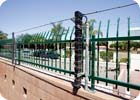
A perimeter system – before the door – can integrate into access control systems and security video. Photo courtesy: Zareba
SIDEBAR 1: The Perimeter Beyond the Door
Before people get to the front door or the lobby of an enterprise, perimeter security systems can play an access control role.Newer perimeter solutions emphasize an integrated approach.
For example, an intrusion detection system from Zareba Security uses filtering technology to fight false alarms and has redundant detection modes to identify the point of intrusion to within 10-feet. It integrates with security video systems, sending an alarm to central security control monitors while directing surveillance cameras to the point of intrusion for video verification. It also ties into existing control panels and monitoring systems, either as a hard-wired or wireless connection.
SIDEBAR 2: The Door to Data: Smart Cards
With Microsoft ready to push next generation operating system Vista, it is no surprise that the giant software firm is seeking partnerships that can provide high level access.One example: Microsoft told Security Magazine that Windows Vista will support Gemalto .NET devices right out of the box. Enterprises can replace weak user name and password-based security with smart cards and tokens, as well as deploy additional digital security applications such as document signature, physical access control and employee e-purse services. These steps protect digital identities and data from ever-evolving threats.
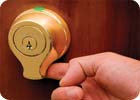
Keypads and biometrics are being built into doorknobs for extra security in specific areas.
SIDEBAR 3: Keypad in the Doorknob
New electronic keypad locks and deadbolts securely lock doors until a user enters his or her valid four-digit access code, using the specially designed, easy-to-read keypad, making it accessible for users of all ages and abilities. The keypad locks and deadbolts come with a premium quality nine-volt battery and are ready to use right out of the box. Preprogrammed with two unique access codes, there’s the option to store an additional 17 access codes.There’s another solution that stresses integrating a fingerprint biometrics into the doorknob.
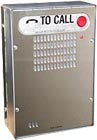
Phone-based call boxes can provide security door controls. This unit from Talk-A-Phone can be programmed for diverse uses.
SIDEBAR 4: Emergency/Info Phones at the Door
Call boxes can be used to control incoming as well as outgoing traffic and can be integrated with card readers, wireless cameras, and other access control devices to provide an all-in-one access solution. Individuals can gain entrance into campuses or buildings simply by pressing the “call” button. Pressing the button automatically dials the attending operator who grants access by dialing the number six on the attending phone. The call boxes can also be used at access points to provide the option to call for assistance in the event of an emergency or technical complications where assistance is needed, according to Sam Shane of Talk-a-Phone.Next generation security phones use VoIP or voice over IP.
For enterprises, VoIP advantages include the integration of data and voice communication traffic into a single network. Using VoIP, analog voice signals are digitized and converted into data packets that are sent over IP-based networks. The integration of multiple media types--voice, data, video--into a single network eliminates infrastructure and maintenance redundancies, helping to reduce operational cost.
Looking for a reprint of this article?
From high-res PDFs to custom plaques, order your copy today!