Zalud Report: Spread This ‘Muster’

In high-rise buildings and even under water, unique security technology aims at identifying people and their location when there are disasters and emergencies.
Many facility management and security executives see “mustering” as a life safety tool. To provide for building emergencies like fire, terror and hostage situations, businesses, schools and others are developing such mustering practices. Unfortunately mustering is not always an ideal practice that can assure first responders that a building is completely free of occupants, contends Jerry Cordasco of Compass Technologies, Exton, Pa.
He told the Zalud Report that employing standard access control cards and readers means everyone evacuating a building would theoretically present their badges while running out the door. People just don’t do that in an emergency. In most cases evacuees won’t bother to go to an outside-the-building mustering station, either. So first responders will still have no idea how many people remain in the building.
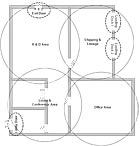
Multi-readers can pick up tags with different signal strengths depending on proximity. Such a mustering approach can determine relative location of tag holders remaining within the building based on signal strength.
Consider Long-range RFID
A more viable approach employs long-range RFID or radio frequency identification, the technology used in advanced asset tracking software. With RFID, badges are active tags, continuously being read by the RF readers.Technology exists to read multiple tags simultaneously at high speed. Even with a throng of people pushing out the door, the RF reader can pickup real-time information from all tags with a high degree of accuracy: near-100 percent if long-range readers are properly deployed throughout the building.
A further step will deploy a serial-interface configuration of long-range RFID readers. Multi-readers will pick up tags with different signal strengths depending on proximity. This technology can determine relative location of tag holders remaining within the building based on signal strength.
State-of-the-art software will use proximity methodology to triangulate relative locations of inside-the-building tags and locate them as “inventory zones” on a graphical map. Responders will also follow the increasing signal on handheld directional devices to locate people. In hostage situations, responders can determine how many people are being held, and where.
This emerging technology extrapolates access control, combining traditional control and the databases associated with it, with the emerging technology of long-range RFID.
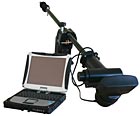
High-resolution sonar imagery allows first responders or security operators to classify a submerged target by size and shape.
High Resolution Solar
In a twist on locating people, high-resolution sonar is being used by first responders, law enforcement, corporate security and military personnel to locate people underwater.What its maker calls Viperfish Underwater Detection Unit recently helped find a deceased male in Lake Winnipeg, Canada. Deep Development Corp’s gear was instrumental in assisting the Canadian Amphibious Search Team (CAST) to locate the body early last month. The Royal Canadian Mounted Police performed an extensive underwater search for the individual but was forced to terminate it when the lake began to freeze. Ken Lugg, one of the volunteer CAST team members, said, “This search was especially harsh due to the frigid temperature, which hovered about -31 oC (-24 oF) during the search of about 1.6 hectares (4 acres) of harbor.”
The high-resolution imagery of the equipment allows first responders or security operators to classify a submerged target by size and shape.
Looking for a reprint of this article?
From high-res PDFs to custom plaques, order your copy today!




